Welltower (WELL)
Welltower research profile: the senior housing operating portfolio, how SHOP differs from triple-net and outpatient medical, and what drives a healthcare REIT.
Educational analysis for professional use. This profile is not investment advice or a recommendation to buy or sell any security, and it is not personalised.
Snapshot
Business Overview
Welltower has stopped behaving like a landlord in most of its portfolio, and that is the single fact to hold on to before reading a line of its accounts. It owns more than 2,500 senior and wellness housing communities across the United States, Canada and the United Kingdom, and it runs three different businesses inside them.
The senior housing operating portfolio, SHOP, is the one that matters. Welltower owns the buildings and books the residents' fees as its own revenue, paying third-party operators such as Cogir, Oakmont, StoryPoint and Barchester to run them. The legal wrapper is called RIDEA, a structure that lets a REIT take operating income from a healthcare property rather than only rent. What it means in practice is that Welltower takes the whole margin: the occupancy, the room rate and, on the other side, the wage bill. Nobody stands between it and the operating result.
The triple-net portfolio is the opposite. Welltower collects a contracted rent, and the operator absorbs both the upside and the labour cost. The third leg is outpatient medical, which is closer to conventional office leasing and which Welltower is selling: an 18 million square foot portfolio valued at about $7.2 billion, going out in phases since October 2025. These three behave nothing alike, and the commonest mistake with this company is reading one blended growth number as though it described all of them.
That sale is one leg of what management calls Welltower 3.0. The aim is to lift seniors housing from 69% of net operating income to the mid-80s, funded by roughly $23 billion of announced transactions. Buying has run well ahead of that pace: $15.5 billion of pro rata gross investments closed or under contract in the first half of 2026 alone, including the C$4.1 billion Amica portfolio in Canada, which closed on 1 April 2026 after being agreed in March 2025.
What to Watch in the Financials
Read same-store NOI by segment or you learn nothing from it. In the second quarter of 2026 the three legs printed 20.5% for SHOP, 5.2% for triple-net and 2.4% for outpatient medical, blending to 15.5%. The spread is structural rather than a run of luck. A triple-net lease pays a contractual escalator, so it grows a few per cent whatever the operator earns. Outpatient medical grows with releasing spreads on office-like space. SHOP has no contract in front of it at all, so a good year in senior housing lands in Welltower's own profit line and a bad one does too.
The 20% is worth taking apart, because it is operating leverage rather than a 20% market. SHOP revenue grew 9.2%, made up of 330 basis points of occupancy gain and 5.2% growth in revenue per occupied room, the rate each resident pays. Most of the cost of running a community, the building, the management, a large part of the staffing, does not move much when a few more flats fill. So a 9% revenue line becomes a 20% NOI line. That arithmetic works in reverse with the same force.
Which is why the two halves of that revenue number should be checked together, never one alone. Occupancy bought by discounting the room rate is not the same achievement as occupancy won while raising it, and only the second expands the margin. Welltower's occupancy and RevPOR have been rising side by side, and 2026 guidance assumes both continue: 350 basis points of occupancy and 5.1% on rate, giving SHOP NOI growth of 18.5% to 21.5%. If the rate line softens while occupancy keeps climbing, the growth case is quietly changing shape.
Average SHOP occupancy was 87.6% in the second quarter of 2026. That looks low against a national market now running near 90%, and the gap is mostly deliberate. Welltower keeps buying communities in the high 70s and low 80s and filling them, so its own average is held down by whatever it bought last. This also corrects a story that has outlived the facts: senior housing is no longer recovering from the pandemic. National occupancy peaked at 87.2% in early 2020, troughed at 77.9% in mid-2021 and has since passed the old peak, with construction starts at their lowest in more than a decade. The runway now is leasing up what Welltower has acquired into a market with almost no new supply, not a return to some earlier normal.
On normalised FFO, Welltower earned $5.29 per share in 2025, up 22.5%, and $1.60 in the second quarter of 2026, up 25%. Guidance for the full year is $6.36 to $6.44, raised twice from an opening range of $6.09 to $6.25. Note that FFO is the standardised measure here, defined by Nareit; the AFFO figures brokers quote for healthcare REITs rest on each company's own view of which capital spending is maintenance and which is growth, so they are not comparable across names in the way FFO is.
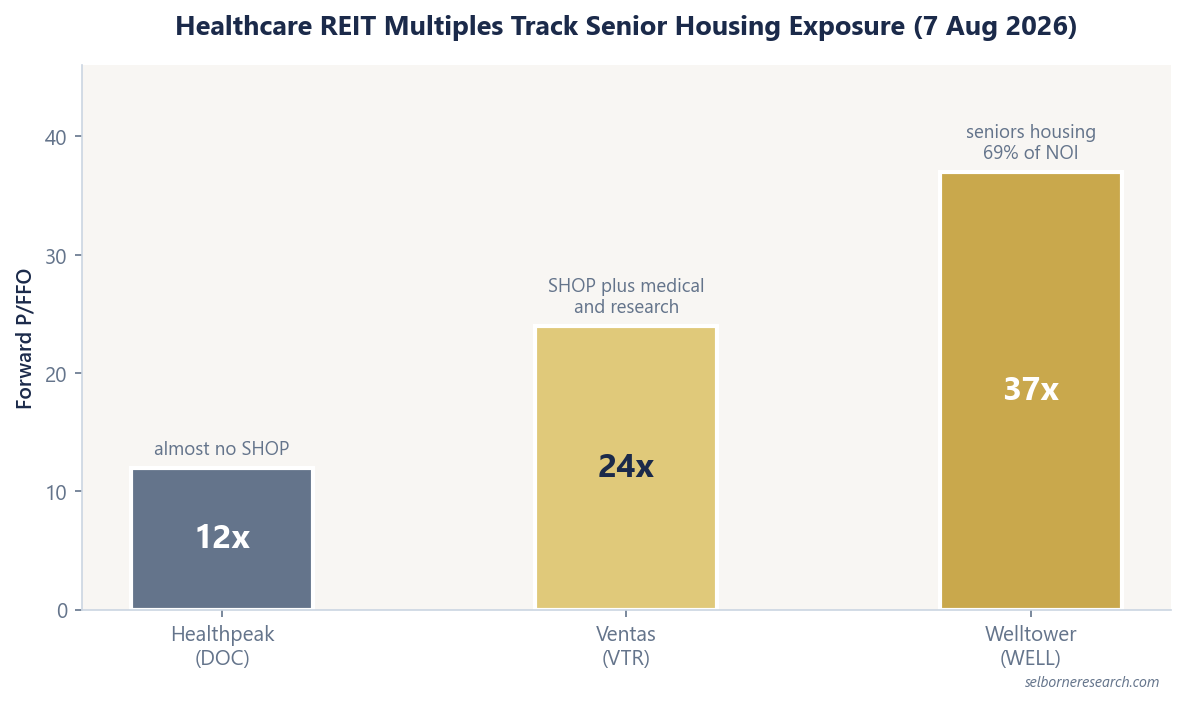
At the 7 August 2026 close of $236.92, that guidance puts Welltower on about 37 times forward FFO. Ventas, on its own raised guidance, trades near 24 times; Healthpeak, which is mostly outpatient medical and lab space with almost no SHOP, near 12. The ladder is not a ranking of quality. It is the market paying for how much of each company's income moves with senior housing occupancy, and paying most where the operating leverage is most direct.
Peer Context
Ventas is the closest comparison and the useful one, because it is doing the same thing with less of itself committed. Its SHOP same-store NOI grew 16% in the second quarter of 2026 on 300 basis points of occupancy, against Welltower's 20.5% on 330. Normalised FFO per share rose 9% to $0.97, with full-year guidance of $3.85 to $3.90. Both numbers are good; Welltower's are larger because a larger share of the company is exposed to the same tailwind.
So the trade-off is structural, not a judgement about management. Welltower has more senior housing upside because it has more senior housing, and less to fall back on for exactly the same reason. Ventas keeps meaningful outpatient medical and research space, which grows slowly and reliably and dampens both directions. When you see the two multiples side by side, that mix is most of what you are looking at.
Risks
The multiple is the risk. Thirty-seven times forward FFO is a price paid for growth continuing, and SHOP's 20% is not a run rate any portfolio holds indefinitely. It is a 9% revenue line multiplied by a fixed cost base. Once occupancy stops climbing 300-plus basis points a year, revenue growth falls back toward the rate increase alone and the leverage effect goes with it. The company would still be growing; it would not be growing at a pace that supports three times Healthpeak's multiple.
Labour. Under a triple-net lease, wage inflation is the operator's problem. Under SHOP it is Welltower's, and staffing is the largest line in a senior housing community's costs. Agency labour, the temporary staff bought in when a community cannot recruit, costs far more per hour than employed carers and rises fastest exactly when the sector is filling up. Falling agency use has flattered SHOP margins through the recovery. That is a tailwind that can only be spent once.
Operator concentration. A handful of large operators run most of the SHOP portfolio, so a covenant breach or a failed refinancing at one lands as an operational problem Welltower has to solve on short notice. The RIDEA 6.0 contracts launched in 2026 with Cogir, Oakmont and StoryPoint tie operator incentive fees to performance and pay a large part of them in units of Welltower's operating partnership, which is real alignment. It does not change who carries the profit and loss.
Lease-up execution. The acquisition programme works only if Welltower fills communities faster than the sellers could. It has been buying at occupancy in the high 70s and low 80s and underwriting a climb from there, so the return on $15.5 billion of first-half investment is a bet on its own operating platform rather than on the price paid. Watch the gap between same-store and total-portfolio NOI growth: same-store excludes recent acquisitions, so a widening gap is where slow stabilisation shows up first.
Thinning diversification. Selling $7.2 billion of outpatient medical removes the part of the portfolio that would have kept paying through a weak year in senior housing. The counterweight is the balance sheet, which is genuinely conservative: net debt was 2.99 times adjusted EBITDA at the half year, low for a REIT of any kind, so the concentration risk is not compounded by leverage.
Bull and Bear Summary
The bull case rests on a supply gap rather than a demographic slogan. The 80-plus population is growing quickly and nothing anybody decides now changes that, but the sharper point is that senior housing construction starts are at their lowest in over a decade, so the units to house the demand largely do not exist. That is what lets Welltower raise the room rate 5% and fill flats at the same time, and it is why fifteen straight quarters above 20% SHOP NOI growth have been possible at all. What has to go right is the acquisition pipeline stabilising at the pace Welltower underwrote.
The bear case is arithmetic, not catastrophe. Occupancy gains of 330 basis points a year are a one-off filling-up, and when they stop, revenue growth drops to the rate rise alone and the leverage that turned 9% into 20% works the other way. A stock at 37 times forward FFO has that continuation priced in. Add a labour cycle Welltower now absorbs itself, a small number of operator relationships carrying most of the portfolio, and an outpatient medical business on its way out of the door, and the diversification that would cushion a slow year is being sold to pay for the concentration.
Welltower's senior-housing margin swings with occupancy. The primer models the senior-housing portfolio on its own.
The Excel model is the primer's two worked examples live across 13 sheets: change the cap rate, NOI growth or discount rate and the valuation moves.