REIT Implied Cap Rate: Reading Discount to NAV
The implied cap rate is the market's cap rate on a REIT's own portfolio: how to calculate it, how it compares to market rates, and what the gap says about NAV.
Educational analysis for professional use. This guide is not investment advice or a recommendation to buy or sell any security, and it is not personalised.
The Cap Rate the Market Is Putting on the Buildings
A REIT’s share price contains a cap rate, whether or not anyone states it. Work backwards from the price and you get the implied cap rate: the yield the stock market is demanding on the REIT’s portfolio. It is the mirror image of the market cap rate, which comes from actual property sales. The market cap rate says what a building changes hands at in a private deal; the implied cap rate says what the same building is being priced at through the REIT’s shares. When the two disagree, the gap is the discount or premium the REIT trades at against its net asset value.
That makes the implied cap rate one of the most useful numbers in REIT analysis, because it turns a share price into a directly comparable property yield. You cannot compare a REIT’s share price to a cap rate; you can compare its implied cap rate to one.
Calculating the Implied Cap Rate
The calculation reverses a NAV. Instead of applying a cap rate to NOI to get an asset value, you take the market’s asset value and back out the cap rate it embeds.
Implied cap rate = forward NOI ÷ (equity market capitalisation + net debt − non-property assets)
Work it in order. Start with forward twelve-month NOI, the income the buildings will produce. Add the equity market capitalisation to net debt: that is the total value the market is putting on the enterprise. Then subtract anything in that enterprise value that is not an income-producing building, cash, development land, a third-party management business, joint-venture stakes, because those assets have value but produce no property NOI, and leaving them in would understate the cap rate. Divide the NOI by what is left, and you have the yield the market is applying to the property itself.
A worked demonstration: a REIT with US$500m of forward NOI, a US$6.0bn equity market cap, US$3.0bn of net debt and US$500m of non-property assets carries an implied cap rate of 500 ÷ (6,000 + 3,000 − 500) = 500 ÷ 8,500 = 5.9%. Change nothing but let the share price fall so the equity is worth US$4.5bn, and the implied cap rate rises to 500 ÷ 7,000 = 7.1%. The buildings did not change; the market repriced them.
Reading the Gap: Discount and Premium to NAV
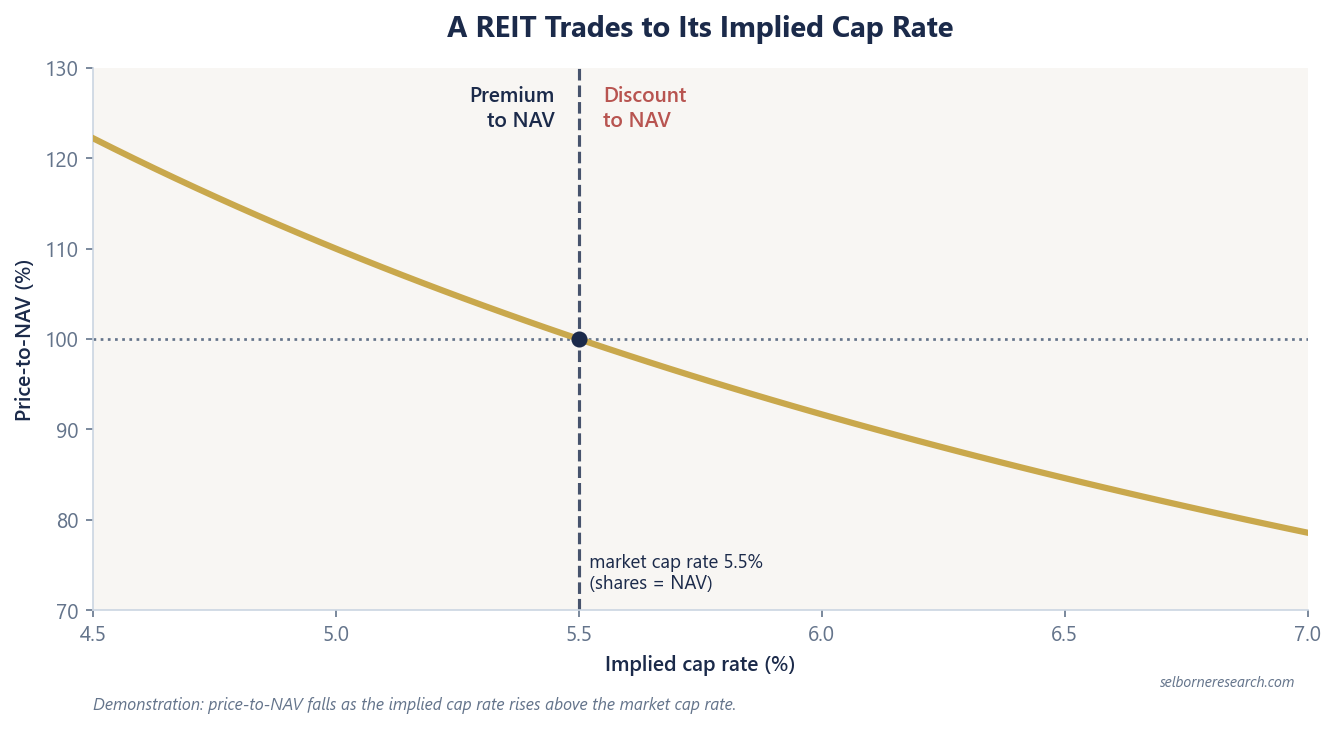
The implied cap rate is only useful against a reference, and the reference is the market cap rate for the REIT’s kind of property. When the implied cap rate sits above the market cap rate, the market is demanding a higher yield than a private buyer would, so it is valuing the buildings below their private-market worth: the REIT trades at a discount to NAV. When the implied cap rate sits below the market cap rate, the shares carry a premium to NAV, and the market is paying up for the portfolio, usually for management quality, growth, or a scarcity of the asset class.
Roughly, the price-to-NAV ratio tracks the market cap rate divided by the implied cap rate. A REIT whose buildings transact at 5.5% but which the market prices at a 6.5% implied cap rate is worth about 5.5 ÷ 6.5, or around 85% of NAV, a 15% discount. The same REIT at a 4.8% implied cap rate trades near 115% of NAV. So the two cap rates together, not the share price alone, tell you whether you are buying property cheap or dear relative to the private market.
The Traps in the Comparison
The comparison is only as good as its inputs, and three of them are where it goes wrong. First, the NOI must be forward, not trailing: a REIT with strong embedded rent growth will look expensive on last year’s income and fair on next year’s, and the implied cap rate should use the income the buyer is actually buying. Second, the non-property adjustment is a judgement, and two analysts who strip out different things will get different implied cap rates from the same price, so state what you removed. Third, the market cap rate you compare against has to match the portfolio: an implied cap rate for a REIT is meaningless against the wrong property type’s transaction yield, which is why the cap rate by property type is the reference table this calculation leans on.
So use the implied cap rate as the bridge between a REIT’s share price and the private property market, but build it carefully: forward NOI, a stated non-property adjustment, and the right market cap rate to compare against. Done properly it turns a discount to NAV from an assertion into a number; done loosely it just launders a share price back into a yield that looks precise and is not.
The implied cap rate is the market's verdict on a REIT's buildings. The primer bridges it to a per-share NAV.
The Excel model is the primer's two worked examples live across 13 sheets: change the cap rate, NOI growth or discount rate and the valuation moves.
Frequently Asked Questions
- What is an implied cap rate for a REIT?
- The implied cap rate is the capitalisation rate the stock market is applying to a REIT's own portfolio, worked backwards from its share price. You take the REIT's forward net operating income (NOI) and divide it by the total value the market puts on the assets, which is the equity market capitalisation plus net debt, less the value of any non-property assets. It tells you the yield the market is demanding on the buildings, which can differ sharply from the yield the same buildings would change hands at in a private sale.
- How do you calculate a REIT's implied cap rate?
- Implied cap rate = forward NOI ÷ (equity market capitalisation + net debt − non-property assets). Start from forward twelve-month NOI, add the market value of the equity to net debt to get the market's total enterprise value for the property, subtract the book or fair value of anything that is not an income-producing building (cash, development land, management businesses, joint-venture stakes), and divide. Use forward NOI, not trailing, and be consistent about what you strip out, because the non-property adjustments are where two analysts' implied cap rates diverge.
- What does it mean if a REIT's implied cap rate is above market cap rates?
- It means the market is valuing the REIT's buildings more cheaply than the private market would, so the REIT trades at a discount to net asset value. If a REIT's implied cap rate is 6.5% while comparable buildings transact at a 5.5% market cap rate, the stock market is demanding a higher yield than a private buyer, which is the same as saying the shares are priced below the portfolio's private-market value. An implied cap rate below the market rate is the reverse: a premium to NAV.