What Is FFO? Funds From Operations Explained
FFO (funds from operations) is the REIT industry's standard earnings measure: what it is, how Nareit defines it, and why net income does not work for REITs.
Educational analysis for professional use. This guide is not investment advice or a recommendation to buy or sell any security, and it is not personalised.
FFO Is the REIT’s Version of Earnings
FFO, funds from operations, is the number REIT analysis is built on, and it exists because a REIT’s net income does not tell you what the business earns. Nareit, the US REIT industry body, defined FFO in 1991 to fix a specific distortion: accounting depreciation writes a REIT’s buildings down every year on a fixed schedule, whether or not they have lost any value, and that non-cash charge is large enough to swamp the income statement. Net income comes out looking far weaker than the cash the portfolio actually throws off. FFO strips that distortion out, which is why the sector is valued on price-to-FFO rather than the price-to-earnings multiple used almost everywhere else.
So when you see a REIT quoted on a multiple, it is almost always a multiple of FFO, and understanding what FFO includes, and what it quietly leaves out, is the first thing to get right in REIT analysis.
The Nareit Definition
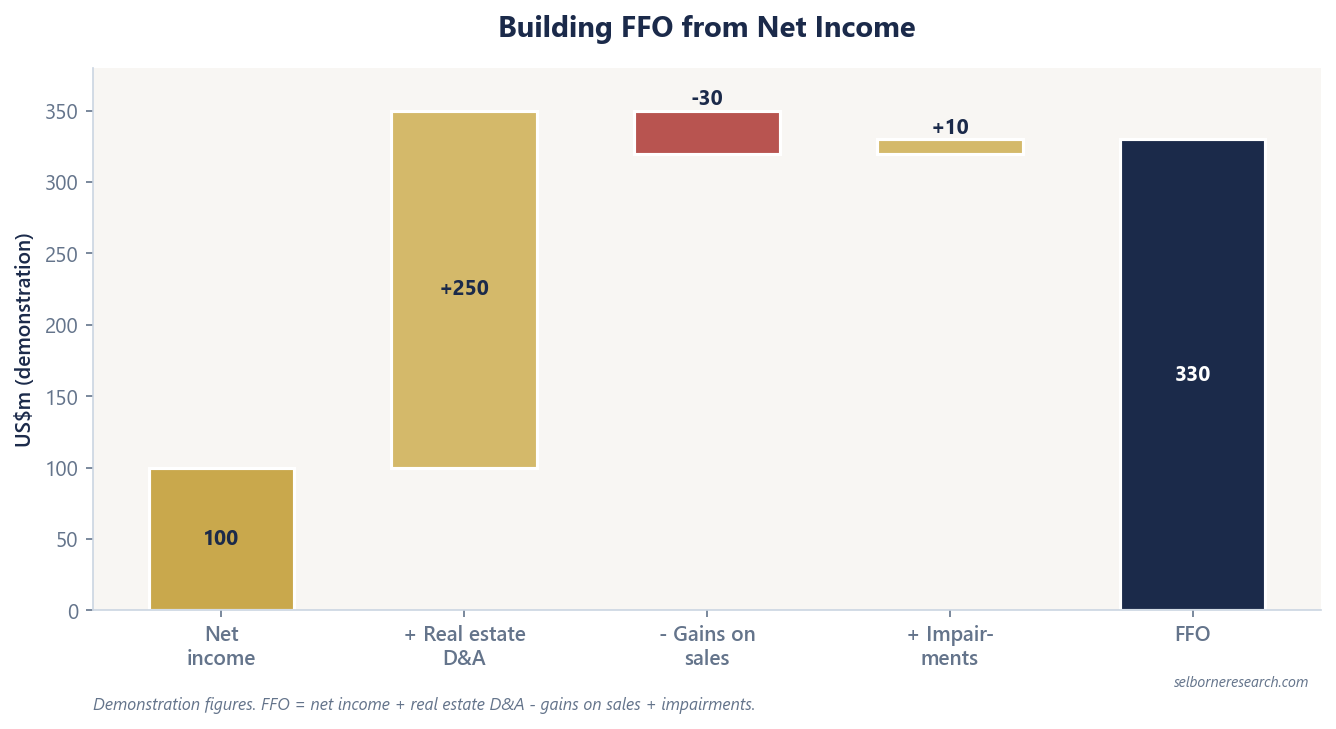
FFO is a defined measure, not a number each company invents, and that is what makes it comparable across REITs. The Nareit definition builds up from net income:
FFO = net income + real estate depreciation & amortisation − gains on property sales + impairments of depreciable real estate
Each adjustment corrects net income for something that misrepresents operating performance. Real estate depreciation is added back because it is a non-cash charge that assumes the buildings are wearing out when they usually are not. Gains and losses on selling property are removed because they are one-off events, not recurring operating income, and leaving them in would make a year of heavy disposals look like a year of strong operations. Impairments of depreciable real estate are added back for the same reason depreciation is: they are non-cash write-downs of the same asset base. What is left is the recurring income the portfolio generates.
Why Net Income Fails for a REIT
The depreciation problem is worth seeing plainly, because it is the whole reason FFO exists. A property company that owns well-located, well-maintained buildings is required to depreciate them anyway, on a schedule that has nothing to do with their real value. For a large REIT that charge runs to hundreds of millions a year, and it is deducted from income even though the buildings may be appreciating. So a REIT can generate strong, growing cash flow and report thin or falling net income at the same time, purely because of an accounting convention.
FFO removes that one distortion and leaves the rest of the income statement intact. It is not a cash flow statement and it is not adjusted for everything, it is net income with the property depreciation, the disposal gains and the impairments taken out, and nothing else. That narrowness is a strength: because the adjustments are defined and few, FFO stays comparable from one REIT to the next in a way a more heavily massaged number would not.
How FFO Is Used
Once you have FFO, it does two jobs. It is the denominator of the sector’s headline multiple, price-to-FFO (P/FFO), which is to REITs what the P/E ratio is to the rest of the market: a REIT trading at 15 times FFO is priced at fifteen years of its current funds from operations. And it is the base for the payout analysis, because a REIT’s dividend is measured against FFO (and, better, against AFFO) rather than against earnings, since earnings are the distorted number FFO exists to replace.
Comparing REITs on P/FFO only works because FFO is standardised. Two REITs’ FFO figures are built to the same Nareit rulebook, so the multiples are genuinely comparable, which is exactly what you cannot say once you move one line further down to AFFO.
Where FFO Stops: The Handover to AFFO
FFO has one large blind spot, and it is the reason a second metric exists. FFO adds back all the property depreciation, but a landlord genuinely does spend real cash each year to keep the buildings let: maintenance capital, tenant improvements, leasing commissions. FFO ignores that spending entirely, so it overstates the cash actually available to pay a dividend. AFFO, adjusted funds from operations, is the attempt to put that spending back, and it is the better measure of distributable cash, at the cost of no longer being a defined, comparable number. The full comparison, and why AFFO is worth the loss of comparability, is in the FFO vs AFFO guide.
So take FFO for what it is: the standardised, comparable measure of a REIT’s operating income, and the right place to start. Just do not stop there. FFO tells you what the portfolio earns; AFFO tells you what it can afford to pay, and the gap between the two is exactly the cash a dividend has to come from.
FFO is where REIT analysis starts, not ends. The primer carries it through to AFFO per share and a payout screen.
The Excel model is the primer's two worked examples live across 13 sheets: change the cap rate, NOI growth or discount rate and the valuation moves.
Frequently Asked Questions
- What is FFO?
- FFO, funds from operations, is the real estate industry's standard measure of a REIT's operating performance, defined by Nareit. It starts from net income and adds back real estate depreciation and amortisation, then strips out gains and losses on property sales and impairments of depreciable real estate. The result is a measure of the recurring cash the portfolio generates, cleaned of the accounting depreciation that makes a REIT's net income understate what it actually earns. Because the definition is published and fixed, one REIT's FFO is comparable with another's.
- How is FFO calculated?
- FFO = net income + real estate depreciation and amortisation − gains on property sales + losses on property sales + impairments of depreciable real estate. In practice you take reported net income, add back the large non-cash property depreciation charge, remove the gains from selling buildings (which are one-off and not operating income), add back any impairments, and the figure you are left with is FFO. Most REITs report it and reconcile it from net income in their results, and the reconciliation is worth reading because the adjustments below the FFO line are where AFFO and company-defined variants creep in.
- Why is FFO used instead of net income for REITs?
- Because accounting depreciation makes net income almost useless for a REIT. Depreciation writes a building's value down on a fixed schedule whether or not it has actually lost value, and a well-kept property in a good location usually has not. That non-cash charge is large enough to dominate a REIT's income statement, so reported earnings badly understate the cash the portfolio produces. FFO adds the real estate depreciation back, which is why the sector is valued on price-to-FFO rather than a price-to-earnings multiple.