Digital Realty (DLR)
Digital Realty research profile covering hyperscale data centres, bookings, power demand, Core FFO and valuation.
Educational analysis for professional use. This profile is not investment advice or a recommendation to buy or sell any security, and it is not personalised.
Snapshot
Business Overview
A data centre lease is signed a long way before it is paid. Digital Realty signed $1.2 billion of new leasing in 2025, measured as the annualised rent those contracts will eventually produce at 100% share, and hyperscale drove the bulk of it. Rent typically starts a year or two later, once the hall is built and, more to the point, energised. So the bookings line is the growth story and the grid connection is the schedule.
The company runs over 300 facilities across more than 55 metros in over 30 countries. Revenue splits into wholesale colocation, where hyperscalers take entire halls, and retail colocation, where enterprises rent cabinets at higher rates per unit of power. Interconnection is the third stream: tenants pay for private cross-connects to each other inside the building rather than routing over the public internet, and each cable added raises what it would cost to move out. Interconnection and other revenue was $479 million in 2025 against $443 million in 2024. Digital Realty does not publish a margin by revenue line, so treat this as a mix and stickiness read rather than a margin one.
Cloud and AI tenants keep adding capacity and Digital Realty sits on the supply side of that build-out. Hyperscalers take volume discounts and long terms; smaller cloud and content operators pay more per megawatt. Both are growing, but hyperscalers set the development pace. Concentration at group level is more moderate than the reliance on a handful of cloud buyers suggests: the 10-K says no single customer accounts for more than about 11.7% of annualised recurring revenue.
The Growth Engine: Bookings, Power, and Development Yields
Revenue grew 10% to $6.1 billion in 2025, with Q4 at $1.63 billion, up 14% on the prior year. Core FFO was $7.39 per share, the metric management leads with; filed AFFO was $6.55. Guidance for 2026 opened at $7.90 to $8.00 of Core FFO and was raised in July to $8.15 to $8.20, roughly 11% growth. The development book runs to $10.1 billion at 100% share, with 769 megawatts under construction at an expected stabilised cash yield of 11.9% and 64% of it already leased.
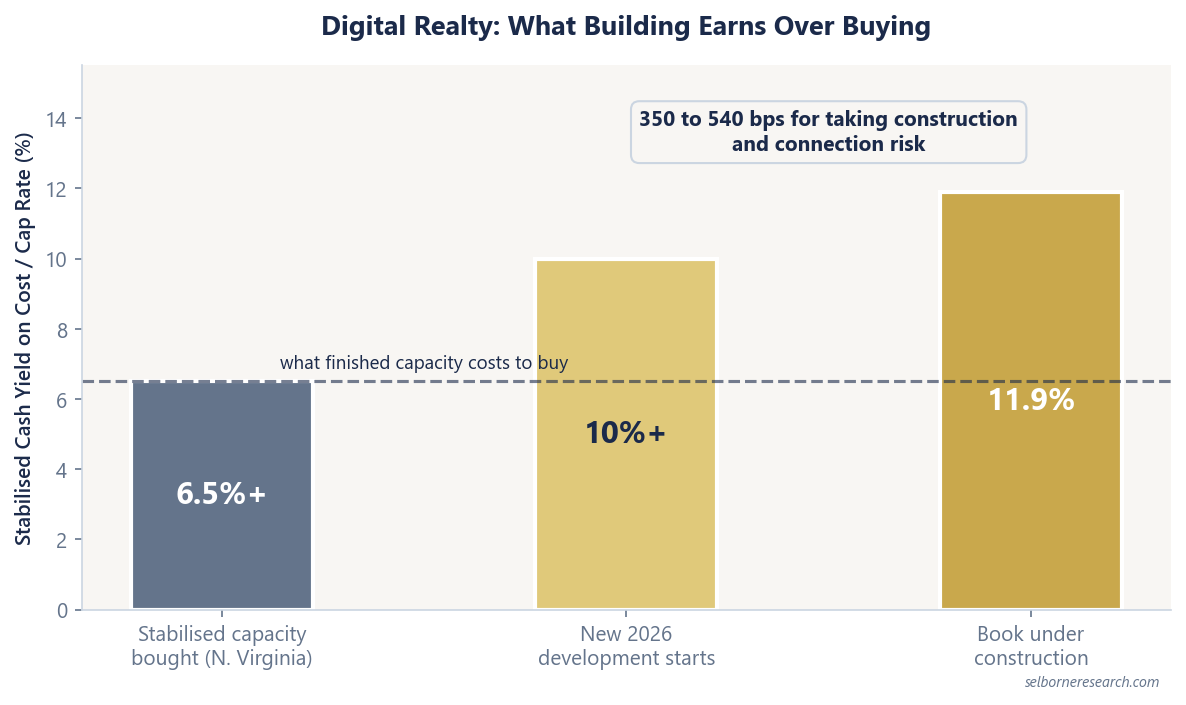
Watch that yield, and watch which yield is being quoted. The 11.9% is what the book already under construction is expected to earn on cost. What Digital Realty guides for development it starts in 2026 is stabilised yields of 10% or better, so the bar for new spending sits nearly two points below the pipeline average investors tend to cite.
Capex ran about $3 billion in 2025, of which $2.5 billion was development, delivering 289 megawatts with three-quarters of the Q4 deliveries pre-leased. Occupancy finished the year at 89% across the portfolio and 91% on same-capital, both measured on IT load, meaning the power that reaches the servers rather than the floor area it occupies; on the older square-footage basis the estate was 84.7% full. Management guides 50 to 100 basis points of improvement through 2026.
Renewals repriced hard, and not where you might expect. The blended cash renewal spread was 6.7% across 2025, but that is the portfolio average. Leases above one megawatt renewed 12.3% higher; the small colocation deals, the 0-1 MW band, renewed at 4.1%. Scarce energised capacity is what the large tenants were paying up for, which is a useful corrective to the idea that pricing power in this sector lives only in the sticky retail business.
The constraint is the wire. Digital Realty has roughly 2.9 gigawatts of IT capacity in place, 770 megawatts building, and describes more than 5 gigawatts of future development capacity behind that. The last of those three is the one to discount: capacity a site could one day support is not the same claim as a connection agreement with a date on it, and interconnection queues run in years. Northern Virginia shows what that does to price. It is the largest data centre market in the United States, with around 4 gigawatts of inventory and vacancy near zero, and PJM's capacity auction cleared at $28.92 per megawatt-day for 2024/25 against $329.17 for 2026/27, a rise of more than tenfold in two auctions.
What Changed in 2026
Digital Realty spent the first half of 2026 buying capacity and the platform to fund it, so a picture built only on the FY2025 filing is out of date. The inaugural US hyperscale fund closed in March at $3.25 billion of equity commitments, with Digital Realty retaining 20% and managing the rest. In June it acquired Columbia Capital, a digital infrastructure investment firm, for about $485 million in stock, raised its stake in the South African operator Teraco to 77% for around $650 million, and paid roughly $475 million for about 1,440 acres near Kansas City, land the company says can support some 2 gigawatts of development by 2028. On its own argument, that last one is a land bank until the connection agreements land.
The largest move was buying Blackstone's interest in three fully leased Northern Virginia data centres, 288 megawatts, at a $7.8 billion gross valuation and an expected initial stabilised cap rate above 6.5%. That transaction is the most useful benchmark on the page: it is what stabilised, energised capacity in the tightest US market actually costs, priced by Digital Realty itself. Second-quarter revenue reached $1.92 billion, up 29%, with backlog at a record $1.9 billion. The share count rose from 344 million at the end of 2025 to 370 million by June as the acquisitions were paid for largely in stock, so per-share growth is doing less work than the group totals suggest.
What to Watch in the Financials
Interconnection and small-deal bookings. The 0-1 MW plus interconnection category booked nearly $340 million across 2025, a record and 35% above 2024, with close to 600 new customers added for the second year running. Interconnection bookings rose 22% over the year, and EMEA set a regional record in the fourth quarter. This is the part of the business that reprices without new construction, so if it stalls while wholesale dominates the mix, Digital Realty is a developer rather than a landlord with a moat.
New lease signings and backlog conversion. Q4 bookings generated $400 million of annualised rent at 100% share, of which Digital Realty's own share was $175 million. That gap matters: the headline includes joint ventures the company does not wholly own. Backlog gives visibility, but what converts it is energisation, so read the megawatts-under-construction table with its delivery dates rather than the bookings headline.
Secured power, not power visibility. Five gigawatts of future development capacity sounds decisive and is the softest of the three capacity figures. The question to put to it is how much holds a signed interconnection agreement with a date. Note too that leases are written on IT load while grid connections are sized on what the whole building draws, cooling included, so the megawatts sold and the megawatts a utility must supply are different numbers. Our power constraint guide works through the distinction.
Yield on cost against cost of capital. This is what decides whether development creates value, not the size of the pipeline. Building at 11.9%, or at the 10%-plus guided for new 2026 starts, against the roughly 6.5% Digital Realty paid for finished Northern Virginia capacity, leaves a spread of roughly 350 to 540 basis points for taking construction and connection risk. That is a real advantage and a narrower one than a headline development yield set against a compressed market cap rate suggests. Market cap-rate bands by property type sit in our cap rate guide.
Peer Context
Equinix (EQIX) is the obvious comparison. Equinix operates 280 data centres across 77 metros in 36 countries, with FY2025 revenue of $9,217 million, AFFO of $38.33 per share, and average MRR churn of 2.4% a quarter, which compounds to roughly 9% a year. Its model is built on retail colocation and interconnection density. DLR covers 55+ metros with 300+ facilities and 5,000+ customers, a broader geographic footprint but thinner interconnection density per site.
The apparent multiple gap between Digital Realty and its interconnection-led peer is a units illusion, not a valuation view. Digital Realty's 24.6x is struck on Core FFO of $7.39, a larger measure that stops short of the AFFO deductions and runs $0.84 a share above them. Put Digital Realty on its own filed AFFO of $6.55 and the multiple is 27.7x. Anyone screening the pair on their headline numbers is comparing two different units. What the interconnection-led peer is actually paid for is revenue that reprices inside buildings that already exist, against a hyperscale backlog that still has to be built and energised.
Equinix has guided to $4 to $5 billion of annual capex through 2029 under its Build Bolder plan, though its own 2026 budget came in below that at $3.7 to $4.2 billion. Digital Realty is running about $3 billion a year against a $10.1 billion pipeline. Both are scaling hard, but Digital Realty is levered to wholesale hyperscale demand while Equinix leans on retail colocation and interconnection stickiness. For a deeper comparison, see our Equinix research profile.
Valuation Framework
Match the multiple to the metric before doing anything else with it. Core FFO adds back depreciation and amortisation to net income; AFFO goes further, deducting the sustaining capex on power systems, cooling and connectivity. At $181.41 (10 Jun 2026) Digital Realty is on 24.6x Core FFO or 27.7x AFFO, and only the second of those belongs beside the roughly 22x to 28x band data centre REITs are usually quoted in, which is an AFFO band.
One caution before leaning on either. Nareit defines FFO, which is what makes P/FFO comparable across the sector, but nobody defines AFFO. Each company decides for itself which spending maintains an asset and which improves it, and only the first reaches AFFO. A data centre is where that line is hardest to draw: a hall stripped out and re-powered for denser racks can honestly be booked either way, and the two answers produce different AFFO from identical cash. Read the reconciliation before ranking anyone on the multiple. Our FFO vs AFFO guide shows where the discretion sits.
On an asset basis, the number to hold onto is what energised capacity actually changes hands for, and Digital Realty supplied one in June: above a 6.5% initial stabilised cap rate for three fully leased Northern Virginia sites. Apply NAV methodology here with care, because replacement cost for a powered, connected facility is not the cost of concrete and steel. The scarce component is the grid connection, and a shell without one values at rather less than the megawatts it is described in.
Risks
Who holds the renewal. A hyperscale hall has one tenant, on a contract of ten years or more signed before the building was energised. That revenue is contracted and the counterparty is strong, which reads as safety and for the length of the term it is. What it does not buy is pricing power at the end. Only a handful of companies buy capacity at that scale, each can build for itself, and each knows roughly what the landlord spent. Concentration at portfolio level is moderate, with no customer above about 11.7% of recurring revenue, but the risk arrives in large single pieces rather than tenant by tenant. Read the lease expiry schedule, not the bookings headline.
The shortage cuts both ways. Constrained power lifts what live megawatts earn, which is visible in that 12.3% renewal spread on large leases. The same shortage raises the price of the next megawatt: connection charges, network reinforcement and the electricity itself all reprice, and utilities recover those costs from whoever is connecting. Residential US electricity prices rose about 25% between 2020 and 2024. Power is the largest variable cost in running a data centre, and it does not pass through to tenants on existing leases as cleanly as a rent escalator does.
Political and regulatory pressure. In December 2025 three US senators opened an investigation into data centres' effect on household electricity bills, writing to Digital Realty, Equinix and the major hyperscalers. Consumer electricity costs are now a live political subject in the states where the capacity wants to go. If permitting slows or utility coordination stalls, development timelines slip and yields on cost degrade with them.
Development execution at scale. A $10.1 billion book at an 11.9% expected yield is only worth that if it lands on time and on budget, and 36% of it is not yet leased. Digital Realty deployed about $3 billion of capex in 2025 for 289 megawatts delivered. Scaling further means absorbing supply chain friction, labour shortages and grid hookup delays together. If that yield compresses toward the high single digits, the spread over what finished capacity costs to buy largely closes, and building stops being obviously better than acquiring.
Paying in stock. The 2026 acquisitions were funded largely with shares, taking the count from 344 million to 370 million in six months. Growth bought that way only helps if the assets earn more than the equity issued to buy them cost. It is the same yield-on-cost test as development, applied to the balance sheet, and it is the discipline to watch across the rest of the year.
Valuation re-rating. At 27.7x AFFO the shares price in sustained AI capital spending for several more years. Most of that value sits in cash flows a long way out, so the multiple is unusually sensitive to long rates: a rate shock, a recession or a hyperscaler pause could compress it toward the low 20s. That is a meaningful drawdown even if earnings slip only single digits.
Infra & Digital REIT Sector Primer
Digital Realty signs hyperscale bookings long before they become rent. The primer puts that backlog into a multi-year AFFO path.
The Excel model is the primer's two AFFO valuations live across 10 sheets: change the escalators, churn or the 10-year Treasury and the valuation moves.