Shipping Cash Breakevens and Operating Leverage
Disclosed cash breakeven TCE by owner, the Frontline vs Scorpio definition gap, margin maths at mid-cycle rates, and why spike earnings mislead dividend tests.
Educational analysis for professional use. This guide is not investment advice or a recommendation to buy or sell any security, and it is not personalised.
Breakeven Is the Dividend Floor
Cash breakeven is the daily TCE (time-charter equivalent: a ship’s daily earnings after voyage costs) at which an owner covers the cash costs it counts. Those are usually vessel opex, G&A, interest and scheduled debt repayments, and sometimes dry-docking, the periodic out-of-water overhaul. Above breakeven, extra TCE falls almost straight to cash because the costs are already paid. That is shipping’s operating leverage.
When TD3C (the benchmark rate for very large crude carriers, or VLCCs, from the Middle East Gulf to China) jumps, every owner looks like a cash machine. Dividend and leverage tests still set mid-cycle TCE against disclosed breakeven.
Disclosed Breakevens and Components (FY2025 / Feb 2026)
Frontline files forward breakevens by vessel class and Scorpio Tankers gives one in an investor presentation. The rest disclose cost components or nothing, so read what each number counts before comparing.
| Company | Breakeven or components | Notes |
|---|---|---|
| Frontline VLCC | $25,000/day forward | 12-month estimate, disclosed 27 Feb 2026 |
| Frontline Suezmax | $23,700/day | Same disclosure |
| Frontline LR2 | $23,800/day | Same disclosure |
| Scorpio Tankers | ~$11,000/day | Investor presentation only; not audited 20-F |
| Star Bulk opex | $5,123/vessel-day | Excludes debt service, dry-docking, upgrade capex |
| Star Bulk net cash G&A | $1,347/vessel-day | Same exclusions; no single breakeven filed |
| Danaos opex | $6,969/vessel-day | Excludes depreciation, drydock amortisation, G&A, interest |
| ZIM | Not applicable | ~87.5% chartered-in; the hire it owes shipowners is the risk to watch |
| Golar LNG | Not disclosed | Floating LNG plants; no per-day opex breakeven filed |
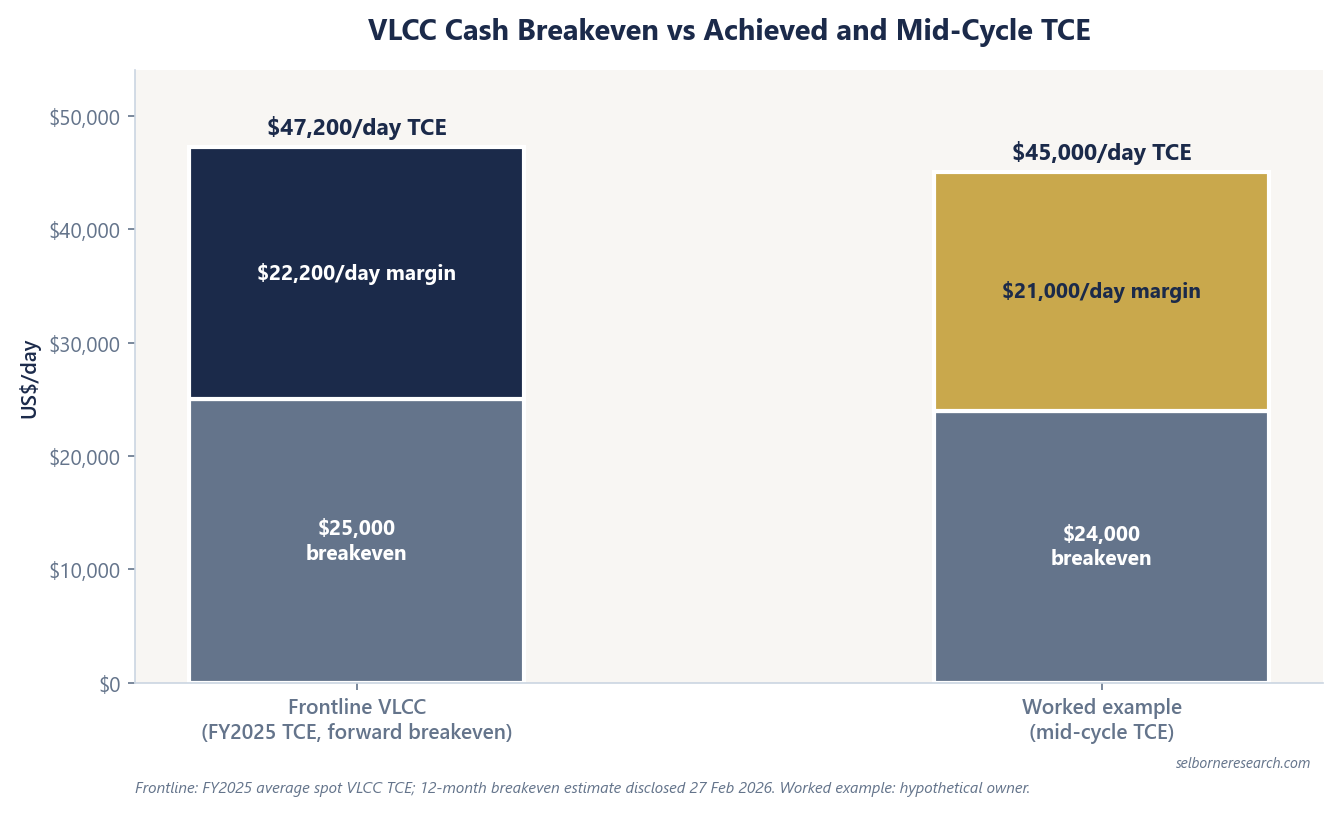
At Frontline, FY2025 VLCC TCE was $47,200/day, roughly $22,200/day above its $25,000 forward estimate. That breakeven covers opex including dry docks, loan repayments, net interest, charter hire and net G&A.
Scorpio Tankers earned a fleet average of $25,964/day against its ~$11,000/day presentation figure. It also had net cash of $123.5m at 31 December 2025, where Frontline carried ~$2,816m of net debt, so the two cushions sit on very different balance sheets.
Star Bulk’s $5,123 + $1,347 = $6,470/day covers only opex and cash G&A. Without loan interest and amortisation from the balance sheet added in, it cannot be read as a dividend breakeven.
Margin Maths at Mid-Cycle TCE
At mid-cycle demonstration prices, an illustrative VLCC owner looks like this:
| Line | $/day |
|---|---|
| Mid-cycle VLCC TCE | $45,000 |
| Cash breakeven (illustrative) | $24,000 |
| Margin above breakeven | $21,000 |
That $21,000/day funds dividends, early debt paydown and growth in a normal year, once the opex, debt service and dry-docking inside the breakeven are paid. Frontline’s FY2025 margin was similar because its VLCC average sat close to mid-cycle. The spike came later, in 2026.
Class mix matters as much as the headline rate. Scorpio Tankers’ product tankers earned $32,138/day on LR2s (the largest), $22,469/day on MRs and $21,179/day on Handymaxes in FY2025, all against one fleet breakeven.
Frontline vs Scorpio Tankers: Two Teaching Cases
The definition and the balance sheet both change what a breakeven means. Frontline is a crude owner with 80 vessels, mostly spot employment and net debt, and publishes a forward breakeven for each of its three classes. For an owner carrying debt, TCE falling toward breakeven squeezes covenant headroom and dividend capacity quickly. Chartering VLCCs out for a year at $76,900–93,500/day, as Frontline did in Q4 2025 and Q1 2026, is one response in an upturn.
Scorpio Tankers owns 89 product tankers and has net cash. Its breakeven is unaudited, and without net debt its reinvestment and payout maths work differently from an indebted owner’s.
Worked Mini-Example: Fleet Cash Above Breakeven
10 VLCCs, 350 on-hire days each, mid-cycle TCE $45,000/day, breakeven $24,000/day:
| Step | Calculation | Result |
|---|---|---|
| Daily margin | $45,000 − $24,000 | $21,000 |
| Per vessel annual | $21,000 × 350 | $7.35m |
| 10-vessel fleet | $7.35m × 10 | $73.5m |
That $73.5m is cash above breakeven before growth capex. Size a dividend off a spike year instead, such as 2026 VLCC spot rates, and the owner over-distributes into the next trough.
Each vessel is valued on charter income, running costs and scrap over its remaining life, summed to a fleet NAV net of debt, stressed through a freight downturn.
The Excel model is the primer's fleet NAV build live across 11 sheets: each vessel valued on its cash flows over the life it has left plus scrap, fleet NAV to equity for a spot tanker owner and a contracted lessor, an implied-multiple cross-check, a built cash breakeven, a freight-trough scenario and sensitivity grids. Change the charter rate, running costs, fleet age or debt and the NAV moves.
Frequently Asked Questions
- What is cash breakeven TCE in shipping?
- Cash breakeven is the daily TCE needed to cover operating costs, general and administrative expense, debt service and maintenance cash outflows, as each company defines them. Definitions vary: Frontline publishes forward 12-month estimates; Scorpio Tankers cites ~$11,000/vessel-day in an unaudited investor presentation; Star Bulk and Danaos disclose opex components without a single headline rate.
- What is Frontline VLCC cash breakeven?
- Frontline disclosed forward cash breakeven estimates for the 12 months from February 2026: VLCC $25,000/day, Suezmax $23,700/day, LR2 $23,800/day. They cover operating expenses including dry docks, loan repayments, net interest, charter hire and net G&A. These are management estimates, separate from achieved rates: the FY2025 VLCC average TCE was $47,200/day.
- Why is Scorpio Tankers breakeven flagged as presentation-only?
- Scorpio Tankers cites ~$11,000/vessel-day estimated cash breakeven (opex, cash G&A, interest, commitment fees, scheduled loan amortisation) in its February 2026 investor presentation. That figure is not in the audited Form 20-F. FY2025 fleet-average TCE was $25,964/day, and the company reported net cash of $123.5m at 31 December 2025, where crude owners such as Frontline carry net debt.
- Can you pay dividends from spike TCE forever?
- No. Spike VLCC TD3C rates can sit many times above a mid-cycle mark of $45,000/day: the benchmark touched ~$400,700/day in June 2026. Dividend sustainability tests use breakeven plus a capex reserve at mid-cycle TCE. When spot rates fall back, distributions sized to peak cash flow become a balance-sheet problem.