FAS vs CAS Pension Accounting for Defence Primes
What the FAS/CAS pension operating adjustment is, where it sits in the income statement, and Lockheed Martin's FY2025 figures worked through.
Educational analysis for professional use. This guide is not investment advice or a recommendation to buy or sell any security, and it is not personalised.
Two Rulebooks, One Pension Cost
A US defence prime works out its pension cost twice for the same year, on the same plans, under two different sets of rules, and the two figures essentially never match. L3Harris states this most plainly: “We calculate and allocate a portion of our defined benefit plan costs to our U.S. Government contracts in accordance with CAS. However, our Consolidated Financial Statements require we calculate our defined benefit plan costs … in accordance with FAS requirements.”
FAS is the shorthand primes use for the Financial Accounting Standards that sit behind US GAAP pension accounting, now codified as ASC 715. It produces the pension expense (or income) that shows up in consolidated net income, the number in the company’s financial statements. CAS, the Cost Accounting Standards, is a separate body of US government rules that sets how much pension cost a contractor is allowed to charge, through the price of its contracts, onto a defence programme. RTX’s own definition names both sides directly: the adjustment is the gap “between the service cost component of our pension and postretirement benefit (PRB) expense under the Financial Accounting Standards (FAS) requirements of U.S. GAAP and our pension and PRB expense under U.S. government Cost Accounting Standards (CAS).”
Neither rulebook is optional. GAAP governs what a public company reports to shareholders; CAS governs what the government will actually pay for on a cost-type or negotiated contract. A prime has to run both calculations every year, and the gap between them is the FAS/CAS adjustment.
Where the Reconciling Line Sits
The adjustment never sits inside a segment’s own margin. It shows up once, as a single reconciling item between total segment operating profit and total consolidated operating profit. Lockheed Martin’s 10-K states this directly: “Business segment operating profit excludes the FAS/CAS pension operating adjustment.” In the reconciliation table, the adjustment appears under “Unallocated items,” between total business segment operating profit and total consolidated operating profit.
That matters for how the number should be read. The adjustment is a bridge between a segment-level result computed on the CAS pension charge and a consolidated result computed on the FAS pension charge, a mechanical reconciling item rather than a cost or benefit the business actually incurred. It sits alongside other unallocated corporate items in that bridge, so segment operating profit plus the adjustment alone will not foot exactly to consolidated operating profit; other reconciling items are in the same line group.
Lockheed Martin’s FY2025 Bridge, Worked
Lockheed Martin’s 10-K carries two related FAS/CAS figures, and the two are easy to conflate. The first is the operating adjustment proper, which uses only the FAS service cost component. The second is a broader total that also nets in the non-service part of FAS pension expense, the part that sits outside operating profit entirely.
| Item | FY2025 value | Basis |
|---|---|---|
| CAS pension cost (charged to segments) | $1,568M | Filed, 10-K |
| FAS pension service cost | $50M | Arithmetic: $1,568M CAS cost minus $1,518M adjustment |
| FAS/CAS pension operating adjustment | $1,518M | Filed, 10-K |
| Total FAS pension (expense)/income, incl. non-service | $(924)M | Filed, 10-K |
| Total FAS/CAS pension adjustment, incl. non-service | $644M | Filed, 10-K |
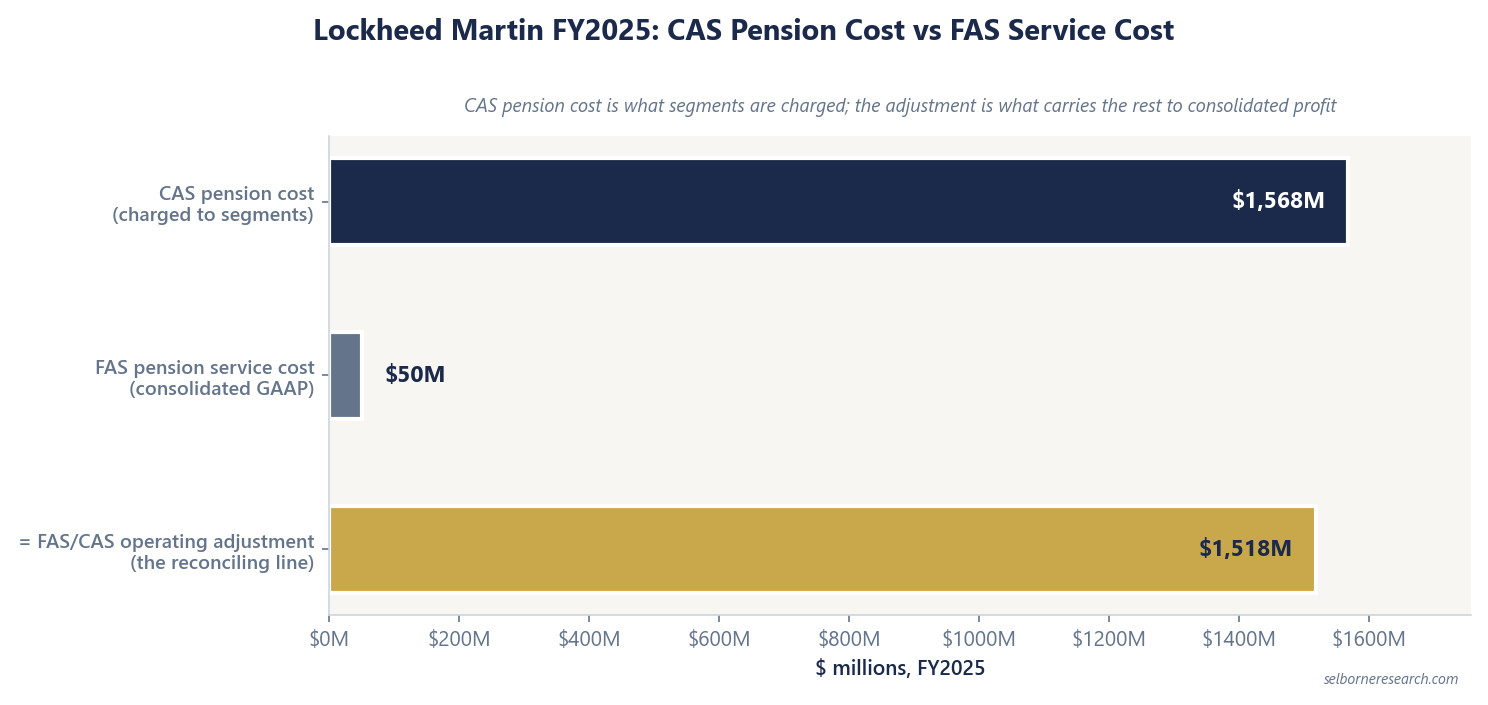
Read the first three rows together and the mechanism is plain: segments were charged $1,568M in CAS pension cost, GAAP consolidated results booked only $50M of FAS service cost for the same plans, and the $1,518M gap between them is what gets added back between segment and consolidated operating profit. The last two rows are a different, wider calculation: once the non-service components of FAS pension expense (the parts driven by plan-asset returns and discount-rate remeasurement rather than a year’s work) are included, the total FAS/CAS pension adjustment for FY2025 was $644M, not $1,518M. Both are genuine, filed FAS/CAS figures; they just answer different questions.
Same Line, Different Words
Every filer that discloses a FAS/CAS adjustment defines it slightly differently, and General Dynamics has no such line at all.
| Filer | Own definition (quoted) |
|---|---|
| Lockheed Martin | ”The FAS/CAS pension operating adjustment (which represents the difference between total CAS pension cost recorded in our business segments’ results of operations and the service cost component of FAS pension (expense) income).” |
| RTX | ”The FAS/CAS operating adjustment represents the difference between the service cost component of our pension and postretirement benefit (PRB) expense under the Financial Accounting Standards (FAS) requirements of U.S. GAAP and our pension and PRB expense under U.S. government Cost Accounting Standards (CAS) primarily related to our Raytheon segment.” |
| Northrop Grumman | ”The FAS/CAS operating adjustment reflects the difference between CAS pension expense included as cost in segment operating income and the service cost component of FAS expense included in total operating income.” |
| L3Harris | ”The difference between CAS pension cost and the service cost component of net periodic benefit income (‘FAS pension service cost’) is reflected in the FAS/CAS operating adjustment, which is included as a component of the ‘Unallocated corporate items’.” |
The wording overlaps heavily, but each filer’s version carries a small tell about its own business. RTX’s definition ties the adjustment “primarily” to its Raytheon segment: the pension gap concentrates in one segment’s numbers there, where at Lockheed Martin or Northrop Grumman it spreads across every business. L3Harris’s FY2025 adjustment was only $10M, the smallest of the four, which shows the line can sit close to zero in a year when CAS pension cost and FAS service cost happen to land near each other; it does not mean L3Harris is exempt from the mechanism, only that the two calculations were close that year.
General Dynamics breaks the pattern outright. Its FY2025 10-K uses the word “FAS/CAS” nowhere. Instead, it describes the same underlying timing difference and puts it somewhere else entirely: “The amount allocated to U.S. government contracts is determined in accordance with the Federal Acquisition Regulation (FAR) and Cost Accounting Standards (CAS), which may result in a timing difference with the amount determined under GAAP. We defer this difference on the Consolidated Balance Sheet. At this time, the amount allocated to contracts exceeds cumulative benefit costs, resulting in a deferred credit that is reported in other noncurrent liabilities.” No dollar figure is given. General Dynamics has the same CAS-versus-GAAP gap as the other four; it just parks the running balance on the balance sheet instead of passing a fresh reconciling line through operating profit every year.
Reading the Adjustment in a Model
Segment operating margin is computed on the CAS pension charge rather than the FAS figure, because that charge is what actually sits inside contract cost. A model that reads segment margin as a clean read on GAAP profitability is quietly mixing two cost bases: the segment’s own margin reflects CAS pension cost, while everything below the adjustment line, consolidated operating profit, net income, EPS, reflects FAS pension cost instead.
The size of the adjustment shifts from year to year. CAS pension cost and FAS service cost are two separate calculations on the same plans, so whenever either side’s inputs move (asset returns, discount rates, actuarial assumptions on either the CAS or the FAS side), the gap between them, and so the adjustment, moves too. A shrinking adjustment does not mean pension risk has fallen; it means the two calculations happened to converge that year.
Because pension funding and cash contributions are governed by rules closer to the CAS side than the FAS side, a large FAS/CAS gap is one of the mechanisms behind operating cash flow running ahead of net income at a pension-heavy prime, alongside working-capital timing and capex. That is only one line in a wider bridge; the free cash flow conversion guide covers the fuller earnings-versus-cash treatment, of which pension timing is one input among several.
Where This Goes Wrong
Lockheed Martin’s two disclosed FAS/CAS figures get conflated more often than any other number in this guide. The $1,518M operating adjustment (service cost only) and the $644M total adjustment (including non-service FAS costs) are both real, filed figures for the same FY2025, and they measure different things. Quoting one while sourcing the other is a citation error waiting to happen.
General Dynamics reporting no FAS/CAS line reads, to some, as the company having solved the problem. It hasn’t. The same FAR/CAS timing difference exists there too; General Dynamics just defers it on the balance sheet rather than reconciling it through the income statement every year, with no dollar figure disclosed to compare against the other four.
There is a subtler trap: reading the size of the adjustment itself as a verdict on pension health. A large adjustment only means CAS pension cost and FAS service cost sat far apart that year. A small one, as at L3Harris, means they sat close. Neither says anything on its own about whether a plan is well funded.
Funded backlog and FCF conversion are the inputs. This primer takes them to a ten-year cash-flow value and an FCF yield you can screen.
The Excel model is the primer's two archetype builds live across 11 sheets: a ten-year, backlog-driven free-cash-flow DCF with a Gordon terminal. Change the book-to-bill, the FCF conversion ratio or the WACC and the value per share moves; the backlog, conversion-bridge and concentration sheets update alongside it.
Frequently Asked Questions
- What is the FAS/CAS pension operating adjustment?
- It is the reconciling line between a defence prime’s segment operating profit and its consolidated operating profit, equal to the difference between the pension cost the government allows onto contract prices under Cost Accounting Standards (CAS) and the service-cost component of the pension expense the company books under US GAAP (FAS, ASC 715). Lockheed Martin, RTX, Northrop Grumman and L3Harris all disclose one; each defines it in its own words but places it in the same spot in the income statement.
- Why doesn’t General Dynamics report a FAS/CAS adjustment?
- General Dynamics’ FY2025 10-K has no FAS/CAS line at all. It still has the same CAS-versus-GAAP timing difference, but instead of running the gap through operating profit every year, it defers the difference on the balance sheet as a deferred credit inside other noncurrent liabilities, with no dollar figure disclosed. Same underlying mechanism, a different place to put it.
- Why is L3Harris’s FAS/CAS adjustment so much smaller than Lockheed Martin’s?
- L3Harris’s FY2025 adjustment was $10M against Lockheed Martin’s $1,518M. Both figures are the same calculation, CAS pension cost minus FAS service cost, so the gap says the two numbers sit close together at L3Harris and far apart at Lockheed Martin that year. Filed disclosure does not break out why; plan size and cost basis differ across the two companies’ pension arrangements.
- Does the FAS/CAS adjustment affect free cash flow?
- Only indirectly. It sits in the operating-profit reconciliation rather than the cash-flow statement, but it is one of the reasons operating cash flow and net income diverge at a prime with a large pension plan, because the cash side of pension funding tracks the CAS-allocated cost while net income books the FAS-computed cost. The free cash flow conversion guide covers the fuller cash-versus-earnings picture.