Carried Interest and Hurdle Rates Explained
How the LP/GP carried interest waterfall works, verified Blackstone hurdle terms (5–8% preferred, up to 20% carry), and the 8%, 80/20 market convention.
Educational analysis for professional use. This guide is not investment advice or a recommendation to buy or sell any security, and it is not personalised.
Carry Crystallises on Realisations, Not Accruals
Carried interest (performance fees, incentive allocation) is the GP’s share of fund profits above a contractual threshold. It accrues as portfolio values rise but crystallises when investments are sold or distributed. That timing gap is why net accrued carry can dwarf current-year fee-related earnings: Carlyle holds $2.9B net accrued carry on $1.2B FRE; KKR reports $10.2B gross unrealised performance income on $3.7B FRE (both end-FY2025).
Carry flows into distributable earnings only on realisation. Our FRE vs DE guide covers how that split affects headline earnings; our valuation guide covers how the market prices FRE separately from carry optionality.
The Standard Waterfall
Most drawdown private equity and credit funds follow a four-step waterfall:
- Return of capital to LPs
- Preferred return to LPs at the hurdle rate (typically 8% compounded annually in LPAs)
- GP catch-up so the GP reaches its agreed share of all profit distributed, the preferred return included
- 80/20 split of remaining profits (80% LP, 20% GP)
The hurdle is a floor, not a fee: until LPs have earned the preferred return on contributed capital, the GP takes nothing at all. The catch-up then reverses most of that. It lets the GP take the next dollars, usually all of them, until it holds its agreed share of every dollar of profit the fund has distributed, the preferred return included. Without a catch-up the hurdle permanently shields the first slice of profit from carry; with one it only delays it.
Standard teaching defaults: 8% preferred return and 80/20 profit split after catch-up. These are market norms in LPAs, not universal legal requirements, and a fund can have a hurdle with no catch-up, a catch-up that is shared rather than full, or no preferred return at all.
Blackstone’s Filed Terms
Blackstone’s 10-K says the GP is entitled to up to 20% carried interest after a preferred return of generally 5–8% per year, subject to a catch-up. The range reflects fund-vintage and strategy differences across the drawdown platform, and the filing is explicit that some carry funds carry no preferred return at all.
| Term | Blackstone filed range | LPA market convention |
|---|---|---|
| Preferred return | 5–8% per year | Typically 8% IRR |
| GP carry share | Up to 20% | 80/20 after catch-up |
| Catch-up | Yes | Standard in LPAs |
That 5–8% spread matters more than it looks. Rerun the worked example below at a 5% hurdle and the preferred return falls from $46.9M to $27.6M, so the catch-up has less to make up. The GP still lands on 20% of the profit either way. Where the hurdle is set changes when the GP gets paid, not how much, provided the fund clears it and the catch-up is full.
Gross vs Net Carry: Do Not Cross-Comp Blind
Issuers define accrued carry differently:
| Company | End-FY2025 accrued carry | Definition |
|---|---|---|
| KKR | $10.2B | Gross unrealised performance income |
| Blackstone | $6.7B | Net accrued performance revenues |
| Carlyle | $2.9B | Net accrued performance revenues |
| Apollo | $1.84B | Net accrued performance fee receivable |
| Ares | $1.1B | Unconsolidated ($1.0B GAAP) |
| Brookfield AM | $1.3B | Accrued unrealised carried interest |
KKR’s gross $10.2B is not directly comparable to Blackstone’s net $6.7B. Footnote the definition before ranking carry balances.
Evergreen Vehicles: Different Rules
Drawdown fund terms do not apply to permanent capital and evergreen products. Blackstone Private Equity Strategies (BXPE) offering documents specify a 5% hurdle and 12.5% performance allocation, not the standard 8%/20% drawdown structure.
Evergreen carry often crystallises on different triggers (NAV-based accruals, periodic crystallisation windows) and may use net-asset-value hurdles rather than IRR hurdles. Treat each product’s offering documents as authoritative.
Worked Example: Where the Catch-Up Does Its Work
The catch-up is the step everyone skips, and skipping it changes the answer nearly fivefold. Run a $100M drawdown fund with an 8% preferred return and a full catch-up, returning $160M after five years.
Step 1: Return of capital. LPs receive $100M back. That leaves a $60M profit pool.
Step 2: Preferred return. Compounded at 8% for five years, $100M grows to $146.9M, so the preferred return is $46.9M. It all goes to LPs. Profit still undistributed: $60M − $46.9M = $13.1M.
Step 3: Catch-up. The GP is entitled to 20% of all profit above the return of capital, not just profit above the hurdle. LPs have taken $46.9M, so for the GP to hold 20% of what has been distributed it needs $46.9M × (20 ÷ 80) = $11.7M, and the catch-up hands it every dollar until it gets there. Remaining: $13.1M − $11.7M = $1.4M.
Step 4: 80/20 on what is left. GP takes 20% × $1.4M = $0.3M; LPs take $1.1M.
GP carry: $11.7M + $0.3M = $12.0M. That is exactly 20% of the $60M profit, which is the point of the catch-up: once the fund clears its hurdle, the GP ends up on its full share of everything.
Now take the catch-up out. On a hard hurdle, where the GP only ever sees profit above the preferred return, its carry is 20% × $13.1M = $2.6M. Same fund, same performance, same headline “8% and 20%”, and the GP earns a fifth as much.
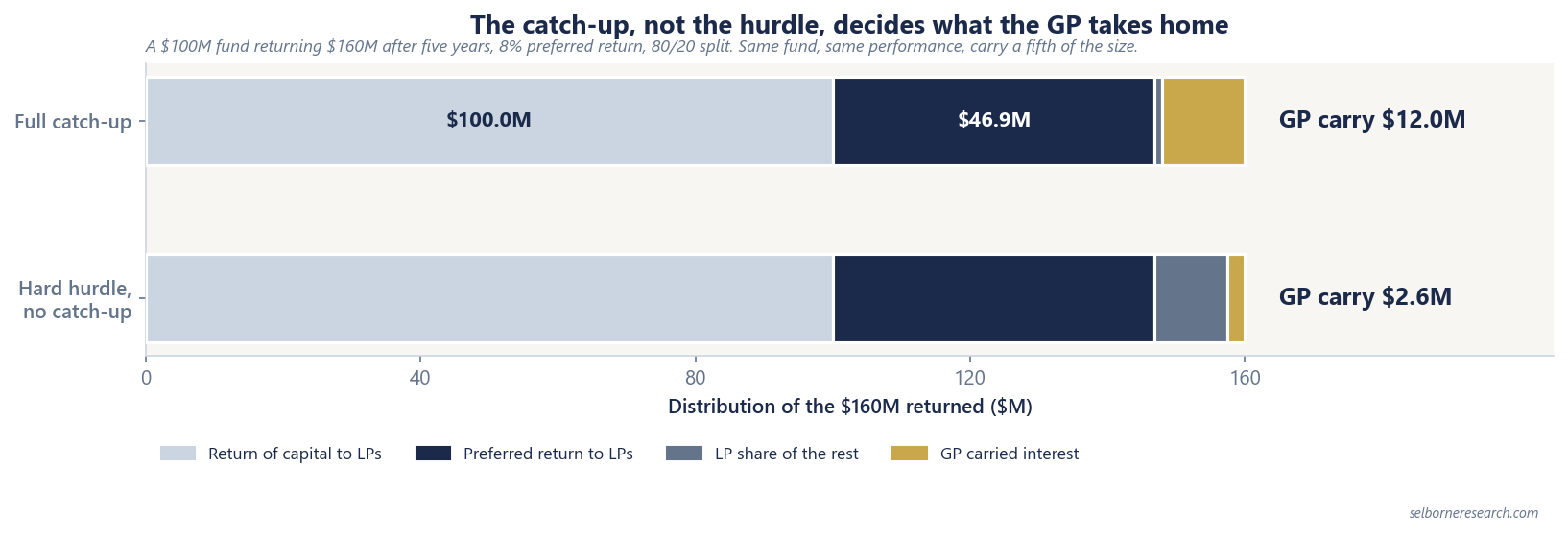
So the hurdle is not a fee rate, and carry is not a percentage of gains. A fund short of its hurdle pays no carry at all. A fund comfortably past it pays the GP a full fifth of every dollar of profit, including the dollars the hurdle looked like it was protecting. In between, during the catch-up, the GP is taking essentially all of the incremental profit, which is the stretch nobody models. Real waterfalls vary further, mainly on whether the hurdle is struck across the whole fund or deal by deal, and whether the catch-up is full or shared.
Carry and Valuation
The market generally capitalises FRE at P/FRE multiples (as of Jun 2026: ~13× to ~33×) and treats carry as optionality that crystallises into DE on realisations. Blackstone FY2025: FRE $5.7B, plus $2.1B of net realisations, less $0.8B of taxes and related payables, gives DE of $7.1B.
High accrued carry without near-term realisations can create a valuation tension. Carlyle carries $2.9B of net accrued carry on a ~13.1× P/FRE; Apollo carries $1.84B on ~33.2×. The two are not being priced on their carry books at all. Apollo’s multiple reflects a fee base of which more than 70% is perpetual, and an insurance balance sheet whose earnings sit outside the FRE denominator entirely.
Clawback and LP Protection
Most LPAs include clawback provisions: if early carry payments exceed what the GP would earn under the full fund waterfall, the GP must return excess carry to LPs. Clawback reduces the risk that GPs crystallise carry on early winners while later losses leave LPs below the hurdle.
Clawback is a legal contingency, not a line item in FRE. It matters for assessing carry quality on managers with heavy early realisations.
For issuer-level carry accrual and realisation history, see our KKR, Blackstone, and Carlyle Group profiles.
What Matters Most
Carried interest is not recurring revenue, and it is not a percentage of gains. It is a contractual share of profit that pays nothing below a threshold and, once the catch-up has run, usually pays the GP its full share of everything. Any carry number you are handed should prompt the same question: does this fund have a catch-up, and has it run? Blackstone files 5–8% preferred returns across its drawdown platform, evergreen products like BXPE use different terms again, and accrued carry balances mean nothing across issuers until you have checked gross against net.
Alternative Asset Managers Primer
A waterfall says who is owed what, not what it is worth. The primer folds carry into the equity bridge.
The Excel model is the primer's two worked valuations live across 12 sheets: change fee-paying AUM, FRE margin or the fundraising rate and the valuation moves. It holds two company slots, one per worked case, not a full peer table.
Frequently Asked Questions
- What is a hurdle rate in private equity carried interest?
- The hurdle rate (preferred return) is the return LPs must earn before the GP receives any carried interest. Market convention in limited partnership agreements is typically 8% compounded annually. Blackstone files a 5–8% per year preferred return range on its carry funds, with catch-up provisions before the GP takes up to 20% of profits. A hurdle is not a fee and carry is not a flat share of gains: a fund below its hurdle pays no carry at all, while a fund above it usually pays the GP its full 20% of every dollar of profit once the catch-up has run.
- How does the carried interest waterfall work?
- Standard order: (1) return of LP capital, (2) preferred return to LPs at the hurdle rate, (3) GP catch-up, (4) remaining profits split 80% to LPs and 20% to the GP. The catch-up is the step that decides the answer. On a $100M fund returning $160M with an 8% hurdle, a full catch-up gives the GP $12.0M, exactly 20% of the $60M profit; the same fund on a hard hurdle with no catch-up gives the GP $2.6M. Carry then crystallises on realisations, which is why net accrued carry ($6.7B at Blackstone, $10.2B gross unrealised at KKR end-FY2025) can far exceed current-year FRE.
- What is the difference between gross and net carry?
- Gross carry is performance income before compensation allocations; net carry is what accrues to the manager after paying deal teams and other performance compensation. KKR reports $10.2B gross unrealised performance income; Blackstone reports $6.7B net accrued performance revenues. Do not compare carry balances across issuers without footnoting the definition.
- Do evergreen funds use the same hurdle as drawdown PE?
- No. Drawdown PE funds typically use an 8% preferred return with 80/20 profit split after catch-up. Evergreen vehicles differ: Blackstone Private Equity Strategies (BXPE) uses a 5% hurdle and 12.5% performance allocation per offering documents. Evergreen terms are product-specific, not sector-wide.