Combined Ratio: the P&C Scoreboard
How the P&C combined ratio is defined, the sub-100% profit and sub-95% strong screens, and why investment income sits outside underwriting.
Educational analysis for professional use. This guide is not investment advice or a recommendation to buy or sell any security, and it is not personalised.
The Combined Ratio Is Underwriting-Only Profitability
Property-and-casualty analysts open with one number: the combined ratio. It adds the loss ratio (incurred losses and loss adjustment expenses divided by premiums) to the expense ratio (underwriting expenses divided by premiums). The result tells you whether the insurance operation itself made or lost money, before a dollar of investment income.
Below 100% means underwriting profit. Below 95% is our screen for strong underwriting. Investment income, float economics, and reserve releases are separate lenses; see our float guide and reserve development guide for those.
The Two Screens
| Threshold | Meaning | Source |
|---|---|---|
| <100% | Underwriting profit | IRMI definition; insurer disclosures |
| <95% | Strong underwriting | House screen. An insurance trade-body study of the US P&C industry put 95.5% as the ratio needed for a 12% ROE in 2024 conditions |
Progressive discloses a company-specific guardrail: grow “as fast as possible” subject to a calendar-year combined ratio of 96% or better. That is PGR policy, not an industry standard.
FY2025 Comp Ladder vs Industry
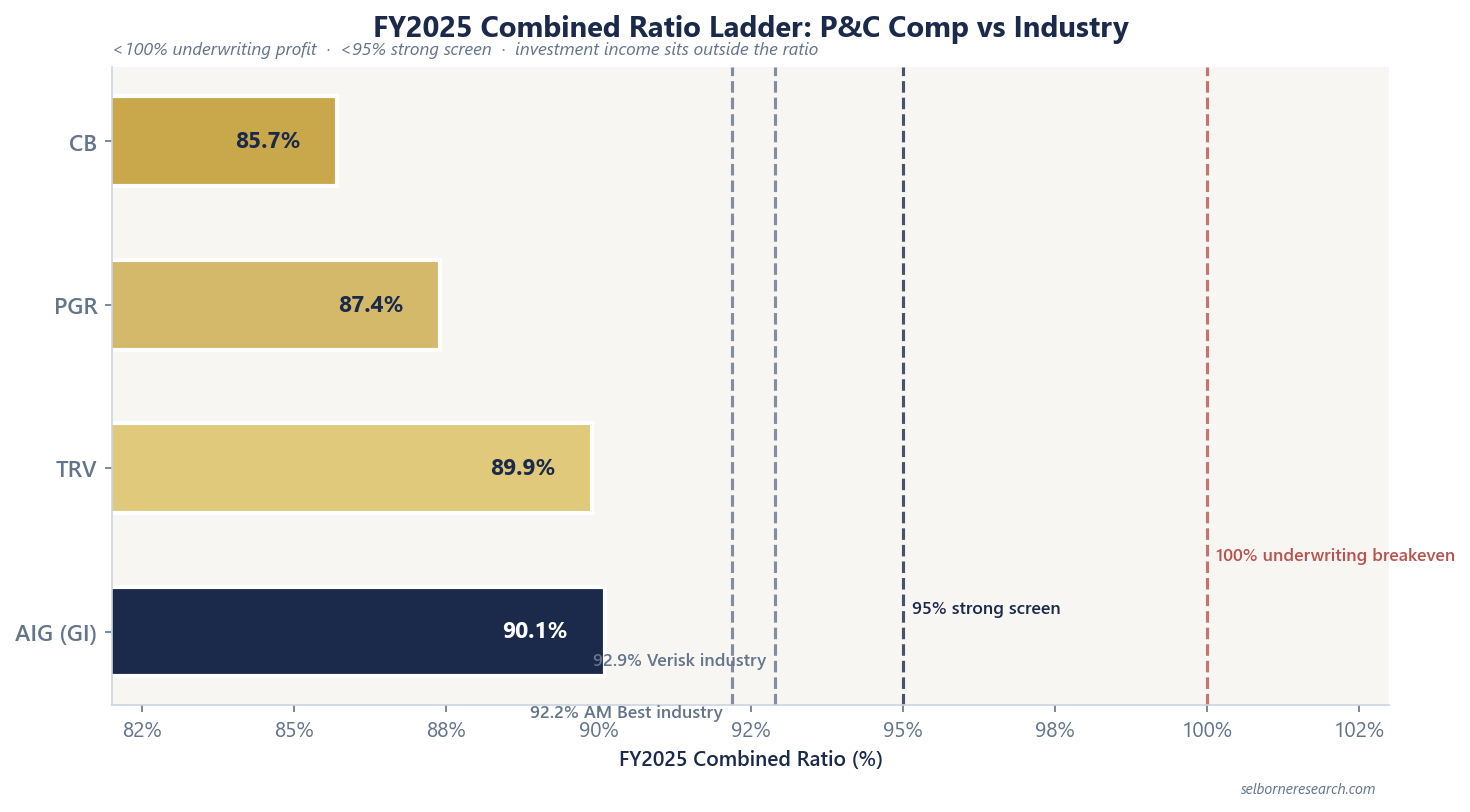
Verified FY2025 companywide combined ratios against preliminary statutory industry compilations:
| Company | FY2025 combined ratio | vs AM Best 92.2% | vs Verisk 92.9% |
|---|---|---|---|
| Chubb (CB) | 85.7% | −6.5 pts | −7.2 pts |
| Progressive (PGR) | 87.4% | −4.8 pts | −5.5 pts |
| Travelers (TRV) | 89.9% | −2.3 pts | −3.0 pts |
| AIG General Insurance | 90.1% | −2.1 pts | −2.8 pts |
| US industry (AM Best) | 92.2% | n/a | n/a |
| US industry (Verisk + APCIA) | 92.9% | n/a | n/a |
AM Best covers roughly 96% of industry net premiums written; Verisk covers roughly 97.8% of US P&C business. Both are preliminary FY2025 statutory tallies (released March 2026). Cat losses added an estimated 7.6 pts to the 2025 industry ratio versus 8.8 pts in 2024.
The four-name ladder spans 4.4 percentage points from Chubb at 85.7% to AIG GI at 90.1%. All four beat both industry prints by at least 2.1 pts.
Investment Income Sits Outside
The combined ratio deliberately excludes net investment income. A 92% combined ratio on $10bn of earned premiums implies $800m of underwriting profit. If the insurer also earns $500m of net investment income on its float-funded portfolio, total pre-tax operating earnings are $1.3bn. ROE blends both engines; the combined ratio scores only the first.
That separation matters when comparing a personal-auto compounder with a high fixed-income book yield to a commercial-lines writer with tighter underwriting but a lower portfolio yield. Rank underwriting on the combined ratio; rank the investment engine separately.
Worked Example: Loss + Expense to Underwriting Profit
Take a simplified P&C insurer with $20,000m of net earned premiums:
| Component | Ratio | Dollar amount |
|---|---|---|
| Incurred losses + LAE | 65.0% | $13,000m |
| Underwriting expenses | 27.0% | $5,400m |
| Combined ratio | 92.0% | n/a |
| Underwriting profit | 8.0% | $1,600m |
A 92.0% combined ratio sits between the verified comp set (85.7–90.1%) and the industry prints (92.2–92.9%). The 8% underwriting margin is the raw material for float economics: an underwriting profit means the insurer is paid to hold the float, break-even underwriting makes it free, and an underwriting loss makes it costly.
What the Scoreboard Misses
Favourable prior-year reserve development (PYD) lowers the calendar-year loss ratio without proving current-year pricing adequacy. AIG’s FY2025 favourable PYD of $548m shaved 2.1 pts off its General Insurance combined ratio. Read PYD through the reserve development lens, not as a substitute for the combined ratio.
Life insurers do not report a P&C-style combined ratio. MetLife and Prudential Financial run spread businesses; their economics sit in general-account spread and new-business metrics, not loss plus expense ratios.
Reading the Ladder
The combined ratio is the P&C scoreboard because it is comparable across lines and filing regimes, updates every quarter, and separates underwriting discipline from investment returns. Chubb at 85.7% and Progressive at 87.4% set the FY2025 ceiling. AIG at 90.1% still clears industry by a comfortable margin. When a name drifts toward 95% or above, the question shifts from “how good is underwriting?” to “is investment income carrying the ROE?”
A combined ratio scores underwriting and nothing else. The primer takes it through float and reserve quality to a justified price-to-book.
The Excel model is the primer's three residual-income valuations live across 13 sheets: change the combined ratio, the spread or the cost of equity and the justified P/BV moves.
Frequently Asked Questions
- What is the combined ratio in insurance?
- The combined ratio is the sum of the loss ratio and the expense ratio: incurred losses and loss adjustment expenses plus underwriting expenses, divided by earned or written premiums. It measures underwriting profitability only. Investment income sits outside the ratio.
- What combined ratio means underwriting profit?
- A combined ratio below 100% indicates an underwriting profit: premiums exceed losses and expenses. IRMI and insurer disclosures treat sub-100% as the definitional threshold. We screen at sub-95% as strong underwriting, though no single regulator codifies that band.
- What is a good combined ratio for a P&C insurer?
- Verified FY2025 leaders ran 85.7% (Chubb) to 90.1% (AIG General Insurance), well below the preliminary US industry prints of 92.2% (AM Best) and 92.9% (Verisk). Anything consistently below 95% with credible reserving is franchise-quality underwriting.
- Does investment income affect the combined ratio?
- No. The combined ratio covers underwriting only. Net investment income on float and the general-account portfolio flows through a separate line and completes total P&C profitability. A 95% combined ratio plus strong investment yield can still produce attractive ROE.