Reserve Development: Favourable vs Adverse
NAIC IRIS sign conventions for prior-year reserve development, verified FY2025 favourable PYD on four P&C comps, and why releases do not prove reserve adequacy.
Educational analysis for professional use. This guide is not investment advice or a recommendation to buy or sell any security, and it is not personalised.
Reserve Development Moves the Calendar-Year Loss Ratio
Prior-year reserve development (PYD) measures how much prior accident-year loss estimates changed since the last evaluation. When actuaries find prior reserves were too high, they release redundancies (favourable PYD). When estimates rise, they strengthen reserves (adverse PYD). Either way, the flow hits the calendar-year loss ratio and therefore the combined ratio.
PYD is a reserving-quality signal, not a current-year underwriting score. A company can report a strong combined ratio partly because of releases while current accident-year loss trends deteriorate.
NAIC Sign Convention
The NAIC IRIS Manual (Ratio 11) defines the direction:
| Direction | Meaning | Effect on calendar-year loss ratio |
|---|---|---|
| Favourable (release) | Current ultimate estimate < prior reserve; reserves were redundant | Lowers reported losses |
| Adverse (strengthening) | Current ultimate estimate > prior reserve; reserves were deficient | Raises reported losses |
Favourable PYD is good news about past reserving judgment. It does not guarantee current reserves are right.
FY2025 Favourable PYD on the P&C Comps
Verified FY2025 prior-year development on the four P&C research names:
| Company | FY2025 favourable PYD | Notes |
|---|---|---|
| Progressive (PGR) | $1,394m | Total prior accident years development |
| Chubb (CB) | $1,133m pre-tax ($858m after-tax) | Pre-tax per earnings release |
| Travelers (TRV) | $1,036m pre-tax ($815m after-tax) | Pre-tax per financial supplement |
| AIG (AIG) | $548m | 2.1 pts favourable on GI combined ratio |
All four released reserves in FY2025. Progressive’s $1,394m was the largest dollar release; AIG’s translated to 2.1 percentage points on the General Insurance combined ratio, the most direct link between PYD and the underwriting scoreboard.
Industry Context: Streak vs Shock
US casualty insurance reported 17 consecutive years of favourable PYD before the run ended (Milliman calendar 2024 analysis). That streak reflected conservative reserving culture and benign loss development on many lines.
Calendar 2023 broke the pattern on US liability lines with $3.7bn adverse PYD, and calendar 2024 doubled down at $7.8bn adverse (~1.5% of prior reserves). Social inflation, severity trends on commercial auto and excess liability, and rising legal system costs drove the strengthening.
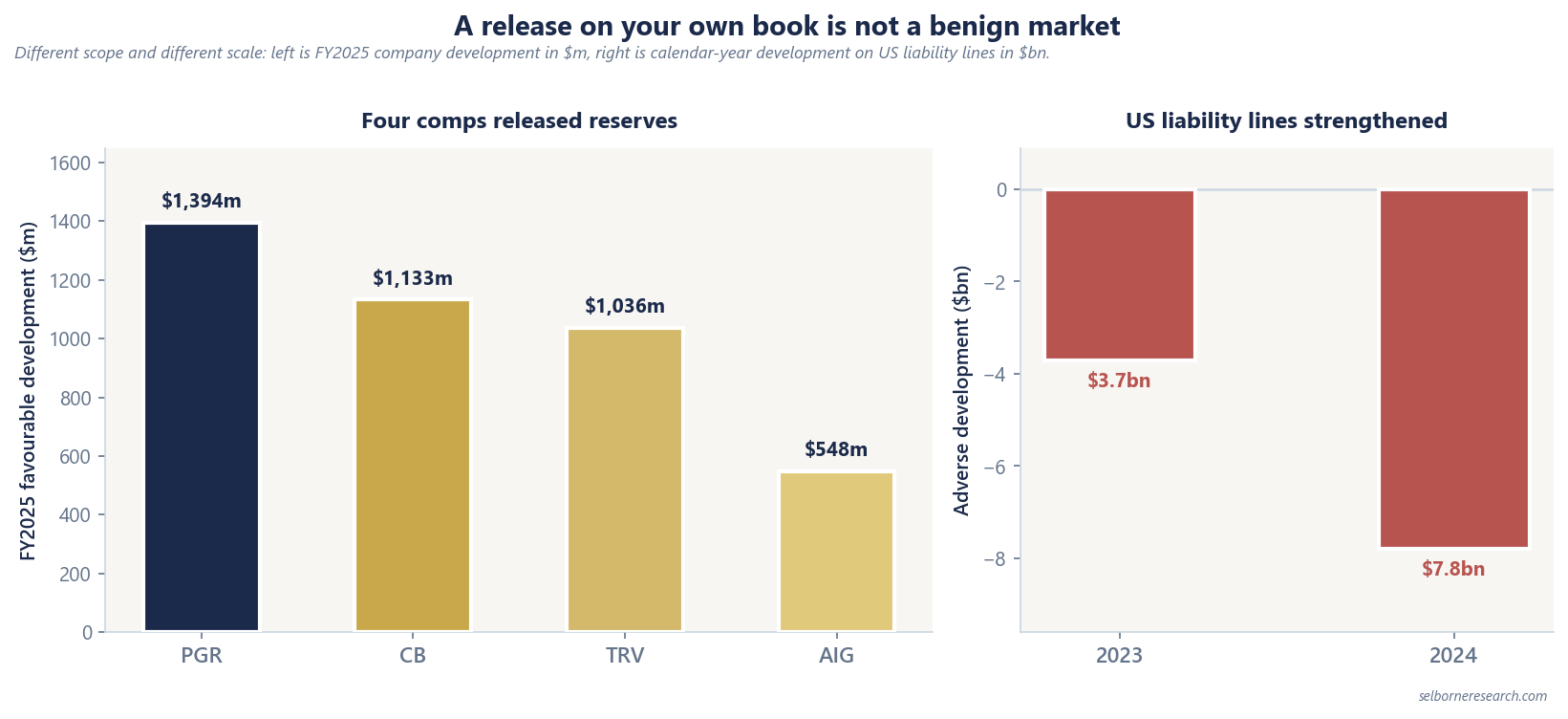
The industry context matters for FY2025 comp analysis. Favourable PYD at Progressive, Chubb, Travelers, and AIG in FY2025 does not mean the industry reverted to a benign regime. It means these four names released on their books while the broader casualty market was strengthening elsewhere.
Worked Example: AIG PYD to Combined Ratio Points
AIG reported $548m of favourable PYD net of reinsurance in FY2025, equal to 2.1 pts on the General Insurance combined ratio.
| Metric | Value |
|---|---|
| AIG GI combined ratio (reported) | 90.1% |
| Favourable PYD contribution | −2.1 pts |
| Implied CR excluding PYD benefit | ~92.2% |
Stripped of releases, AIG’s 2025 underwriting cost 2.1 points more than the headline says. That is not a criticism of AIG’s reserving, and 92.2% is still an underwriting profit; it is the mechanical effect of calendar-year reporting, and it is the number to rank on if the names you are comparing took different releases.
Run the same adjustment mentally on any P&C name before ranking combined ratios.
Life Insurers: AAR Notables, Not PYD
Life insurers do not report P&C-style aggregate calendar-year PYD. MetLife disclosed FY2025 actuarial assumption review (AAR) notables of $89m (all in Q3), with total notables net of $(43)m. Prudential reports annual assumption updates by segment (e.g. Individual Retirement Services net charge of $81m from the FY2025 annual review).
Do not compare MetLife AAR notables to Progressive PYD on a single reserve-development screen. Life spread and new-business metrics are a separate lens on life names.
What Favourable PYD Does and Does Not Prove
Sustained favourable PYD is weak evidence that prior-year reserves were set with margin and that the actuarial process has been conservative. It does not tell you whether current accident-year reserves are adequate, whether loss trends are stable, or whether the combined ratio is sustainable without releases.
That distinction matters when industry development turns. Favourable PYD on one book can coexist with adverse strengthening on other lines or cohorts; calendar 2024’s $7.8bn industry adverse print is the benchmark for that split.
Linking to Float and Valuation
Reserve credibility affects valuation. Insurers trade at a discount to the price-to-book their returns would otherwise support when the market doubts either reserve adequacy or the durability of the ROE. Favourable PYD supports the credibility case but does not close it. Pair reserve analysis with the float and investment-income engine: a release-boosted combined ratio plus a strong NII quarter can flatter one year’s ROE without changing the reserving question.
Practical Screen
Start with direction and size: favourable or adverse PYD in dollars and combined-ratio points. Before ranking underwriting, strip large releases from the calendar-year combined ratio. FY2025 releases at Progressive, Chubb, Travelers, and AIG land differently once you remember the industry context: seventeen favourable years, then two adverse ones on US liability lines.
Releases are not proof that current-year reserves are sufficient. Reserve development is backward-looking. The combined ratio still scores what happened this year; PYD tells you how much of that score was borrowed from prior years.
Favourable development flatters one calendar year and proves nothing beyond it. The primer prices reserving quality into the cost of equity.
The Excel model is the primer's three residual-income valuations live across 13 sheets: change the combined ratio, the spread or the cost of equity and the justified P/BV moves.
Frequently Asked Questions
- What is prior-year reserve development (PYD)?
- PYD is the change in estimated ultimate losses for prior accident years between evaluation dates. It flows through the calendar-year loss ratio and combined ratio, which is why the calendar-year and accident-year figures for the same period differ. Favourable development means prior reserves were redundant (a release); adverse development means prior reserves were deficient (a strengthening).
- What is favourable vs adverse reserve development?
- Under NAIC IRIS Ratio 11 convention: favourable PYD (reserve release) occurs when the current ultimate loss estimate is lower than the prior reserve, indicating redundancy. Adverse PYD (strengthening) occurs when the current estimate exceeds the prior reserve, indicating deficiency. Sign conventions follow statutory reporting.
- Does favourable reserve development prove reserves are adequate?
- No. Sustained favourable PYD signals conservative prior booking, but it does not prove current accident-year reserves are adequate. Calendar-year combined ratios can look strong because of releases even when current-year loss trends are deteriorating. Read PYD as a reserving-quality signal, not a substitute for current-year underwriting metrics.
- How much favourable PYD did major P&C insurers report in FY2025?
- Verified FY2025 favourable PYD: Progressive $1,394m, Chubb $1,133m pre-tax, Travelers $1,036m pre-tax, AIG $548m (2.1 pts favourable on the GI combined ratio). All four are releases, lowering calendar-year loss ratios.