Concession Life and the Expiry Cliff
The comp set spans 6 to 73 years of remaining concession life, short-life mispricing on Vinci Escota and Aena Luton, and cycles with no single asset expiry.
Educational analysis for professional use. This guide is not investment advice or a recommendation to buy or sell any security, and it is not personalised.
Remaining Life Is the DCF Horizon
Every concession valuation starts with one question: how many years of cash flow does the contract actually confer? At expiry, infrastructure reverts to the grantor (IFRIC 12). Terminal value is zero. Apply a perpetuity multiple to an asset with six years left and you overstate value several times over. Apply the same multiple to a 30-year urban concession and it still overstates, by a much smaller margin, because the discount rate now runs well above the combined growth rate. Only a genuinely ultra-long concession, out past 70 years, flips the error the other way.
The comp set spans ~6 years (Vinci Escota) to ~73 years (Ferrovial 407 ETR). Regulatory frameworks without a single expiry (Aena Spain, Auckland vested land) use regulatory-cycle remaining instead.
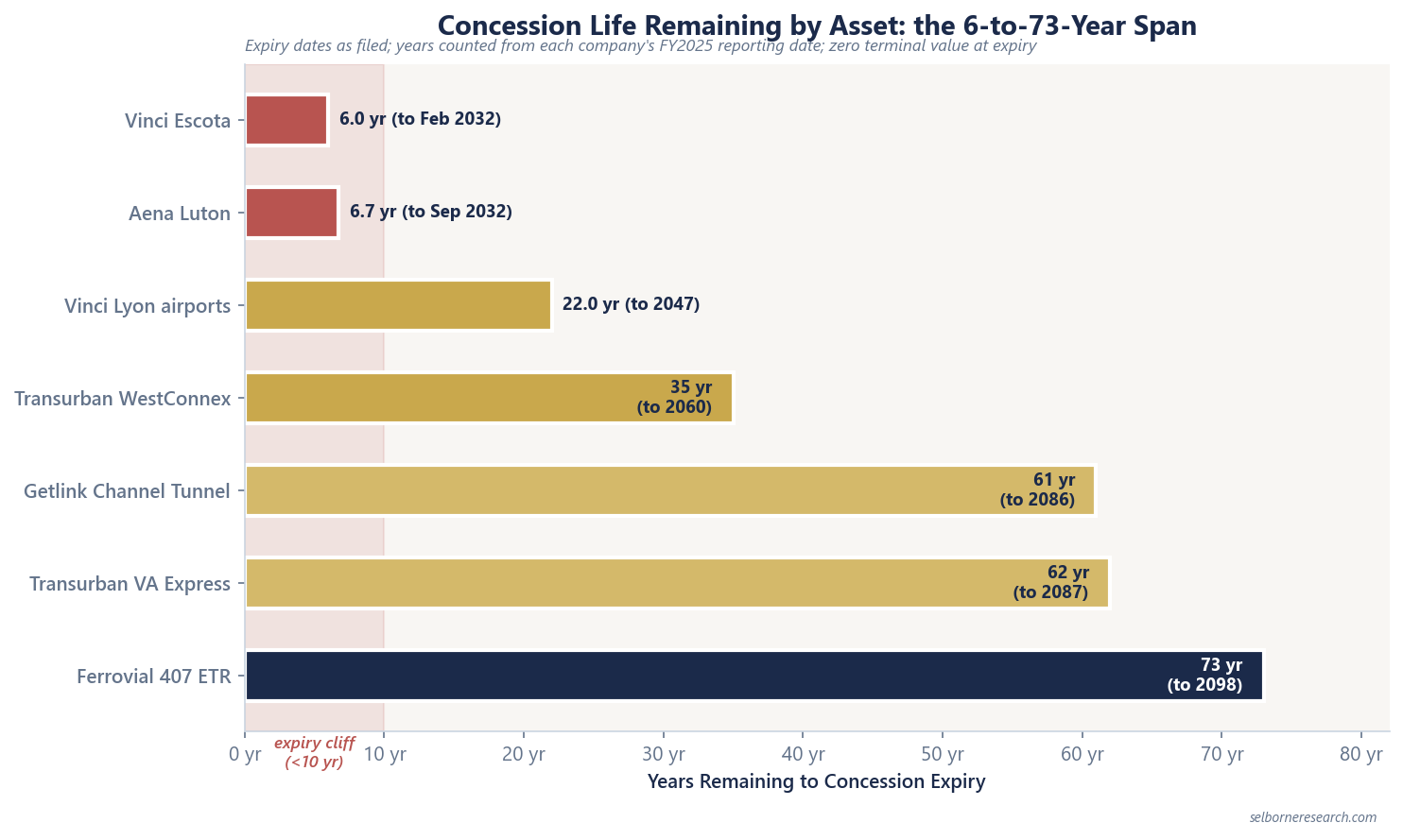
Remaining Life by Asset
| Asset | End date | ~Remaining life | Operator |
|---|---|---|---|
| Vinci Escota | Feb 2032 | ~6 years | Vinci |
| Aena London Luton | Sep 2032 | ~6.7 years | Aena (via international PPP) |
| Vinci Cofiroute | 2034 | ~9 years | Vinci |
| Vinci ASF | 2036 | ~11 years | Vinci |
| Ferrovial Dalaman Airport | 2042 | ~17 years (60% stake) | Ferrovial |
| Transurban CityLink | 2045 | ~20 years | Transurban |
| Vinci Lyon airports | 2047 | ~22 years | Vinci |
| Transurban WestConnex | 2060 | ~35 years | Transurban |
| Ferrovial DFW managed lanes | 2061-2069 | ~36-44 years | Ferrovial |
| Getlink Channel Tunnel | 2086 | ~61 years | Getlink |
| Transurban VA Express Lanes | 2087 | ~62 years | Transurban |
| Ferrovial 407 ETR | 2098 | ~73 years (99-yr term from 1999) | Ferrovial |
Full Vinci contract detail comes from URD 2023 (latest detailed schedule located); FY2025 report confirms Escota 2032 but not a full replacement table.
Short Life: Where Multiples Lie
Vinci Escota (471 km, expires Feb 2032) is the textbook expiry cliff. Mature traffic (+0.9% on Autoroutes FY2025) meets a tariff rise of +0.76% under the ≥0.70 × CPI framework. Cash flows are stable near term; legal life is not.
Mini-example (same growth/discount teaching case as the finite-life DCF guide): Year-zero EBITDA A$500m, combined EBITDA growth ~4.55%, 25% tax and 8% of revenue set aside for maintenance capex, discount 8.21% (a built nominal post-tax WACC):
| Horizon | Present value | EV/EBITDA | vs 13.0× blind screen (A$6,500m) |
|---|---|---|---|
| 6 years (short-dated) | ~A$1,785m | ~3.6× | Screen overstates by more than 3.5× |
| 30 years (mid-life urban) | ~A$6,159m | ~12.3× | Screen overstates by ~5.5% |
Short remaining life describes the contract term, separate from the asset’s health: Escota sits inside Vinci Autoroutes (71.0% segment margin), and its cash flows are solid near term. The mispricing risk is analytical: headline EV/EBITDA without a schedule.
Aena Luton (~6.7 years) adds international PPP expiry risk beside the Spanish DORA II cycle (the airport-charges regulatory period, to 2026), where no single network expiry exists. Split horizons when consolidating Aena.
Ultra-Long Life: The Opposite Error
At the other end, Ferrovial 407 ETR (to 2098, FY2025 vehicle-km +6.1%) and Getlink (~61 years, EBITDA margin 53.9%) run long enough to flip the mispricing. A 13.0× perpetuity anchor on A$500m EBITDA (A$6,500m EV) still undershoots a 73-year cash-flow stream on the same growth, discount, tax and maintenance assumptions, by ~26% (~A$8,789m illustrative present value, ~17.6× year-zero EBITDA), a far smaller gap than the short-dated overstatement above.
Ultra-long life does not eliminate traffic risk or tariff-escalator risk. 407 ETR uses uncapped dynamic tolls; Getlink rail access grows at inflation − 1.1%. Life length and cash-flow quality are separate axes.
When There Is No Expiry Cliff
Some “airport” frameworks do not end with grantor reversion on the core land. Aena’s Spanish charges reset off a regulator-approved asset base, the RAB, revalued each regulatory period rather than lapsing on a single date:
| Framework | Horizon metric | Marker |
|---|---|---|
| Aena Spain | Regulatory cycle | DORA II 2022-2026; avg RAB €9,387.1m |
| Auckland Airport | Vested land + pricing period | 1988 Order (no lapse); current price period (PSE4) to 30 Jun 2027 |
On these names, model regulatory reset risk (DORA III: Aena proposed 9% and CNMC recommended 7.4% in Jun 2026; the Council of Ministers set 8.32% pre-tax for 2027-2031 on 15 Sep 2026) rather than a zero terminal value at asset handback. The airport RAB guide covers charge mechanics; this guide covers contractual expiry on toll roads and PPP airports.
Building the Schedule in Practice
Pull the IFRIC 12 concession table from the annual report (Ferrovial IAI, Getlink press release). One row per asset: end date, remaining years, tariff type, segment margin. Run finite-life DCF to each row’s expiry; sum asset NPVs for the infrastructure equity story.
Weighted-average life is a useful summary stat, but the schedule carries the real information. Six years on Vinci’s Escota and 73 years on Ferrovial’s 407 ETR sit at opposite ends of the same six-name comp set; only the schedule shows which cash flows die first.
Transport Infrastructure Sector Primer
Concession life, traffic growth and the toll escalator feed a finite-life DCF with no terminal value, landing a concession value to weigh against the EV/EBITDA shortcut.
The Excel model is the primer's concession build live across 9 sheets: a finite-life after-tax free-cash-flow DCF with zero terminal value, a WACC build block (risk-free rate, equity risk premium, relevered beta and cost of debt), a traffic-and-tariff build, a regulated-versus-demand-risk two-mode switch, a leverage screen and a multiples cross-check. Change the remaining life, any WACC input or the traffic growth and the concession value moves; the cross-check and leverage sheets update alongside it.
Frequently Asked Questions
- What happens when a toll road concession expires?
- Under IFRIC 12 and standard contracts, infrastructure reverts to the grantor at expiry without consideration. The operator's cash flows stop at the contractual end date. A concession DCF uses zero terminal value at that date.
- Which assets in the comp set have the shortest remaining concession life?
- Near-term expiries: Vinci Escota to February 2032 (~6 years); Aena London Luton to September 2032 (~6.7 years). Vinci Cofiroute to 2034 (~9 years) and ASF to 2036 (~11 years) are also mature French networks.
- Which concessions have the longest remaining life?
- Ferrovial 407 ETR to 2098 (~73 years from a 1999 99-year term); Transurban Virginia Express Lanes to 2087 (~62 years); Getlink Channel Tunnel to 2086 (~61 years). Ultra-long life changes how misleading a perpetuity EV/EBITDA multiple can be.
- How do airports differ when there is no single expiry?
- Aena's Spanish network has no single concession expiry; DORA II runs to 2026 and analysts use regulatory-cycle remaining. Auckland land is vested under the 1988 Order with no lapse date; its current price-setting period, PSE4, runs to 30 June 2027. These are regulatory horizons, not grantor reversion dates on the core asset.