Airline Fuel Costs and Hedging
A mid-cycle jet fuel price vs EIA spot; Delta Monroe refinery as operational hedge; Southwest hedge exit; European rolling books.
Educational analysis for professional use. This guide is not investment advice or a recommendation to buy or sell any security, and it is not personalised.
Fuel Is the CASM Swing Factor
Fuel decides whether an airline’s ex-fuel unit spread survives the quarter. In FY2025 fuel was 3.29¢ of Delta’s 19.31¢ cost per available seat mile (CASM), about 17%. The share rises with the jet price: at $2.85/gal in the worked example below, fuel is about a quarter of unit cost. On a large carrier a $0.50/gal move is measured in billions.
Spot vs Mid-Cycle: Two Different Numbers
Our mid-cycle jet price has sat below the market for most of the time since March 2026, so models built on it flatter airline earnings.
| Mark | Price | Use |
|---|---|---|
| Mid-cycle jet fuel | $2.85/gal | Model and worked-example input |
| WTI assumption | $70/bbl | Crude anchor the jet price is built from |
The $2.85 is WTI at $70/bbl ($1.67/gal) plus a jet crack, the price gap between jet fuel and crude, of about $1.18/gal. US Gulf Coast (USGC) jet fuel traded at $3.290/gal on 8 June 2026 and $4.354/gal on 22 September 2026 (US Energy Information Administration, EIA). Use $2.85 for through-cycle work and exchange prices to stress-test near-term earnings.
Hedging: Three Different Postures
US majors have mostly stopped hedging fuel with derivatives. European groups, Lufthansa among them, still run rolling books, which hedge a share of fuel several quarters ahead and top up as time passes. The footnote matters more than the pattern.
| Carrier / group | Posture | Detail (FY2025 / latest filed) |
|---|---|---|
| Southwest | No financial hedging | Discontinued programme 2025; no additional derivatives intended (10-K) |
| Delta | Operational hedge | Monroe Energy refinery; no broad passenger-fuel derivatives |
| Air France-KLM | Financial rolling book | 62% of FY2026 consumption hedged; policy extended 6→8 quarters from Jan 2026 |
| International Airlines Group | Financial rolling book | 62% of 2026 fuel hedged (FY2025 results, Feb 2026) |
| Ryanair | Financial rolling book | 77% of FY2026 (year to Mar 2026) jet fuel hedged at 31 Mar 2025 |
Worked Mini-Example: Fuel Sensitivity on 200bn ASMs
An illustrative large carrier, with capacity measured in available seat miles (ASMs):
| Input | Value |
|---|---|
| ASMs | 200bn |
| Fuel burn | 15 gal / 1,000 ASMs → 3.0bn gal/yr |
| Ex-fuel opex | 200bn × 13.0¢ = $26.0B |
| Total revenue | 200bn × 18.0¢ = $36.0B |
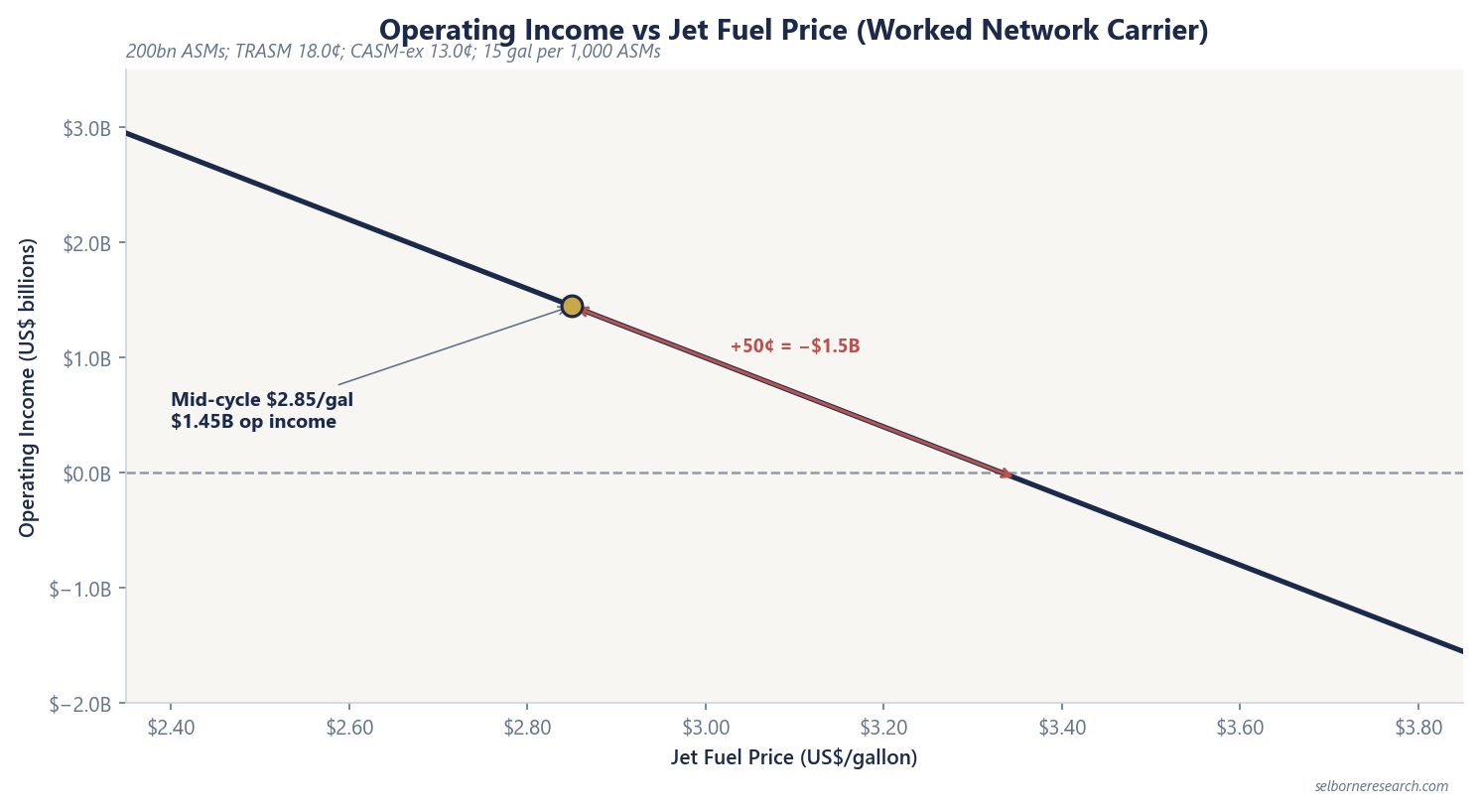
Fuel cost and operating income before other items, at four jet prices:
| Jet fuel ($/gal) | Fuel ¢/ASM | Fuel cost ($B) | Op income ($B) |
|---|---|---|---|
| $2.35 | ~3.5¢ | ~$7.1 | ~$2.9 |
| $2.85 (mid-cycle) | ~4.3¢ | ~$8.6 | ~$1.5 |
| $3.35 (+$0.50 vs plan) | ~5.0¢ | ~$10.1 | ~$0.0 |
| $3.85 | ~5.8¢ | ~$11.6 | ~−$1.6 |
A $0.50/gal rise from $2.85 to $3.35 costs 3.0bn gal × $0.50 = $1.5B, wiping out all of the ~$1.45B operating income at the mid-cycle price. That is why fuel sits beside free cash flow in the credit story: with margins this thin, a fuel spike leaves little to pay down debt.
Reading Filers on Economic Fuel Price
A carrier’s reported fuel price per gallon is all-in, so it compares with neither the exchange price nor a peer’s until you read the reconciliation table. It blends taxes, delivery, hedging gains and losses, and refinery results. Delta’s FY2025 adjusted $2.30/gal sat above the 2025 average USGC exchange price of about $2.11/gal (EIA) for that reason: the refinery’s contribution is netted inside it rather than showing as a discount.
When comparing carriers, pair ex-fuel cost with how exposed each is to the fuel price, from unhedged at Southwest to partly offset by a refinery at Delta. A European hedge ratio buys time. A rolling book spreads a price rise over several quarters but does not stop it arriving.
EBITDAR builds from a thin unit margin on seat miles, the leases are capitalised into net debt, and the value moves on what a small load-factor drop costs.
The Excel model is the primer's airline build live across 11 sheets: EBITDAR from seat miles and unit margin, leases capitalised into adjusted net debt, a through-cycle EV/EBITDAR valuation for a network carrier and a low-cost carrier, a load-factor downturn, a lease-adjusted leverage screen and a sensitivity grid. Change the unit revenue, fuel or leases and the value moves.
Frequently Asked Questions
- What jet fuel price do the worked examples use?
- Selborne models use a mid-cycle price of $2.85/gal US Gulf Coast (USGC), linked to a $70/bbl WTI assumption plus a jet crack. It has sat below exchange prices for most of the time since March 2026 (USGC jet was $4.354/gal on 22 September 2026, EIA), so it flatters modelled earnings relative to spot. Worked examples use it; stress tests should use current prices.
- Do US airlines still hedge jet fuel with derivatives?
- Largely no. Southwest discontinued its fuel-hedging programme in 2025 and stated it does not intend to add new derivatives. Delta carries no broad passenger-fuel derivatives book; it uses the Monroe Energy refinery as an operational hedge. European groups maintain rolling hedge books: Air France-KLM and IAG each reported 62% of 2026 fuel hedged in their FY2025 results.
- How much does a $0.50/gal fuel move affect a large US carrier?
- On an illustrative carrier (200bn ASMs, 15 gal per 1,000 ASMs), a $0.50/gal increase adds roughly $1.5B of fuel cost (3.0bn gallons × $0.50). That is operating income, not net income, and assumes volume and non-fuel costs are unchanged.
- What is Delta's adjusted fuel price and how does Monroe affect it?
- Delta reported an FY2025 adjusted fuel price of $2.30/gal. It is an all-in figure: taxes and delivery are in it, and so is the Monroe refinery's result, which offsets part of the fuel bill. It is not a discount to the exchange price; USGC jet averaged about $2.11/gal over 2025 (EIA). Monroe is an operational hedge, not a derivatives book.