Funded vs Unfunded Backlog in Defence
What funded and unfunded backlog mean, why appropriation is the dividing line, and a worked FY2025 example from Lockheed Martin's 10-K.
Educational analysis for professional use. This guide is not investment advice or a recommendation to buy or sell any security, and it is not personalised.
Appropriation Is the Line, Not the Contract
A defence prime’s backlog number tells you how much future revenue sits under signed contracts. It does not tell you how much of that money the customer has actually set aside to pay for it. That second question is what the funded/unfunded split answers, and it matters because a government contract can be legally binding long before Congress, or an equivalent legislature, has appropriated the cash to pay for it.
The split turns on one fact: whether the money has cleared appropriation, the final step after authorisation. Funded backlog covers firm orders where it has; unfunded backlog covers firm orders that have been awarded but are still waiting on that step. Lockheed Martin’s FY2025 10-K states the distinction plainly: backlog “includes both funded (firm orders for our products and services for which funding has been both authorized and appropriated by the customer) and unfunded (firm orders for which funding has not been appropriated) amounts.” Northrop Grumman’s own definition, quoted later on this page, applies the same authorised-and-appropriated test.
Both funded and unfunded amounts are inside total backlog. Neither is a promise the government will never keep. Unfunded backlog is not a cancelled contract or a soft order; it is real, government-committed work waiting on the next appropriation cycle to release the cash.
What Sits Outside Backlog Altogether
Backlog is not the largest number a defence contractor can point to. Above it sits a separate, larger pool: contract options that have not been exercised, and ceilings under indefinite-delivery, indefinite-quantity (IDIQ) vehicles that have not yet generated an actual task order. Every filer that defines backlog excludes this pool by name, and General Dynamics is the one that puts a dollar figure on it.
General Dynamics’ FY2025 backlog table carries a column headed “Estimated Potential Contract Value” alongside funded, unfunded and total backlog, and reports a company-wide $60.9B in that column, on top of $118.0B in backlog. That $60.9B is not an order. It is the value of options and IDIQ ceilings the company could still be awarded, and none of it counts as backlog, funded or unfunded, until it converts into a firm order. Reading a defence prime’s growth story off backlog alone therefore understates the size of the relationship with the customer; reading it off backlog plus estimated potential contract value overstates how much of that relationship is actually locked in.
Lockheed Martin’s FY2025 Backlog, Worked
Lockheed Martin’s 10-K gives the cleanest single example of the mechanics. At 31 December 2025, the company reported funded backlog of $120.2B against total backlog of $193.6B.
| Item | FY2025 value | Basis |
|---|---|---|
| Total backlog | $193.6B | Filed, 10-K |
| Funded backlog | $120.2B | Filed, 10-K |
| Unfunded backlog | $73.4B | Arithmetic: $193.6B minus $120.2B |
| Funded share | 62% | Arithmetic: $120.2B / $193.6B |
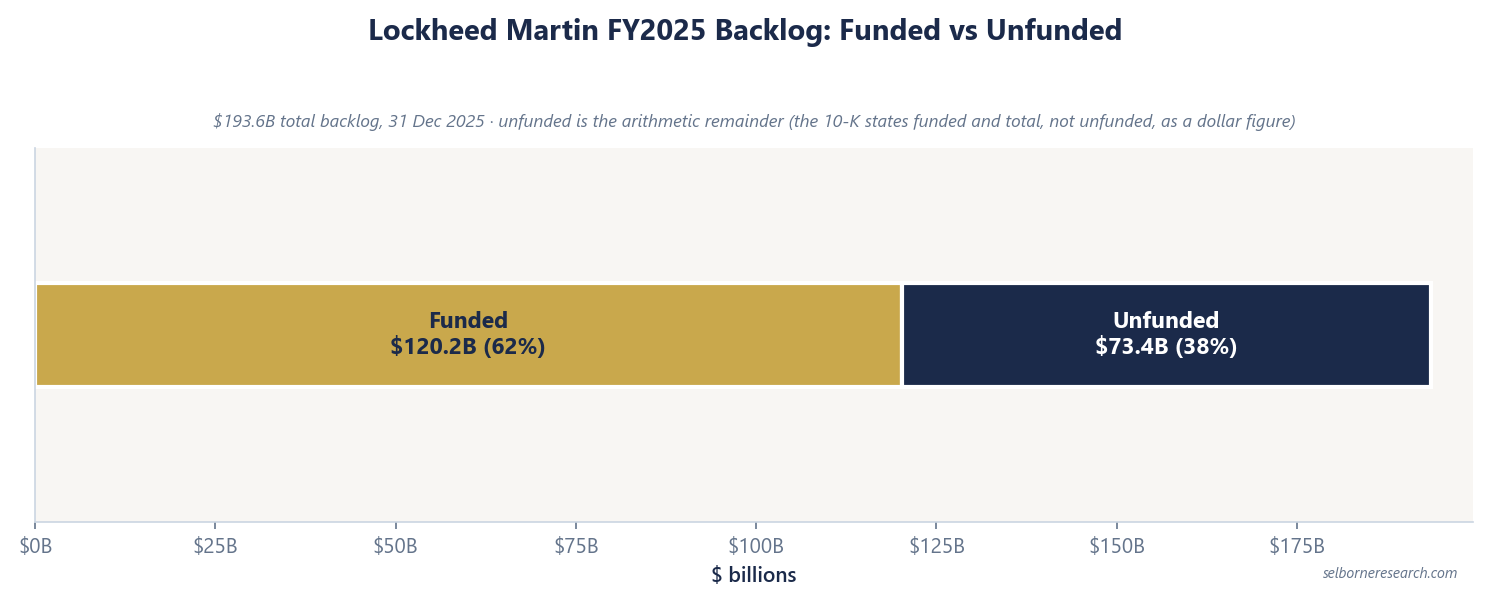
Notice what the 10-K states directly and what it does not: total backlog and funded backlog are both filed figures, but unfunded backlog never gets its own line. The $73.4B only exists once you subtract one filed number from the other, so every mention of “Lockheed’s unfunded backlog” is describing a number the company never actually published.
Same Word, Different Definitions Across Filers
Funded and unfunded sound like a single, portable standard. They are not. Each filer that uses the terms defines them slightly differently, and one filer has abandoned the framing entirely.
| Filer | Own definition (quoted) |
|---|---|
| Lockheed Martin | ”Funded (firm orders for our products and services for which funding has been both authorized and appropriated by the customer) and unfunded (firm orders for which funding has not been appropriated) amounts.” |
| Northrop Grumman | ”Funded backlog (firm orders for which funding is authorized and appropriated) and unfunded backlog.” |
| General Dynamics (defence segments) | “The funded portion of total backlog includes items that have been authorized and appropriated by the Congress and funded by customers, as well as commitments by international customers that are approved and funded similarly by their governments.” |
| BAE Systems | ”Unfunded orders include the elements of US multi-year contracts for which funding has not been authorised by the customer.” |
The Lockheed Martin and Northrop Grumman definitions are close to identical, which is what makes their funded shares directly comparable: Northrop Grumman’s FY2025 funded backlog was $43.5B of $95.7B total, a 45.5% funded share, well below Lockheed Martin’s 62%. That gap is real. It reflects where each company’s contracts sit in the appropriation cycle in a given year; it says nothing about which backlog is worth more.
General Dynamics complicates a straight comparison because it runs two different definitions inside one company. Its defence segments use the same authorised-and-appropriated test as Lockheed Martin and Northrop Grumman. Its Aerospace segment, which is mostly Gulfstream business jets, uses a different one entirely: “Aerospace funded backlog represents primarily new aircraft orders for which we have definitive purchase contracts and deposits from customers. Unfunded backlog consists of agreements to provide future aircraft maintenance and support services.” That is a commercial deposits-and-contracts test, nothing to do with government appropriation. General Dynamics’ company-wide FY2025 backlog table shows $93.5B funded against $24.5B unfunded, a 79.2% funded share, but that figure blends a government appropriation definition with a commercial one and should not be read against Lockheed Martin’s or Northrop Grumman’s pure-defence figures above.
BAE Systems’ £83.6bn Group order backlog includes an unfunded line of only £5.6bn, a funded share above 93%. The gap to its American peers is definitional rather than a sign of more secure contracts: BAE’s “unfunded” covers only the elements of US multi-year contracts awaiting authorisation, and says nothing about the appropriation status of BAE’s UK, European or Saudi government work. A narrower definition of unfunded mechanically produces a higher funded share. It does not, on its own, make the backlog behind it stronger.
RTX does not draw a funded/unfunded line at all. Its FY2025 10-K defines backlog as “equivalent to our remaining performance obligations (RPO) for our sales contracts,” reported by commercial versus defence market rather than by funding status. That is not an oversight. Nearly half of RTX’s business is commercial aerospace, where government appropriation has no bearing on whether the money will show up, so a funded/unfunded split built for government contracting does not map cleanly onto the rest of RTX’s book.
Reading Funded Share in a Model
A low funded share is not a weak backlog. It is a backlog that is further back in the appropriation queue. That changes the timing of when the revenue is likely to convert; it does not change whether the revenue arrives at all. Unfunded backlog isn’t idle. It is contracted work waiting for the next appropriation, which arrives on a predictable annual or multi-year budget cycle. The budget and demand-cycle guide covers how that timing moves with the wider defence budget.
The practical rule for a model: use total backlog to size the revenue opportunity, and use the funded share to read how much of that opportunity is already past the appropriation gate. The gate changes timing. It doesn’t shrink the opportunity.
Where This Goes Wrong
Ranking funded share across filers as though it were one measurement is the error that shows up most often. It isn’t one measurement: General Dynamics blends a commercial-and-government figure, BAE narrows its unfunded definition to US multi-year contracts only, and both end up sitting in the same column as Lockheed Martin’s and Northrop Grumman’s pure appropriation-status figures.
RTX’s absence from that comparison isn’t a data gap to fill in. The company has already explained, in its own definition, why the funded/unfunded split doesn’t apply to most of its backlog.
A company’s “unfunded backlog” is rarely a number it chose to publish. Lockheed Martin’s is the arithmetic remainder of two figures it did file, and any unfunded figure a filer doesn’t state directly should get the same scepticism.
Funded backlog and FCF conversion are the inputs. This primer takes them to a ten-year cash-flow value and an FCF yield you can screen.
The Excel model is the primer's two archetype builds live across 11 sheets: a ten-year, backlog-driven free-cash-flow DCF with a Gordon terminal. Change the book-to-bill, the FCF conversion ratio or the WACC and the value per share moves; the backlog, conversion-bridge and concentration sheets update alongside it.
Frequently Asked Questions
- What is the difference between funded and unfunded backlog?
- Funded backlog is the value of firm contract work for which the customer has both authorised and appropriated the money. Unfunded backlog is firm contract work that has been awarded but not yet appropriated. Both sit inside total backlog; the difference is only whether the cash has cleared the budget process yet.
- Why doesn’t RTX report a funded backlog figure?
- RTX defines backlog as its remaining performance obligations under ASC 606, the US accounting standard for revenue recognition, and splits it by commercial versus defence market instead of funded versus unfunded. Nearly half of RTX’s business is commercial aerospace, where government appropriation is not the relevant distinction, so the funded/unfunded split that the pure-defence primes use does not map onto most of RTX’s book.
- Why is Northrop Grumman’s funded share so much lower than Lockheed Martin’s?
- Both figures come from each company’s own segment disclosure and use the same authorised-and-appropriated definition, so the gap is real: a difference in contract mix and timing rather than a data error. It reflects how far each company’s programmes are through the appropriation cycle in a given year, no more than that.
- Are contract options and IDIQ ceilings part of backlog?
- No. Every filer that defines backlog explicitly excludes unexercised options and indefinite-delivery, indefinite-quantity (IDIQ) ceilings until they are actually exercised or awarded. General Dynamics quantifies that excluded pool separately as “estimated potential contract value”; most other filers describe the exclusion but do not put a number on it.