The Insurance Engine: Athene and Global Atlantic
How Apollo Athene and KKR Global Atlantic reshaped alternative manager economics, origination on insurance balance sheets versus traditional AM fees.
Educational analysis for professional use. This guide is not investment advice or a recommendation to buy or sell any security, and it is not personalised.
Insurance Adds Duration and Imports Credit Risk
The largest alternative managers stopped being pure fee businesses when they put insurance balance sheets inside the corporate structure. Apollo/Athene (merger completed 2021) and KKR/Global Atlantic (100% ownership effective January 2024) originate credit and place the yield on indefinite-duration capital rather than routing every asset through a drawdown fund.
Insurance adds two things: duration, meaning capital that never comes back on a fund calendar, and spread economics, the gap between what the assets earn and what the firm has promised its policyholders. It imports credit risk, regulatory capital and rating-agency scrutiny that traditional asset managers avoid entirely.
It also changes what you are reading. Come to Apollo expecting an asset manager and roughly half its headline earnings turn out to come from an annuity book, with the credit risk that implies. The figures below will not line up against a pure manager’s until you have separated the two.
Apollo/Athene: Captive Origination
Apollo merged with Athene to create a closed loop: Apollo originates private credit and structured assets; Athene’s retirement services balance sheet absorbs them. Pre-merger, Marc Rowan stated on the Mar 2021 merger call that Athene represented ~40% of Apollo AUM and ~30% of FRE revenue.
Post-merger, the fee engine is only one part of what Apollo reports:
| Apollo FY2025 segment | Amount | Role |
|---|---|---|
| FRE (asset management) | $2.5B | Recurring AM fees |
| Adjusted Net Income (headline) | $5.2B | FRE + SRE + PII + interest/taxes |
| Perpetual-capital AUM | $536B (57% of $938B total) | Duration-backed fee and spread base |
Apollo renamed distributable earnings to Adjusted Net Income in May 2022; Spread Related Earnings (SRE) captures Athene retirement services spread. SRE is not FRE, but it is recurring relative to carry realisations.
The Rowan Economics Example
On the merger call, Marc Rowan compared economics on $100M of yielding assets:
| Channel | Economics on $100M |
|---|---|
| Traditional AM (fee only) | ~$1M management fee |
| Insurance balance sheet | ~$1.8M fee-like + ~$4.8M cash-on-cash spread |
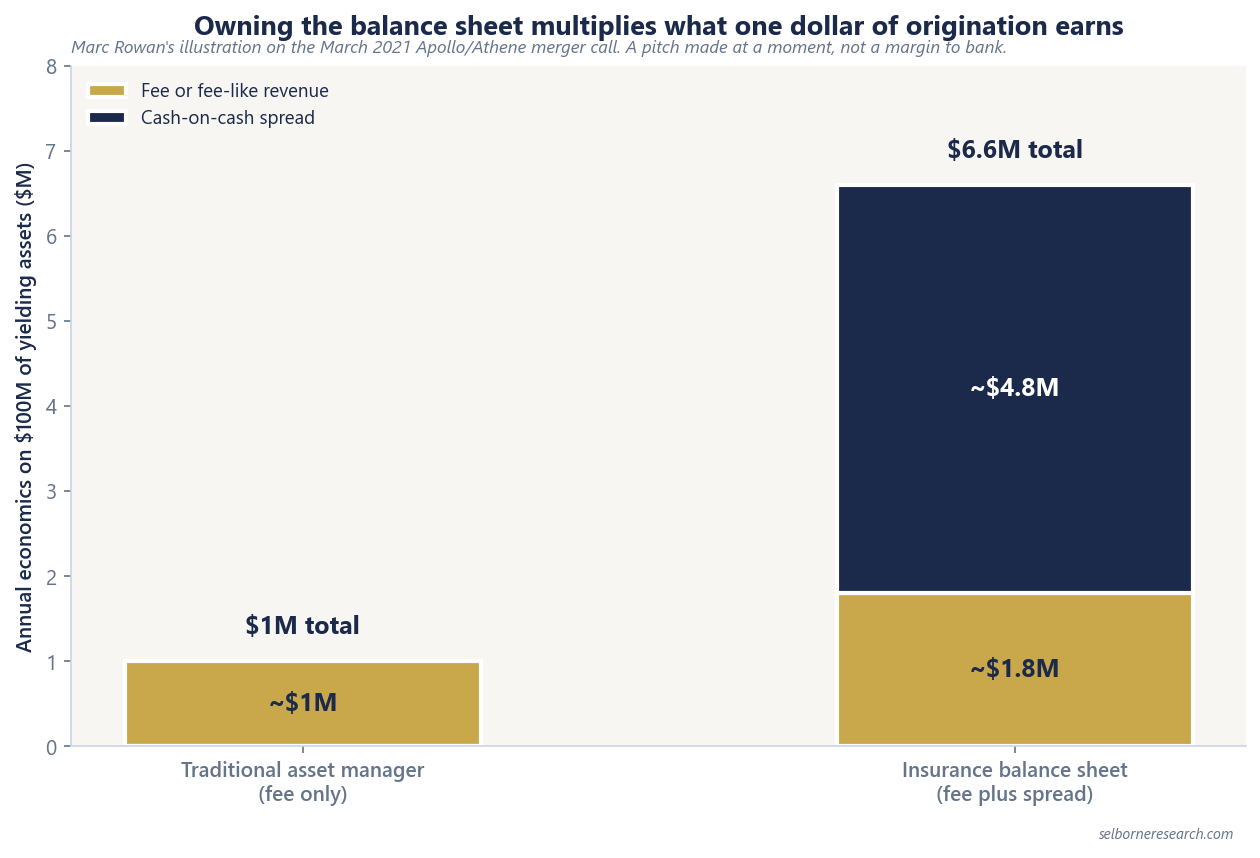
That is $6.6M against $1M on the same $100M, more than six times the fee-only economics, per Rowan in March 2021. The insurance channel earns a fee and the net spread on assets held to match long-duration liabilities. The traditional channel earns the fee and nothing else.
Treat those figures as a pitch made at a moment, not as a margin you can bank. Spread compresses when crediting rates rise or asset yields fall, regulatory capital limits how fast the balance sheet can grow, and the extra return is being paid for by taking credit risk the fee channel never touches. The direction of the argument is what survives: the same origination is worth several times more to the firm that owns the balance sheet it lands on.
KKR/Global Atlantic: Insurance Inside Perpetual Capital
KKR acquired full ownership of Global Atlantic effective January 2024. Global Atlantic sits inside KKR’s perpetual capital bucket, not as a standalone segment in AUM headlines.
Perpetual-capital growth:
| Metric | Amount | As-of |
|---|---|---|
| KKR perpetual capital | $268B (+20% YoY) | 31 Dec 2024 |
| Global Atlantic AUM | $191B | Q4 2024 |
| KKR perpetual capital | $321B (43% of AUM; 51% of FPAUM) | 31 Dec 2025 |
The Dec 2024 earnings release attributed perpetual-capital growth primarily to Global Atlantic organic growth. Insurance is now embedded in KKR TOE ($5.0B FY2025), which includes insurance operating earnings alongside FRE.
KKR’s Feb 2025 investor presentation defines perpetual capital as indefinite-term vehicles including registered funds, unregistered permanent vehicles, listed companies, and insurance companies. Global Atlantic is perpetual capital by construction, not by marketing label.
What Insurance Adds vs What It Imports
Insurance balance sheets bring indefinite-duration capital (no fund wind-down), spread earnings beyond management fees (SRE at Apollo; insurance OE at KKR), and captive distribution for originated credit at scale. Those features support the perpetual-capital premium in valuation (see our AUM and perpetual capital guide).
They also import credit underwriting risk on the balance sheet, regulatory capital and rating-agency constraints, and interest-rate sensitivity on spread (crediting rates versus asset yields). Earnings comparability gets harder: ANI and TOE are not Blackstone DE.
Where the Insurance Earnings Actually Show Up
Apollo’s FY2025 numbers make the split visible. Headline Adjusted Net Income was $5.2B. Fee-related earnings, the asset-management engine, were $2.5B. The $2.7B in between is mostly Athene’s spread earnings plus principal investing income, struck after interest and tax, and it is more than half the headline.
That gap is the thing to hold on to, because it breaks the sector’s standard multiple. P/FRE divides a whole-firm market capitalisation, which prices Athene, by an asset-management-only earnings figure, which does not include it. Apollo’s ~33.2× at Jun 2026 is therefore not comparable, dollar for dollar, with the ~13.1× of a manager that owns no balance sheet. Some of Apollo’s premium is real, but part of the gap is a denominator that covers less of the company than the numerator does. KKR has a milder version of the same problem: $3.7B of FRE inside $5.0B of total operating earnings.
The clean way to handle it is to stop trying to fix the multiple and value the two engines separately, taking a fee multiple on FRE and something closer to an insurance valuation, on book value and return on equity, for the annuity book.
Valuation Implications
Insurance-augmented managers screen in the top P/FRE band (25–35×). As of Jun 2026:
| Company | P/FRE | Perpetual share | Insurance engine |
|---|---|---|---|
| Apollo | ~33.2× | 57% of total AUM | Athene (SRE) |
| Brookfield AM | ~25.6× | 87% of fee-bearing capital | None; real assets |
| KKR | ~23.2× | 43% of AUM, 51% of FPAUM | Global Atlantic (maturing) |
Brookfield is in that table as the control. It reaches the same band with no insurance at all, on duration alone, which is the evidence that the premium here is being paid for permanence rather than for owning an annuity writer.
Apollo carries the highest multiple in the set, and two things are running together in it. The Athene engine is mature and scaled, which is a genuine reason to pay up. The multiple is also flattered by the denominator, as above. KKR sits lower with insurance that is still bedding in. See our alternative manager valuation guide for the full comp ladder.
Credit-Cycle Framing
A spread business lives on the difference between what its assets yield and what it has promised policyholders, so both legs need watching and they do not move together. Crediting rates on annuities reset with competition and with short rates; asset yields reset only as the portfolio turns over, which on a long-duration book takes years. A firm can therefore be squeezed from the liability side long before anything goes wrong with its investments. Our own framing runs off mid-cycle anchors rather than the spot curve, currently a 3.00% policy rate, a 4.50% ten-year and 150 basis points of BBB credit spread.
Origination on insurance balance sheets accelerates when banks retreat from lending, which is most of the story of the last few years. But defaults and spread compression flow straight into these earnings, and there is no fund investor to share the loss with. The insurance engine multiplies the economics of origination in both directions.
For stock-level ANI/SRE decomposition and perpetual-capital detail, see our Apollo Global Management and KKR profiles.
What Matters Most
Apollo/Athene and KKR/Global Atlantic turned insurance balance sheets into permanent capital and origination channels, and Rowan’s arithmetic on the same $100M of assets explains why the rest of the sector copied it. What the reader should carry away is narrower than the strategy. These firms report a fee number and a headline number, and the space between them is an insurance company. Value it as one, or leave it out and say so, but do not run a fee multiple across the pair and call the answer a premium for quality.
Alternative Asset Managers Primer
Spread earnings sit outside FRE, so a fee multiple misses them. The primer carries them into a per-share sum-of-the-parts.
The Excel model is the primer's two worked valuations live across 12 sheets: change fee-paying AUM, FRE margin or the fundraising rate and the valuation moves. It holds two company slots, one per worked case, not a full peer table.
Frequently Asked Questions
- What is Apollo Athene insurance engine model?
- Apollo merged with Athene (completed 2021) to create a captive origination channel: Apollo originates credit and places yield on Athene retirement services balance sheet. Pre-merger, Athene represented ~40% of Apollo AUM and ~30% of FRE revenue (Marc Rowan, Mar 2021 merger call). Post-merger, Apollo reports Spread Related Earnings (SRE) alongside FRE and Principal Investing Income in Adjusted Net Income.
- How do insurance balance sheets change alternative manager economics?
- Marc Rowan illustrated on the March 2021 merger call that $100M of yielding assets generates roughly $1M in traditional asset-management fees, against roughly $1.8M plus $4.8M cash-on-cash on an insurance balance sheet: $6.6M against $1M, more than six times, on the same origination. Insurance adds duration, because the capital never comes back on a fund calendar, and it adds a spread on top of the fee. It imports credit risk, regulatory capital requirements and rating-agency scrutiny, and the extra return is the payment for taking them on.
- Where does KKR Global Atlantic sit in KKR reporting?
- KKR completed 100% ownership of Global Atlantic effective January 2024. Global Atlantic sits inside KKR perpetual capital ($321B end-FY2025, 43% of total AUM). Perpetual capital was $268B at 31 Dec 2024 (+20% YoY), driven primarily by Global Atlantic organic growth; GA AUM was $191B Q4 2024.
- Why do insurance-augmented managers trade at higher P/FRE?
- Partly for a good reason and partly for a mechanical one. The good reason is that an insurance balance sheet is capital that never has to be re-raised, and it gives the credit business a guaranteed home for what it originates. The mechanical one is that P/FRE divides a whole-firm market capitalisation by asset-management-only fee earnings, so any spread earnings the market is paying for inflate the multiple without appearing in the denominator. Apollo screens at ~33.2× at Jun 2026 with $2.5B of FRE inside a $5.2B headline; KKR at ~23.2× has $3.7B of FRE inside $5.0B of total operating earnings. Brookfield reaches ~25.6× on duration alone, with no insurance at all.