Net Accrued Carry: Valuing the Carry Receivable
What net accrued carry is, how it accrues against fund NAV, why it reverses with markets, and how much of the balance to credit in a valuation.
Educational analysis for professional use. This guide is not investment advice or a recommendation to buy or sell any security, and it is not personalised.
A Receivable for Money Nobody Has Paid Yet
Net accrued carry is the performance fee a manager has earned on paper and has not collected. It sits on the balance sheet as a receivable, and it can go backwards.
The mechanism is simple once you see it. At each reporting date the manager marks every carry-eligible fund to its net asset value, then runs that fund’s waterfall as though it liquidated at that value on the day. Whatever the general partner would be owed in that hypothetical liquidation is accrued. No investment has been sold, no cash has moved, and the LP agreement has not been triggered. The accounting simply recognises a claim that has come into existence because the portfolio is worth more than the hurdle requires.
Our carried interest guide covers the waterfall itself: return of capital, preferred return, catch-up, split. This page picks the story up one step later, at the balance-sheet line that waterfall produces and what an analyst should pay for it.
What “Net” Strips Out
The word doing the work is net: net of the carry owed onward to the people who sourced and ran the deals.
Carry earned at fund level is not all the manager’s to keep. Deal teams, investment professionals and in some structures the parent company hold contractual slices of it. Gross accrued carry is the fund-level figure; net accrued carry is what survives those allocations and belongs to shareholders. The gap is not a rounding difference, and it is not disclosed consistently.
| Company | End-FY2025 balance | Label as filed |
|---|---|---|
| KKR | $10.2B | Gross unrealised performance income |
| Blackstone | $6.7B | Net accrued performance revenues |
| Carlyle | $2.9B | Net accrued performance revenues |
| Apollo | $1.84B | Net accrued performance fee receivable |
| Brookfield AM | $1.3B | Accrued unrealised carried interest, net of Brookfield Corporation’s share |
| Ares | $1.1B | Unconsolidated ($1.0B GAAP) |
KKR’s $10.2B is the largest number in that column and it is not the largest shareholder claim in the column, because it is measured before compensation. Lining it up against Blackstone’s $6.7B without the footnote produces a ranking that is simply wrong. Brookfield adds a second wrinkle: its figure is already net of the share attributable to Brookfield Corporation, so the label is doing more than the usual employee adjustment.
Read the label, then compare. Never the other way round.
It Is a Mark, So It Moves Like One
The line swings with markets because it is recomputed against fund NAV every period, and NAV is where private-market valuations land.
That has two consequences an analyst should hold on to. First, the balance can rise sharply in a strong year without a single exit, which flatters anyone who reads it as earnings power. Second, it can reverse: if marks fall, funds slide back towards their hurdles and previously accrued carry is reduced, again with nothing sold. In an extreme case where carry has already been paid out in cash on early winners and later losses drag the fund back below its hurdle, LP agreements generally require the manager to hand money back. That clawback risk is a legal contingency rather than a line item, and the carried interest guide covers how it works.
So accrued carry is directional, unrealised and reversible. It is also, in a normal year, one of the larger assets on an alternative manager’s balance sheet. Both things are true, which is exactly why the valuation treatment is contested.
The Haircut Question
This is the decision that actually confronts you: face value, zero, or something in between.
Face value is wrong. The balance is a mark on illiquid assets, it converts to cash only on the manager’s realisation timetable, tax comes out on the way, and the whole thing can shrink if marks soften. Zero is also wrong, and more common than it should be among analysts who have been burned once. Carry balances of this size do not evaporate; they get realised, slowly and lumpily, across a fund’s harvest years, and a manager sitting on years of accrued claims has real value that the fee multiple does not capture.
Our sector model credits roughly 70% of the reported net balance and adds it to the fee-related earnings valuation as a separate block, alongside balance-sheet net cash. The reasoning behind that number matters more than the number:
- Timing. Realisation is years out and discounting alone justifies a meaningful reduction before you have made any judgement about the assets.
- Reversal. Marks can fall. A haircut is the cheapest way to express that the balance is an estimate, not a contract receivable with a due date.
- Tax and leakage. The cash that reaches shareholders is smaller than the accrued figure.
- Netting across funds. Carry is computed fund by fund; a strong fund’s accrual is not offset by a weak fund’s shortfall, so the reported total is a sum of favourable cases.
Move the haircut with the evidence. A manager whose accruals sit in mature funds already in their harvest window, with a recent realisation record, deserves better than 70%. A manager whose balance is concentrated in young funds marked up in one strong vintage deserves worse. What you should not do is apply 70% and stop thinking, and what you really should not do is skip the split.
Why It Never Belongs Inside the Fee Multiple
Blending carry into fee-related earnings and capitalising the total at one multiple is the classic error in this sector. The two things have nothing in common: fees are an annuity on committed capital, carry is an option on portfolio outcomes. Put the volatile piece through the multiple built for the stable piece and you over-value it every time.
The house construction keeps them apart:
Equity value = FRE value + (net accrued carry × haircut) + balance-sheet net cash
The fee block is where the multiple lives, and it is where most of the value sits: in our template managers, fee-related earnings account for roughly 82% to 89% of equity value. Carry is the tail, sized separately. Our valuation guide covers the fee side and the P/FRE bands; the FRE versus DE guide covers how carry re-enters the income statement as realisations.
How Much of a Manager This Line Can Be
Run the 70% credit across the FY2025 balances against Jun 2026 market caps and the dispersion is the point.
| Company | Net accrued carry (end-FY2025) | Credited at 70% | Jun 2026 market cap | Credited carry as % of cap |
|---|---|---|---|---|
| Carlyle | $2.9B | ~$2.0B | ~$16.2B | ~12.5% |
| Blackstone | $6.7B | ~$4.7B | ~$147.2B | ~3.2% |
| Ares | $1.1B | ~$0.8B | ~$45.0B | ~1.7% |
| Apollo | $1.84B | ~$1.3B | ~$83.8B | ~1.5% |
| Brookfield AM | $1.3B | ~$0.9B | ~$76.7B | ~1.2% |
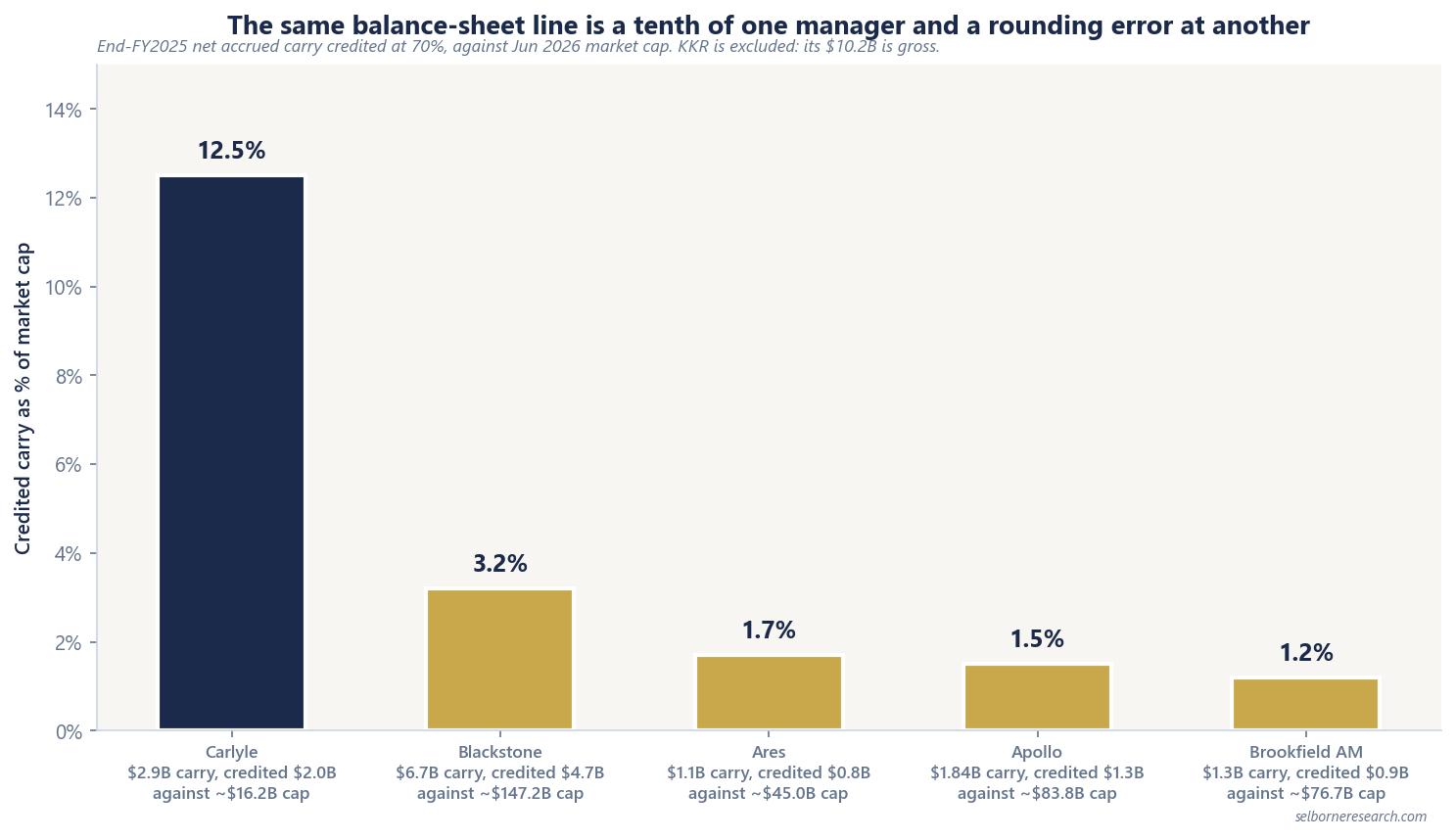
KKR is deliberately absent. Its $10.2B is gross, so haircutting it on the same basis would compare a pre-compensation figure with five post-compensation ones.
Carlyle is the case worth sitting with. Its accrued balance is $2.9B against $1.2B of FY2025 fee-related earnings, so more than two years of the recurring engine is parked in a line that pays nothing until exits happen, and the stock trades at the bottom of the peer range on ~13.1× P/FRE. Blackstone’s $6.7B is more than twice the size in absolute terms and barely moves the needle on a ~$147.2B capitalisation. Same balance-sheet line, entirely different weight in the investment case.
Market caps use the share count each filer divides its own per-share earnings by, priced at the 10 Jun 2026 close; the carry balances are end-FY2025 as filed. Both will have moved. The ratio, and what it tells you about where a manager’s value is sitting, is the part that keeps.
Reading the Line in Practice
Take the balance from the filing with its label attached, size it against fee-related earnings rather than against other managers’ carry, then ask what would have to happen for it to convert. Fund vintages and realisation history answer that better than the balance itself does.
For issuer-level carry balances and realisation history, see our Blackstone, KKR and Carlyle Group profiles.
The reflex to resist is treating a rising carry balance as good news on its own. It usually means marks went up, which you could have observed elsewhere, and it tells you nothing about whether anyone will pay for those marks.
Alternative Asset Managers Primer
Accrued carry moves with fund marks and reverses without a sale. The primer credits it at a haircut inside a sum-of-the-parts.
The Excel model is the primer's two worked valuations live across 12 sheets: change fee-paying AUM, FRE margin or the fundraising rate and the valuation moves. It holds two company slots, one per worked case, not a full peer table.
Frequently Asked Questions
- What is net accrued carry?
- Net accrued carry (net accrued performance revenues) is the carried interest a manager has earned on paper but has not yet collected in cash. Each fund is marked to its current net asset value, the waterfall is run as if the fund liquidated at that value today, and the general partner's resulting share is accrued as a receivable on the balance sheet. It converts to cash only when the underlying investments are actually sold, and it reverses if fund values fall.
- What does the "net" in net accrued carry mean?
- Net means after the share of carry owed to deal teams and other employees under compensation arrangements. Gross carry is the fund-level number before those allocations. The distinction is large enough to break cross-company comparisons: at end-FY2025 Blackstone reported $6.7B of net accrued performance revenues while KKR reported $10.2B of gross unrealised performance income. Check the label before ranking any two managers.
- Should you haircut accrued carry in a valuation?
- Yes, but not to zero. The balance is real, contractual and often years in the making, so writing it off understates the manager; crediting it in full ignores that it is unrealised, reversible with markets, taxed on realisation and payable only on the manager's own timetable. Our sector model credits roughly 70% of the reported net balance and values it separately from fee-related earnings rather than folding it into one multiple.
- Why does accrued carry move so much between quarters?
- Because it is a mark, not a cash flow. The balance is recomputed each period against fund net asset values, so a drop in portfolio marks pulls funds back below their hurdles and reverses accrued carry that was previously recognised. Nothing has to be sold for the line to fall. That is why it belongs outside the recurring fee engine when you value the business.