EV/GEO and $/GEO: Judging Royalty Deal Value
Learn how EV per GEO and implied value per GEO help assess royalty and streaming companies, acquisitions and peer valuations.
Educational analysis for professional use. This guide is not investment advice or a recommendation to buy or sell any security, and it is not personalised.
Use EV/GEO for Accretion, Not Ranking
EV/GEO answers one question well: did a company just buy ounces more cheaply than the ounces the market already credits it with? Enterprise value divided by annual gold-equivalent ounces gives you the price the market puts on each ounce of attributable production. Compare that with the implied $/GEO of a new deal and you have a fast accretion screen.
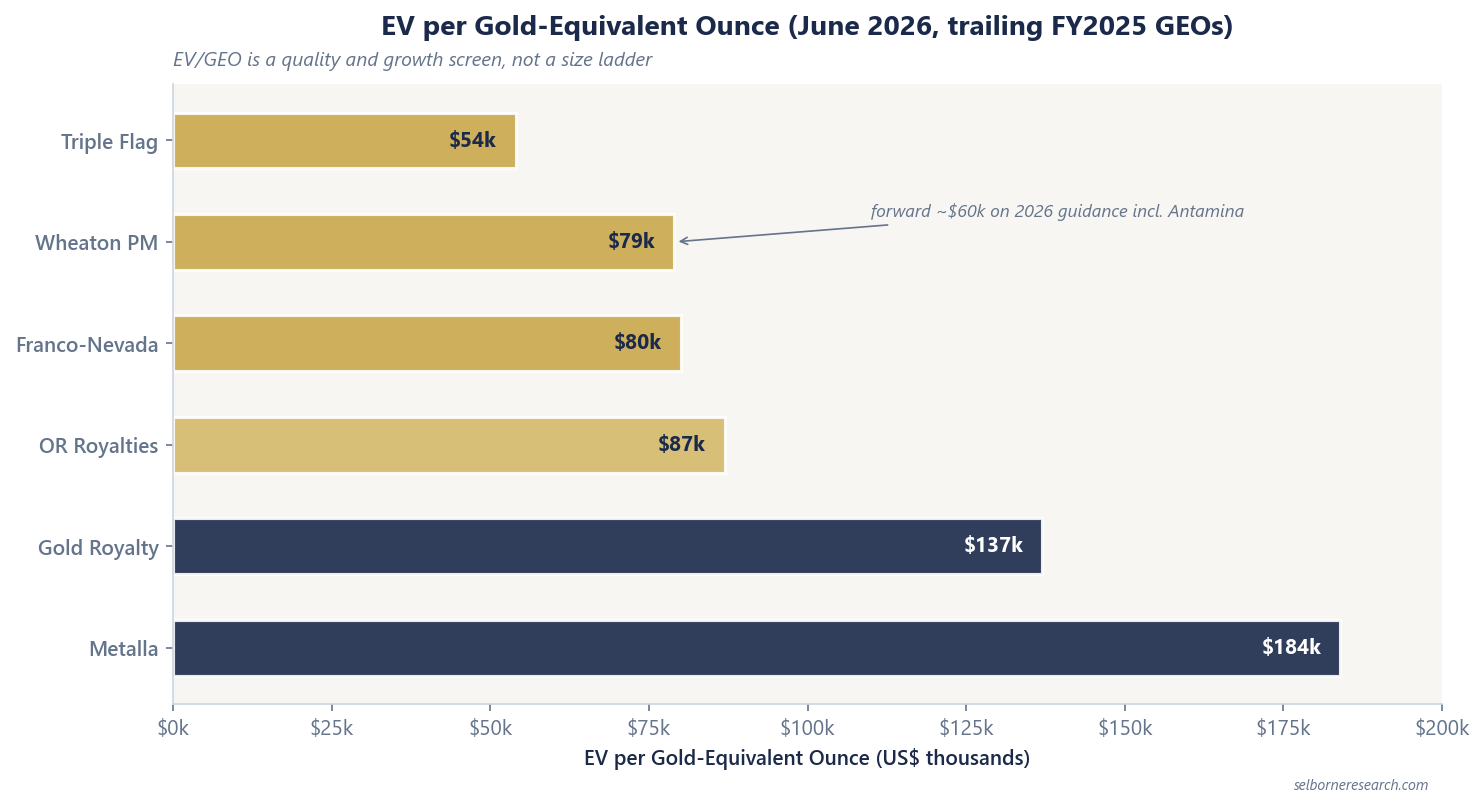
What EV/GEO does not do is rank companies by size. The conventional rule of thumb is a tier ladder, seniors at $50-100k per GEO, mid-caps at $35-60k, juniors at $15-35k. The June 2026 data refute it outright. The two largest names in the sector sit around $75-80k per trailing GEO, one mid-cap trades above them, and the juniors, supposedly the cheap end, screen at $137-184k. If you use EV/GEO as a “where should this company trade” band, the market will look permanently wrong to you. It isn’t. The multiple is carrying information about growth and portfolio quality, not size.
What EV/GEO Actually Measures
EV/GEO is enterprise value (market capitalisation plus debt, less cash) divided by annual attributable gold-equivalent ounces. Because GEOs normalise silver, copper, and PGM revenue into gold terms, the metric works across portfolios with very different metal mixes.
Three things move the answer before you compare anything:
The denominator vintage. Trailing GEOs and forward guidance can be a long way apart. Wheaton produced 689,864 GEOs in FY2025, but its 2026 guidance is 860,000-940,000, including roughly 70,000 incremental ounces from the Antamina stream that completed on 1 April 2026. On the trailing base Wheaton screens at ~$79k per GEO; on the 2026 guidance midpoint, with the Antamina debt in the numerator and the Antamina ounces finally in the denominator, it drops to roughly $60k. Same company, same day, a 25% cheaper multiple. Always state which denominator you are using.
The conversion prices behind the ounces. A GEO is not a physical unit. It is non-gold revenue restated at whatever gold and silver prices the company chose, so the denominator moves when those prices move. At Selborne’s planning deck of $3,500 gold and $48 silver, one GEO is about 73 ounces of silver; at Wheaton’s 2026 guidance prices of $4,800 and $80 it is 60. The same physical silver converts into roughly a fifth more ounces on the second deck, and the multiple falls with it. That is the metric’s central weakness: two companies converting at different prices are not measured on the same ruler.
What EV includes. Wheaton funded Antamina with cash on hand, a new $1.5B term loan and a draw on its revolver, leaving about $2.1B of pro forma net debt, so its enterprise value ($54.2B) runs ahead of its market cap ($52.1B). Franco-Nevada is debt-free, so cap and EV are close to interchangeable. Miss the debt and you flatter the acquirer.
Where the Peers Trade (9 June 2026)
At the 9 June 2026 close, against FY2025 GEO denominators:
| Company | Enterprise value | FY2025 GEOs | EV/GEO (trailing) |
|---|---|---|---|
| Franco-Nevada (FNV) | ~$41.5B (debt-free) | 519,106 sold | ~$80k |
| Wheaton Precious Metals (WPM) | ~$54.2B (incl. ~$2.1B pro forma Antamina net debt) | 689,864 produced | ~$79k |
| OR Royalties (OR) | ~$7.0B | 80,775 earned | ~$87k |
| Triple Flag (TFPM) | ~$6.1B | 113,237 sold | ~$54k |
| Gold Royalty (GROY) | ~$0.71B | 5,173 | ~$137k |
| Metalla (MTA) | ~$0.63B | 3,436 | ~$184k |
Market data at the 9 June 2026 close; OR Royalties’ market cap is the issuer’s own 31 March 2026 figure.
Read down the third column before the fourth. Franco-Nevada counts ounces sold, Wheaton ounces produced, OR Royalties ounces earned, and each sets its own conversion prices. The denominators are close cousins, not the same measure, so treat small gaps between neighbours as noise.
The ladder, though, is gone by more than noise. The seniors form a working band around $75-80k per trailing GEO. The mid-caps do not sit below it: they straddle it, with Triple Flag at ~$54k and OR Royalties at ~$87k, above both seniors. OR’s premium per ounce reflects what the market thinks of its portfolio duration and growth pipeline, not a mispricing of its size tier. And the juniors, on GEO bases of a few thousand ounces, trade at multiples no producing senior could ever justify.
On forward denominators the picture tightens but does not reorder much: Wheaton drops to ~$60k on its 860,000-940,000 GEO guidance, while Franco-Nevada sits near $77k on its 2026 guidance of 510,000-570,000 GEOs, a range that excludes Cobre Panama entirely.
Why Juniors Screen Highest
A trailing production multiple on a tiny GEO base mostly measures optionality. Metalla’s FY2025 GEOs were 3,436; Gold Royalty’s were 5,173. Almost all of the enterprise value at both names sits in royalties on development and exploration assets that contribute nothing to the denominator yet. So the trailing multiple looks absurd, and partly is, but the market is paying for the portfolio that exists on paper, not the ounces delivered last year.
Guidance shows the compression mechanism working. Gold Royalty guides to 7,500-9,300 GEOs for 2026, which takes its multiple from ~$137k trailing to roughly $85k forward, suddenly in senior territory. Metalla’s 3,500-4,500 GEO guidance only brings it to about $158k. The practical reading: for juniors, EV/GEO is a growth-delivery scorecard. Track whether the multiple compresses as guided ounces land. It is useless as a cheap/expensive screen against the seniors.
The Accretion Test
This is the use the metric was built for. A royalty or streaming company trades at some EV per annual GEO. When it buys a new stream, the deal has an implied price per annual GEO: upfront payment divided by annual ounces delivered. Buy below your own multiple and each acquired ounce costs less than the market pays for your existing ounces; the deal screens accretive. Buy above it and you are diluting your own per-ounce valuation.
Antamina is the live worked example. Wheaton paid $4.3B for roughly 70,000 GEOs a year, an implied ~$61k per annual GEO. Against Wheaton’s own trailing multiple of ~$79k, that is buying ounces at a discount to its own paper: accretive on the screen, even at the largest upfront payment in streaming history. The market’s verdict sits in the forward multiple, where the same enterprise value over the enlarged GEO base lands near $60k.
Two cautions before the screen becomes a recommendation. First, $/GEO ignores duration: a five-year fixed entitlement and a multi-decade stream can carry the same headline number and very different values, which is why the screen only settles anything once a full stream model has run behind it. Second, an ounce is worth only its after-tax margin. Consolidated tax rates across the sector run from about 11% to 22%, so the same gross ounce is worth roughly 14% more at the bottom of that range than at the top, and modelling any of these companies at a miner’s 30% understates NAV by 20-30%.
Why Implied $/GEO Ranges So Widely
There is no going rate for an ounce. Two streams signed in the same year can price four times apart, which is what makes a comp table of headline $/GEO numbers close to useless on its own. Three filed deals show the spread:
| Deal | Buyer | Year | Upfront | Annual GEOs | Implied $/GEO |
|---|---|---|---|---|---|
| Kurmuk gold stream | Wheaton | 2024 | $175M | ~16,000 oz/yr average (first 10 years) | ~$10.9k |
| Casa Berardi gold stream | Franco-Nevada | 2026 | $100M | 6,500 oz/yr (fixed, first 5 years) | ~$15.4k |
| Antamina silver stream | Wheaton | 2026 (completed 1 Apr) | $4.3B | ~70,000/yr | ~$61k |
Asset stage does most of the work. Kurmuk was an undeveloped project in Ethiopia when Wheaton committed in December 2024, with construction still to come and first gold not expected until 2026, so the ounces came cheap at ~$10.9k. Antamina is one of the largest operating mines in the world, already producing, and Wheaton paid nearly six times as much per ounce for it. Some of the gap is the fourteen months between the two deals, and metal prices that ran hard in between. Most of it is that one buyer took construction risk and the other did not.
Casa Berardi shows the second lever. It is a 2026 deal like Antamina, yet it sits near the bottom at ~$15.4k, because what Franco-Nevada bought is 6,500 fixed ounces a year for five years before the entitlement converts to a small percentage of production. Antamina’s runs until 100 million ounces have been delivered and then for the life of the mine. A cheap headline number is usually a short entitlement rather than a bargain. Read the term before reading the multiple.
Feeding the Screen into a Valuation
The multiple is a fast accretion check, not a valuation. It flags whether a buyer paid above or below its own per-ounce paper and whether deal pricing has shifted since the comp you are using; for juniors, watch whether the premium compresses as guided ounces land. Sum-of-parts NAV work means modelling each royalty and stream after tax and discounting it.
The Royalty & Streaming Sector Primer covers that full framework, including the deal-evaluation method that pairs implied $/GEO with IRR so a cheap-looking headline number cannot smuggle in a bad deal.
Royalty & Streaming Sector Primer
An implied value per ounce screens a deal in seconds. The primer pairs it with the IRR the deal implies.
The Excel model is the primer's two NAVs live across 10 sheets: change the gold price, delivery percentage or discount rate and the valuation moves.
Frequently Asked Questions
- What is EV/GEO and how is it calculated?
- EV/GEO is enterprise value divided by annual gold-equivalent ounces (GEOs). It tells you what the market is paying for each ounce of annual attributable production at a royalty or streaming company. As of the 9 June 2026 close, Franco-Nevada trades at roughly $80,000 per trailing GEO ($41.5B enterprise value over 519,106 FY2025 GEOs sold) and Wheaton Precious Metals at roughly $79,000 ($54.2B EV including pro forma Antamina debt, over 689,864 FY2025 GEOs produced). Because a GEO count depends on the gold and silver prices each company converts at, the denominators are not built to a common standard, which makes EV/GEO a screen rather than a ranking.
- What is a good EV/GEO multiple for a royalty company?
- There is no single good number, and the old size-tier ladder (seniors $50-100k, mid-caps $35-60k, juniors $15-35k) no longer matches the data. At the 9 June 2026 close, seniors cluster around $75-80k per trailing GEO, mid-caps span $54k (Triple Flag) to $87k (OR Royalties), and juniors on tiny GEO bases screen far higher: Gold Royalty at roughly $137k and Metalla at roughly $184k. Read EV/GEO as a quality and growth-adjusted screen, and as an accretion test against a buyer's own multiple, not as a band a company should sit in.
- How do you calculate implied $/GEO on a streaming deal?
- Divide the upfront payment by the annual GEOs the deal delivers. Wheaton's Antamina silver stream, completed 1 April 2026, paid $4.3B for roughly 70,000 GEOs a year, about $61,000 per annual GEO. Franco-Nevada's 2026 Casa Berardi stream paid $100M for 6,500 fixed ounces a year, about $15,400. The number sets up the accretion comparison against the buyer's own EV/GEO, but entitlement length, delivery price, and asset stage all sit behind it, so it is a starting screen rather than a verdict.
- Why do junior royalty companies trade at higher EV/GEO than seniors?
- Because the denominator is tiny and the market is pricing growth, not current ounces. Metalla sold 3,436 GEOs in FY2025 against an enterprise value of about $632M, roughly $184k per trailing GEO; Gold Royalty's 5,173 GEOs put it near $137k. On 2026 guidance midpoints those multiples compress to roughly $158k and $85k respectively. For a junior, most of the enterprise value sits in royalties on mines that have not yet been built, so a trailing production multiple mostly measures optionality.