Steel Spread and Metal Margin: How EAF Steelmakers Earn
Learn how the steel spread, hot-rolled coil less scrap, drives electric-arc-furnace margins and differentiates steelmakers.
Educational analysis for professional use. This guide is not investment advice or a recommendation to buy or sell any security, and it is not personalised.
The Spread Is the Business
An electric arc furnace steelmaker buys scrap, melts it with electricity, and sells hot-rolled coil (HRC), the flat sheet steel that goes on to become cars, appliances and pipe. Strip away everything else and the earnings equation is one line: price of the steel out, minus cost of the metal in, minus the cost of converting one into the other, multiplied by tons shipped.
The first two terms, HRC minus scrap, are the steel spread, also called the metal margin or metallics margin. HRC and scrap prices sit outside any single mill’s control, yet together they set whether the business makes money. Conversion costs move slowly. Volume moves with demand, but volume only multiplies the spread; it never rescues a bad one. A mill shipping 25 million tons at a $50 spread earns less than one shipping 5 million tons at a $300 spread.
This is why steel equity analysis starts with the spread, not the steel price. HRC at $1,200 with scrap at $900 is a worse business than HRC at $800 with scrap at $350.
The EAF Spread Formula
For an EAF producer the formula is direct, and quoted in US short tons because that’s how the US marks trade:
Spread ($/st) = HRC price − scrap cost
The scrap grade matters. The figure used here is shredded scrap (Midwest/Southeast); prime grades feed different mixes, and direct-reduced iron (DRI), a scrap substitute made straight from iron ore, fills the gap when scrap is scarce or too dirty for the product. Nucor is the reference case for the model: its FY2025 10-K states the steelmaking operations use EAFs for 100% of their production, fed by roughly 20 million gross tons of recycled scrap a year, with the David J. Joseph scrap business and two DRI plants (about 3.3 Mt of DRI supplied to the mills in FY2025) sitting upstream of the furnaces.
That vertical integration into metallics is not a detail. It means the input side of Nucor’s spread is partly self-supplied, which dampens the squeeze when scrap tightens.
Do Not Value on Spot: Use the Planning Spread
Spot spreads can run far above mid-cycle planning marks, and you should not value anything on them.
| Input | Planning |
|---|---|
| US Midwest HRC | $900/st |
| US shredded scrap | $375/st |
| EAF spread | $525/st |
The planning spread of $525/st is the through-cycle anchor. The gap between spot and planning is often policy, not steel demand: Section 232 tariffs sit at 50% on primary steel imports and can lift US HRC well above landed Asian coil without a matching scrap move. Capitalising an inflated spot spread means capitalising a trade measure that can be amended by proclamation.
The planning price is not a guess. US Midwest HRC averaged roughly $901/st over 2022-2025, so $900 is simply the post-2021 mid-cycle. Scrap at $375/st is a conservative planning haircut below recent spot marks. The through-cycle valuation chain, from normalised spread to normalised EBITDA to the multiple you apply, is spelled out in the guide on valuing steelmakers on through-cycle EV/EBITDA.
Volume Multiplies, It Doesn’t Save
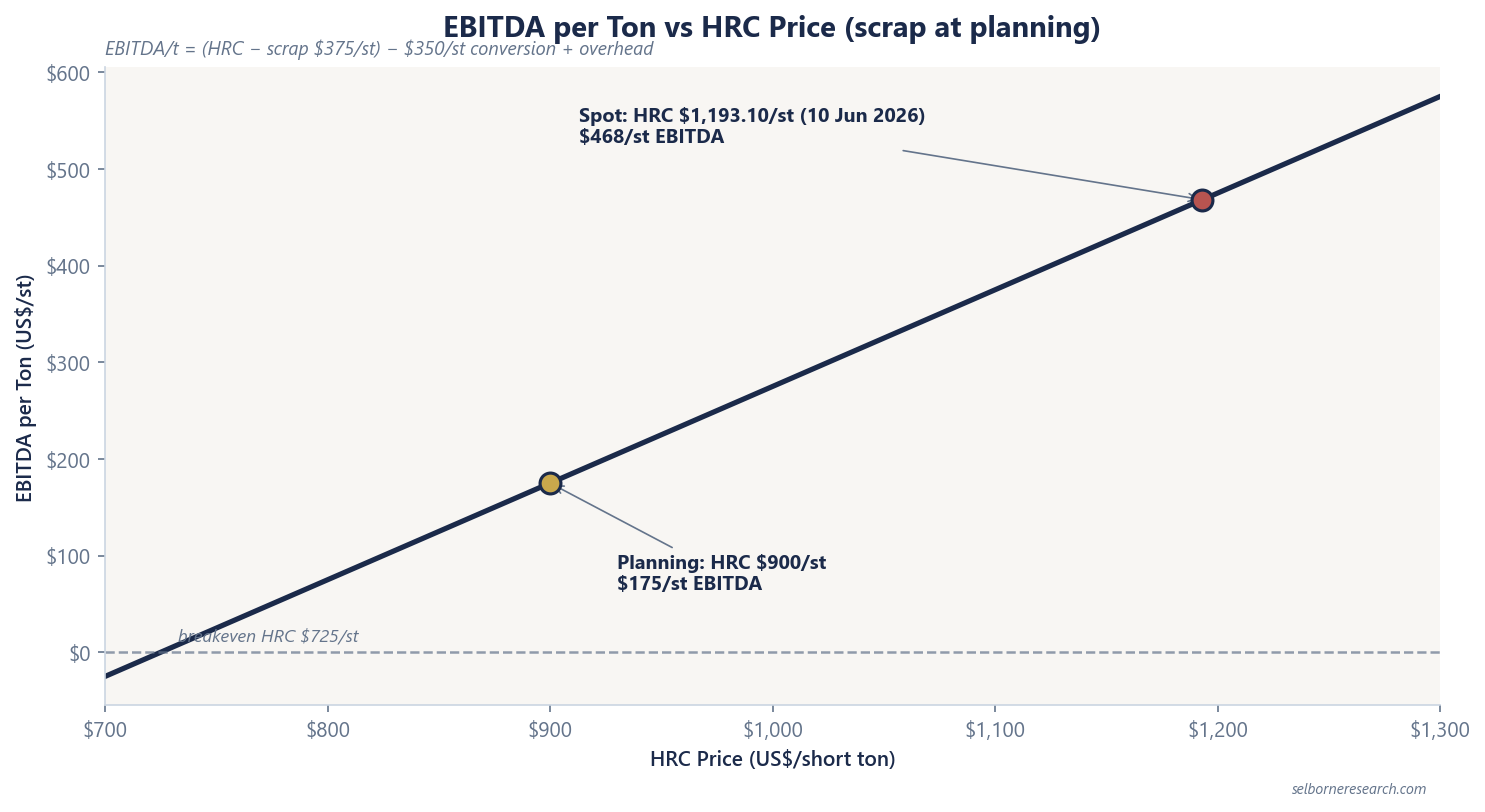
Take a mid-size EAF producer shipping 10.0M st/yr, with conversion costs plus overhead of $350/st. At the $525 planning spread it earns $175/st of EBITDA, or $1.75B a year.
Now move the spread. Conversion cost barely responds, so every dollar the spread gives up comes straight off EBITDA per ton. At a $400 spread the same producer earns $50/st; once the spread falls below its $350 conversion cost, every ton is loss-making. A 24% fall in the spread has taken 71% of the profit, and that gearing, rather than anything happening to the volume line, is what makes steel equities move the way they do.
What FY2025 Actually Said About Route Economics
FY2025 ran the experiment for us. One US market, one set of HRC and scrap marks, and two ways of making steel: the EAF route, melting scrap in an electric furnace, and the integrated route, smelting iron ore in a blast furnace and refining the hot metal in a basic oxygen furnace (BF-BOF). The outcomes could hardly be further apart.
| Producer | Route | FY2025 shipments | FY2025 EBITDA | EBITDA per ton |
|---|---|---|---|---|
| Nucor (NUE) | EAF, 100% of production | 19.8M st external (25.3M st incl. internal) | $4,174M | ~$210/ton external; ~$165/ton total |
| Cleveland-Cliffs (CLF) | Integrated BF-BOF, captive ore and pellets | 16.2M net tons | $37M adjusted | ~$2/ton |
| ArcelorMittal (MT) | Integrated, 74% BOF / 26% EAF, global | 54.0 Mt (metric) | $6,541M | $121/t |
The same spread that made Nucor roughly $210 per external ton left Cleveland-Cliffs at break-even, with a $1.4B GAAP net loss on $18.6B of revenue. Two mechanisms explain it. Scrap is a variable cost that falls when steel prices fall, so an EAF’s spread is partially self-hedging; captive iron ore and pellet operations are a largely fixed cost base, so a blast furnace eats the full downswing. And about 30% of Cliffs’ revenue comes from automotive contracts, which are fixed-price and negotiated a year ahead, so its realised prices lag the spot HRC market instead of tracking it.
ArcelorMittal’s $121/t sits in between, but read it carefully: 52.6% of its segment shipments are European, so it isn’t earning the tariff-supported US spread at all. Per-ton comparisons across these three also carry two definitional traps, short tons vs metric tonnes and external vs total shipments (Nucor is $210 on one basis and $165 on the other). Those traps get a full treatment in the guide on EBITDA per tonne.
The Integrated Variant of the Spread
For a BF-BOF steelmaker, scrap drops out and a raw-material basket takes its place. The worldsteel industry averages are 1,370 kg of iron ore and 780 kg of metallurgical coal per 1,000 kg of crude steel (per-plant ratios vary, so any model should carry them as editable inputs).
At planning prices of $90/t for 62% Fe iron ore and $200/t for premium hard coking coal, the basket costs:
- Iron ore: 1.37 t × $90 = $123
- Met coal: 0.78 t × $200 = $156
- Basket: ~$279 per tonne of crude steel
One conversion before subtracting, because US HRC quotes in short tons while the ore and coal basket is metric. A short ton is 2,000 lb, or 0.907 tonnes, so $900/st is about $992 per tonne. On that basis the integrated raw-material spread at planning prices is roughly $713/t, against an EAF spread of about $579/t on the same metric basis ($525/st).
On raw-material input alone, the integrated route’s spread is wider than the EAF’s, yet FY2025 delivered $121/t for ArcelorMittal and $2/ton for Cliffs against Nucor’s $210/st, which is about $232 on the same metric basis. The difference is everything between the basket and the coil: coke ovens, sinter plants, blast furnaces and their fixed costs consume far more of the integrated spread than an EAF’s melt shop consumes of its own. The spread that matters is the one net of route conversion cost, and on that measure FY2025 went entirely the EAF’s way.
When a steelmaker screens cheap on last-twelve-months EBITDA, the first question is which spread that EBITDA was earned on. At an inflated spot spread nearly every US mill looks brilliant. At $525/st planning you find out which ones actually are.
Steel & Bulk Commodities Primer
The EAF and integrated routes earn on different spreads. The primer turns each into its own worked DCF.
The Excel model is the primer's three worked DCFs live across 13 sheets: change the mid-cycle spread, utilisation or discount rate and the valuation moves.
Frequently Asked Questions
- What is the steel spread or metal margin?
- The steel spread (also called the metal margin or metallics margin) is the difference between the selling price of steel and the cost of the metallic raw material that goes into it. For an EAF steelmaker the spread is the hot-rolled coil price minus the scrap price per short ton. It is the earnings engine of the business: volume multiplies the spread, but the spread itself decides whether the producer makes money.
- What EAF steel spread should you value on?
- A mid-cycle planning spread, not the spot mark. The planning spread used here is $525 per short ton: US Midwest HRC at $900 minus shredded scrap at $375. HRC averaged roughly $901/st over 2022-2025, which is why $900 is a sensible planning price. Spot spreads can run far above that when tariffs or a tight scrap market lift the steel price without lifting the scrap price, and capitalising that gap means capitalising a policy decision rather than an earnings stream.
- Why did Nucor earn ~$210/ton EBITDA in FY2025 while Cleveland-Cliffs earned ~$2/ton?
- Both sell into the same US steel market, but the routes behave differently. Nucor's EAF mills buy scrap, a variable cost that falls when steel prices fall, and earned $4,174M of EBITDA, about $210 per external ton shipped. Cleveland-Cliffs runs integrated blast furnaces fed by captive iron ore and pellets, a largely fixed cost base, with around 30% of revenues tied to automotive contracts. On $18.6B of revenue it produced just $37M of adjusted EBITDA, roughly $2 per ton, and a $1.4B net loss. The same spread, two very different cost structures.
- How do you calculate the spread for an integrated steelmaker?
- Replace scrap with a raw-material basket. The worldsteel industry averages are 1,370 kg of iron ore and 780 kg of metallurgical coal per 1,000 kg of crude steel (per-plant ratios vary). At planning prices of $90/t iron ore and $200/t coking coal the basket costs about $279 per tonne of crude steel. Subtract that from the HRC price, after converting US short-ton quotes to metric tonnes, to get the integrated raw-material spread. The catch is that integrated conversion costs (coke ovens, sinter plant, blast furnace) consume much more of that spread than an EAF's do.