BOF vs EAF Steelmaking: Two Different Businesses
The two steelmaking routes compared: blast-furnace BOF (iron ore and coking coal) versus scrap EAF (scrap and power), their costs, capital and carbon.
Educational analysis for professional use. This guide is not investment advice or a recommendation to buy or sell any security, and it is not personalised.
Two Routes to Steel, Two Different Businesses
A steelmaker is not just a steelmaker. The route it uses to make steel, integrated blast-furnace-BOF or scrap-based EAF, decides what its cost is driven by, how much capital it carries, how much carbon it emits, and how you should value it. Treating an integrated producer and an electric-arc producer as peers on a single steel multiple misses that they are exposed to different raw materials and different risks. One rises and falls with iron ore and coking coal; the other with scrap and electricity.
So the first question about any steel equity is which route it runs, and in what mix, because that answer sets every other number in the model. A company that runs both, or is shifting from one to the other, has to be split and valued in parts.
The Two Routes and Their Inputs
The routes diverge at the very first step, in how they make iron into steel at all.
| Integrated (BOF) | Electric arc (EAF) | |
|---|---|---|
| Core process | Blast furnace makes hot metal, BOF refines it | EAF melts feed with electricity |
| Main inputs | Iron ore + coking coal (via coke) | Scrap steel, sometimes DRI + power |
| Cost driver | The iron ore and coking coal basket | Scrap price and power price |
| Scale | Large, capital-heavy | Flexible, smaller units viable |
| Product range | The full range, including premium flats | Historically long products, now flats too |
The integrated route reduces iron ore to iron in a blast furnace, burning coking coal to do it, then refines that hot metal into steel in the basic oxygen furnace. Its raw-material bill is therefore the iron ore cost curve and the coking coal cost curve stacked together. The EAF route skips iron-making entirely: it melts existing steel scrap, sometimes topped up with direct-reduced iron for quality, in an electric furnace. Its bill is the scrap price and the power price. That single difference in feedstock is what makes them different businesses.
The Cost Driver Is Different, So the Margin Is Different
Because the inputs differ, the two routes earn on different spreads. An EAF producer’s margin is the steel spread: the price of hot-rolled coil less the cost of the scrap that goes into it, net of conversion. An integrated producer’s margin is the price of steel less the assembled cost of iron ore, coking coal and the coke-making and blast-furnace conversion in between. The two move differently: when iron ore and coking coal are expensive relative to scrap, the EAF route earns more; when scrap is tight and dear, the integrated route can pull ahead.
FY2025 showed the gap opening the EAF’s way. On raw-material input the integrated route’s spread can look wider, but after the far heavier conversion cost of running coke ovens, sinter plants and blast furnaces, the picture flips: ArcelorMittal earned about US$121/t and Cleveland-Cliffs about US$2/ton on integrated spreads, against Nucor’s roughly US$210 per short ton on the EAF route. The lesson is that you cannot rank two steelmakers on a single spread number if they run different routes; you have to compare each against the spread its own route actually earns.
Capital, Carbon and Flexibility
Beyond the cost driver, three structural differences shape how each route is valued. The integrated route is capital-heavy and only economic at large scale, because a blast furnace, coke ovens and the associated plant are a multi-billion-dollar commitment that runs best flat out. The EAF route needs far less capital per tonne and works at smaller scale, so it can be built closer to the customer and turned down more easily when demand softens. That flexibility is worth something across a cycle that punishes fixed cost.
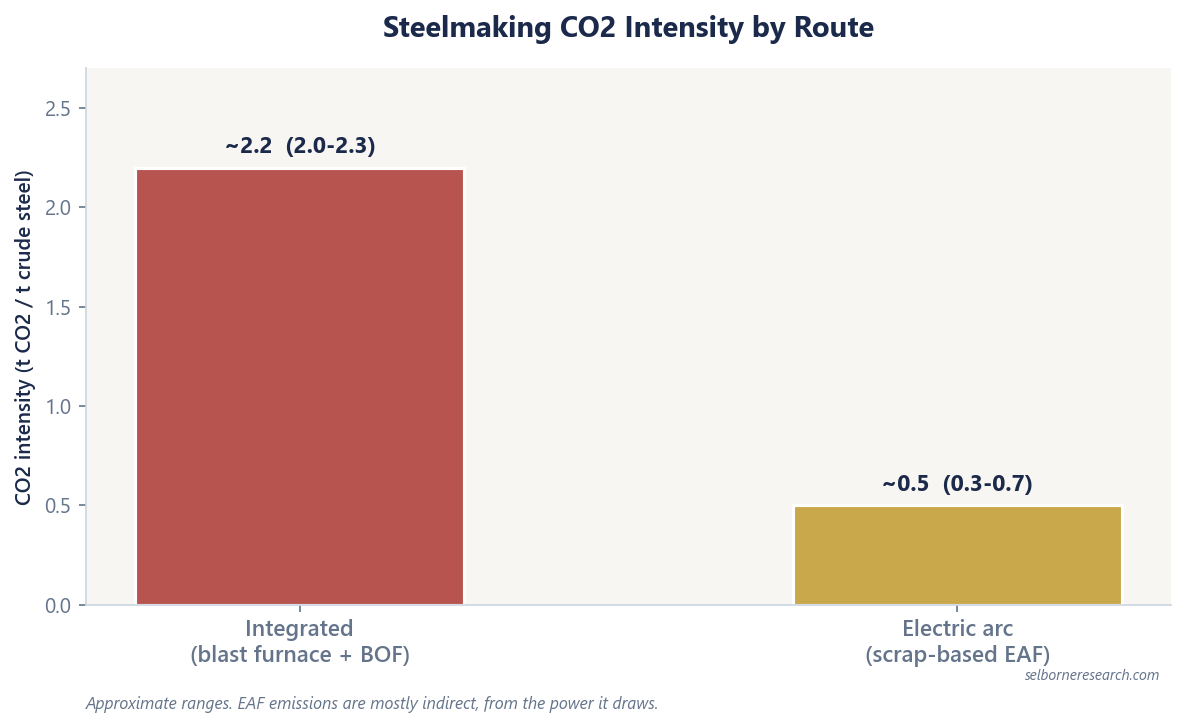
Carbon is the difference that is growing fastest. The blast furnace burns coking coal to reduce iron ore, and that reduction releases most of the carbon dioxide in steelmaking, so the integrated route emits roughly 2.0 to 2.3 tonnes of CO2 per tonne of steel. An EAF melting scrap emits roughly 0.3 to 0.7 tonnes, most of it indirect from the power it draws. As carbon carries a rising cost, that four-to-five-fold gap moves from an environmental statistic to a line in the valuation, and a producer’s route mix becomes part of its through-cycle earnings power rather than a footnote to it.
Valuing a Steelmaker by Its Route
So value a steelmaker on the route it actually runs. For an integrated producer, the model starts from the iron ore and coking coal cost curves and adds the conversion cost of iron-making; its earnings gear to the raw-material basket and its balance sheet has to carry heavy fixed cost through the trough. For an EAF producer, the model starts from the scrap-to-steel spread and the power cost; its earnings gear to that spread and its lighter capital base gives it more room to flex. Both are then valued on normalised, through-cycle earnings rather than a screen-price multiple, because steel spreads swing too far for a trailing number to mean much.
The single mistake to avoid is the one the headline multiple invites: ranking an integrated and an electric-arc producer side by side on one EV/EBITDA figure as though the number behind it were the same. It is not. Split the route first, value each on its own spread and its own cost curve, and only then compare.
Steel & Bulk Commodities Primer
The route decides the cost driver, the capital and the carbon. The primer values each on its own economics.
The Excel model is the primer's three worked DCFs live across 13 sheets: change the mid-cycle spread, utilisation or discount rate and the valuation moves.
Frequently Asked Questions
- What is the difference between BOF and EAF steelmaking?
- They are two different routes to steel with different raw materials. The basic oxygen furnace (BOF) route is integrated: a blast furnace turns iron ore and coking coal into hot metal, which the BOF refines into steel. The electric arc furnace (EAF) route melts scrap steel, sometimes with direct-reduced iron (DRI), using electricity. So a BOF producer's cost is driven by the iron ore and coking coal basket, while an EAF producer's is driven by the price of scrap and power. They are not two ways of doing the same thing; they are two different businesses that both end in steel.
- Which is cheaper, BOF or EAF?
- It depends on input prices, which is the point. The EAF route carries far less capital and can be built at smaller scale, but its cost floats with the scrap price and the power price. The BOF route is capital-heavy and only works at large scale, but it controls its inputs through iron ore and coking coal contracts and can make the highest-quality flat steel. When scrap is cheap relative to iron ore and coking coal, EAF has the cost edge; when scrap is tight, the integrated route can be more competitive. Neither is structurally cheaper across the cycle.
- Why is EAF steel lower-carbon than BOF steel?
- Because it skips the blast furnace, where coking coal is burned to reduce iron ore to iron and releases most of the carbon dioxide in steelmaking. An EAF melting scrap emits roughly 0.3 to 0.7 tonnes of CO2 per tonne of steel, mostly indirect emissions from the electricity it uses, against roughly 2.0 to 2.3 tonnes for the integrated blast-furnace-BOF route. That gap is why EAF capacity is central to steel decarbonisation, and why a producer's route mix matters increasingly to its valuation as carbon costs rise.