Firm Backlog vs Unfilled Orders in Aerospace
Why an airframer's backlog is an accounting test, not an order count, worked through Boeing's ASC 606 adjustment, Airbus's IFRS 15 test and GE's RPO.
Educational analysis for professional use. This guide is not investment advice or a recommendation to buy or sell any security, and it is not personalised.
Backlog Is an Accounting Test, Not an Order Count
A number labelled “backlog” in an airframer’s filing has already passed through a filter before it reaches the page: a piece of accounting judgement about whether the customer will actually pay for what they ordered. Boeing’s FY2025 10-K states that test directly. Total backlog “represents the estimated transaction prices on unsatisfied and partially satisfied performance obligations to our customers where we believe it is probable that we will collect the consideration due and where no contingencies remain before we and the customer are required to perform.” The next sentence does the actual excluding: “Backlog does not include prospective orders where customer-controlled contingencies remain, such as the customer receiving approval from its board of directors, shareholders or government or completing financing arrangements.” An order sitting in an airline’s fleet plan, announced in a press release, does not automatically become Boeing backlog. It has to clear the collection-probability and no-contingency test under US GAAP’s ASC 606 revenue recognition standard first.
Even the more specific figure Boeing calls “contractual backlog of unfilled orders” carries its own exclusions. Boeing defines it as excluding “purchase options, announced orders for which definitive contracts have not been executed, orders where customers have the unilateral right to terminate, and unobligated U.S. and non-U.S. government contract funding.” That last exclusion is why Boeing’s total backlog splits into two pieces at all: $639,721M of contractual backlog and a separate $42,486M unobligated amount, together making the $682,207M headline. The unobligated bucket is government work under contract but not yet released by the appropriation process, the same distinction the funded-vs-unfunded backlog guide covers for the pure-defence primes. It shows up in Boeing’s number because Boeing also builds for the US government through its Defense, Space & Security segment.
Airbus runs a near-identical test under a different accounting standard:
| Filer | Standard | Own definition (quoted) |
|---|---|---|
| Boeing | US GAAP, ASC 606 | ”Our total backlog represents the estimated transaction prices on unsatisfied and partially satisfied performance obligations to our customers where we believe it is probable that we will collect the consideration due and where no contingencies remain before we and the customer are required to perform.” |
| Airbus | IFRS 15 | ”As of 31 December 2025, the total backlog represents the aggregate amount of the transaction price allocated to the unsatisfied and partially unsatisfied performance obligations to the Company’s customers. Backlog commitments are relative to the Company’s enforceable contracts with its customers where it is probable that the consideration will be collected.” |
Different standards, same underlying test: an enforceable contract, probable collection. That is what separates a filed backlog figure from a simple count of orders an airline has said it wants.
Boeing’s FY2025 Test, Worked
Two numbers show what the ASC 606 filter actually removed from Boeing’s order book in a single year, and Boeing discloses both only in dollars: no aircraft count sits behind either one.
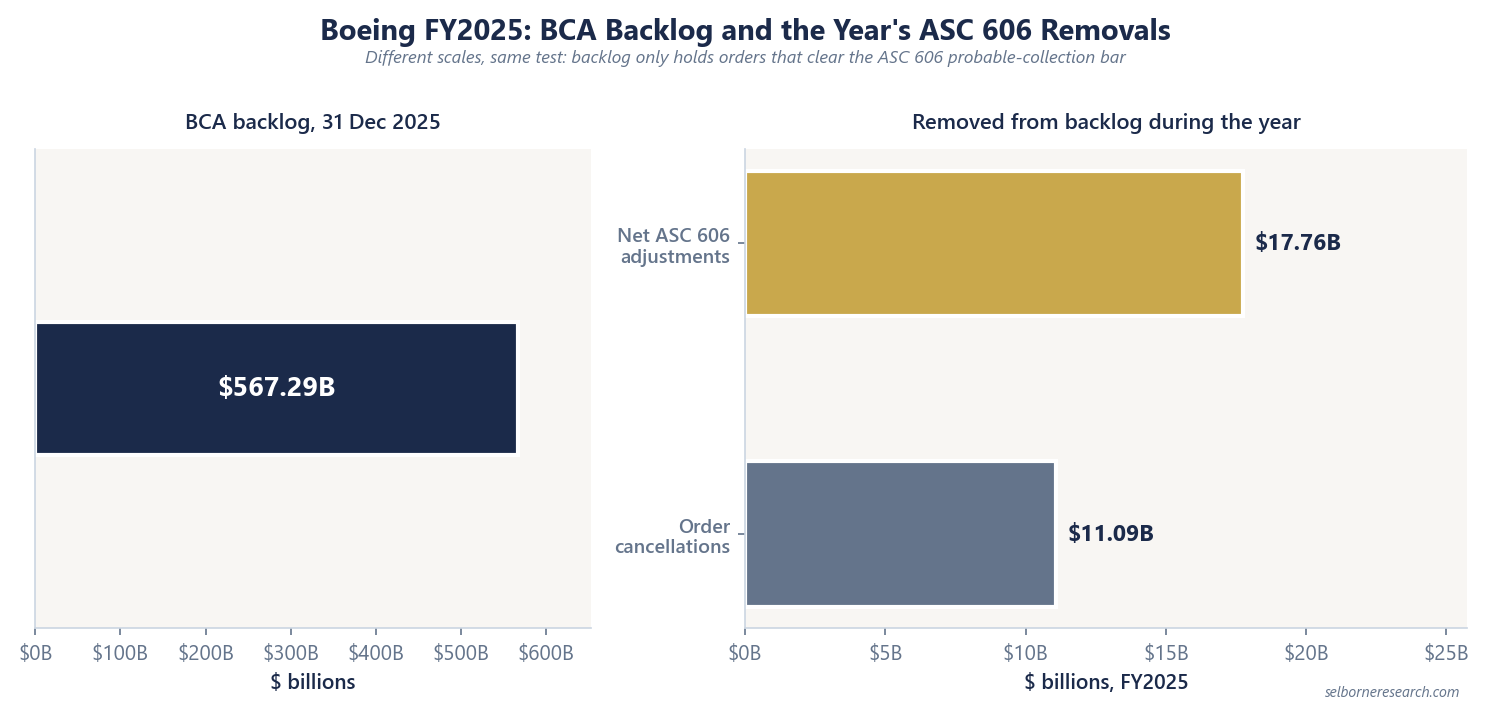
At 31 December 2025, Boeing’s commercial aeroplanes division, BCA, carried backlog of $567,290M, inside a total company backlog of $682,207M that also includes Defense, Space & Security and Global Services work.
| Item | FY2025 value | What the filing says |
|---|---|---|
| Total company backlog | $682,207M | Contractual backlog $639,721M plus unobligated backlog $42,486M |
| BCA (commercial aeroplanes) backlog | $567,290M | Filed segment backlog table |
| Net ASC 606 adjustments, removed in the year | $17,759M | ”Primarily relate to 777X and 787 aircraft” |
| Order cancellations, removed in the year | $11,094M | ”Primarily relate to 777X, 737, and 787 aircraft” |
Boeing spells out what feeds the ASC 606 adjustment figure: “consideration of aircraft orders where a customer-controlled contingency may exist, as well as an assessment of whether the customer is committed to perform, impacts of geopolitical events or related sanctions, or whether it is probable that the customer will pay the full amount of consideration when it is due.” Cancellations sit in a plainer, separate category: orders the customer has actually walked away from, reported alongside the adjustment figure rather than merged into it. Boeing calls the $17,759M figure “net” because it nets any previously excluded orders that cleared the test during the year against new ones that failed it, and the 10-K does not split those two directions apart.
Airbus Applies a Near-Identical Test Under IFRS 15
Airbus runs the same enforceability-and-collectability test as Boeing, under IFRS 15 rather than ASC 606, and its FY2025 results show the test working on the order-intake side rather than only on the year-end backlog stock.
Airbus applies that test each time an order is booked, as well as when the year-end backlog figure is struck. Its FY2025 financial statements report gross commercial aircraft orders of 1,000 units, of which 111 did not survive to become net orders: “total gross commercial aircraft orders amount to 1000 units… with net orders of 889 aircraft after cancellations.” That 889 is what actually enters the order book. The 111-unit gap is the equivalent of Boeing’s cancellations line, not of its ASC 606 adjustment: Airbus does not publish a separate collectability adjustment, so the only removal it quantifies is the cancellation count.
The same statements describe how the surviving backlog turns into revenue: “the backlog will mainly be released into revenue over a period of eight years with approximately 10% of the Airbus backlog in units expected to be converted into revenues in 2026.” That release schedule is the flow side of the same test. A contract only counts toward the roughly ten per cent converting in the next twelve months if it has already cleared the enforceable-and-probable bar.
Airbus also keeps a second, stricter version of backlog that never appears as a headline number. For hedge accounting on its foreign-currency exposure, Airbus assesses a “highly probable” criterion by “reducing the contractual firm backlog by all deliveries which cannot be considered as highly probable due to the existence of either cancellation rights, risk of bankruptcy or other risk of order restructuring.” That adjusted figure exists only to support Airbus’s own hedge accounting. It is never published as a number, and a reader should not go looking for it in the order-book disclosures.
What an Engine Maker Counts: GE’s RPO
GE Aerospace files the equivalent number under the label Remaining Performance Obligations, RPO: its FY2025 10-K table is headed “Total RPO”, $190,564M at 31 December 2025, split into $27,534M of equipment and $163,029M of services.
The label is worth knowing because it is the same underlying revenue-recognition concept as Boeing’s and Airbus’s backlog: the transaction price allocated to unsatisfied performance obligations, with the same test built into how the number is constructed. Two labels for what is structurally the same accounting test.
The size of the split matters more than the label. GE’s $163,029M of services RPO is roughly 85.5% of the $190,564M total, computed from the filed table, well over five times the $27,534M sitting in equipment. For an engine maker, the backlog that actually carries revenue forward for years is overwhelmingly the maintenance and overhaul contracts on engines already in service, running far ahead of the queue of new engines still to be delivered.
Reading the Gap Between Orders and Backlog in a Model
A model that tracks backlog in isolation misses the more useful comparison: backlog against orders taken. If reported backlog is shrinking or flat while gross orders are still coming in, the ASC 606 or IFRS 15 test is doing more work than usual, worth investigating before assuming demand has stalled.
Boeing’s FY2025 net ASC 606 adjustments, $17,759M, and cancellations, $11,094M, are both flows that ran through the year Boeing’s BCA backlog was building toward $567,290M. Without knowing those two figures, a reader comparing Boeing’s backlog growth to gross orders booked would overstate how much of that order intake actually survived onto the balance sheet. Airbus’s 111-unit gap between 1,000 gross and 889 net orders is the same check on a smaller, more transparent scale, because Airbus discloses both sides of the subtraction where Boeing discloses only the removal figures, separately from the ending number.
None of this changes how you size the revenue opportunity once an order clears the test. The backlog-years and narrowbody ramp guide covers how to turn a filed backlog figure into a delivery-years estimate once you trust the number you are dividing.
Where This Goes Wrong
Treating backlog as a running tally, orders taken minus deliveries made, the way a retailer tracks a waiting list, is the most common misreading. It isn’t that. Backlog is the output of a probability and enforceability test applied every reporting period, which is why a filer’s backlog can fall even in a year when new orders exceed deliveries, once adjustments and cancellations are large enough.
Looking for a unit-level breakdown of what Boeing’s ASC 606 test removed is a dead end: Boeing states $17,759M of adjustments and $11,094M of cancellations for FY2025, both in dollars, and the 10-K gives no aircraft count behind either figure.
Nor is Airbus’s or GE’s version of the test identical to Boeing’s just because the underlying standards are close cousins. ASC 606 and IFRS 15 share the same substance: probable collection, no remaining contingency. Each filer applies it to a different population and discloses a different slice of the result, Boeing in dollars only, Airbus in both gross and net order counts, GE under the RPO label.
Commercial Aerospace Sector Primer
Delivery rates and the aftermarket annuity are the inputs. This primer takes them to a dual-rate sum-of-the-parts and an EV/EBITDA you can defend.
The Excel model is the primer's two dual-rate sum-of-the-parts builds live across 12 sheets: original equipment capitalised at a cyclical rate, the installed-base aftermarket at a lower annuity rate, summed to enterprise value. Change the delivery rate, the aftermarket dollars per unit or either discount rate and the value per share moves.
Frequently Asked Questions
- Is Boeing’s backlog the same thing as unfilled orders?
- Not automatically. Boeing’s FY2025 10-K defines total backlog as unsatisfied performance obligations where collection is probable and no customer-controlled contingency remains. Even the more specific figure Boeing calls “contractual backlog of unfilled orders” excludes purchase options, orders awaiting a definitive contract, orders a customer can unilaterally cancel, and unobligated government funding. An order an airline has announced is not backlog until it clears that test.
- What is a net ASC 606 adjustment?
- It is the dollar value Boeing removes from, or on the same net line adds back into, backlog each year because an order no longer meets, or newly meets, the ASC 606 collection-probability and no-contingency test. Boeing’s FY2025 net ASC 606 adjustment was $17,759M, described in the 10-K as primarily relating to 777X and 787 aircraft, reported separately from the $11,094M of outright cancellations.
- Does Airbus disclose the same adjustment Boeing does?
- Not in the same form. Airbus applies IFRS 15’s enforceability-and-collectability test but discloses the result as gross versus net orders rather than a named adjustment line: FY2025 gross commercial aircraft orders were 1,000 units against 889 net after cancellations. Airbus also runs an internal, unpublished “highly probable” backlog reduction for hedge accounting that is stricter than its headline backlog and never appears as a number.
- Why does GE Aerospace file its backlog as RPO?
- GE’s FY2025 10-K files the figure under the label Remaining Performance Obligations, RPO: $190,564M at 31 December 2025, split $27,534M equipment and $163,029M services. RPO is the same revenue-recognition concept as Boeing’s and Airbus’s backlog figures, unsatisfied performance obligations under a contract, under a different label.