Hard Coking Coal & the PLV Quality Benchmark
What PLV low-vol coking coal specifies, the quality parameters (CSR, fluidity, ash) that set the discount, and how semi-soft and PCI coals realise against it.
Educational analysis for professional use. This guide is not investment advice or a recommendation to buy or sell any security, and it is not personalised.
A Coking Coal Earns a Percentage of PLV, Not PLV
Two coking coal mines with the same FOB cash cost can be worth very different amounts, because the price a tonne earns depends on its coke-making quality, and the market prices that quality as a discount to a single benchmark: PLV, Platts Premium Low Vol hard coking coal. Almost no cargo actually sells at the PLV headline. Premium hard coking coal earns close to it; everything else, second-tier hard coking coal, semi-soft, and pulverised coal injection (PCI) coal, earns a defined fraction of it. So the number that matters for a coking coal producer is not the PLV price on the screen but its realisation, the percentage of PLV its coal actually captures.
That makes realisation the coking coal analogue of the iron ore grade discount: a second axis laid over the cost curve that decides how much of the benchmark price a mine ever sees.
What PLV Actually Specifies
PLV is not a vague “best coal” label; it is a normalised specification, which is what lets it work as a benchmark. Platts assesses it FOB Australia against a defined quality:
| Parameter | PLV normalised spec | What it governs |
|---|---|---|
| CSR (coke strength after reaction) | ~71% | Coke strength in the furnace, the master quality metric |
| Volatile matter | ~21.5% | The “low vol” in the name; rank and coke yield |
| Ash | ~9.3% | Inert material the furnace must carry and slag off |
| Sulphur | ~0.5% | A contaminant; higher sulphur is penalised |
| Phosphorus | ~0.045% | A contaminant that embrittles steel |
| Maximum fluidity | ~500 ddpm | How the coal softens and re-solidifies into coke |
A cargo that beats the spec on the parameters that matter can earn a small premium; one that falls short on CSR, ash or sulphur is discounted. The benchmark exists so that every other coal can be quoted as a relativity to it rather than negotiated from scratch.
The Quality Parameters That Set the Discount
Coke strength after reaction is the one to understand first, because it dominates. A blast furnace needs a rigid, permeable column of coke to carry the iron burden and let gas flow up through it; weak coke crushes, the burden chokes, and the furnace has to slow down. CSR measures how well the coke resists that. Coals with high CSR let a steelmaker run the furnace hard on a leaner coke rate, which is worth real money, so CSR is the parameter that most separates a premium price from a discounted one.
The others adjust the price around that. Fluidity and volatile matter describe how the coal softens and fuses into coke, and blenders care about them because they decide how a coal behaves in a mixed charge. Ash is inert weight the furnace must melt and remove as slag, so lower is better. Sulphur and phosphorus are contaminants that carry into the iron and then the steel, and both are penalised hard. None of these is the headline number, but together they set how far above or below PLV a given cargo prices.
The Product Ladder: Realisation Against PLV
Coking and injection coals sort into a ladder, each tier earning a typical band of the PLV price. The bands below are working conventions, not fixed differentials: they move with the market, and they widen when PLV is high because buyers pay up for quality, then narrow when it is low.
| Product | Typical realisation vs PLV | Why |
|---|---|---|
| Premium hard coking coal | ~95-100% | Meets or beats the PLV spec |
| Second-tier hard coking coal | ~85-95% | Sound coking coal, below spec on CSR or ash |
| Semi-hard coking coal | ~75-85% | Weaker coke; a blend component |
| PCI (injection coal) | ~65-80% | Not a coking coal; replaces coke, not makes it |
| Semi-soft coking coal | ~55-70% | Low CSR; dilutes a premium blend |
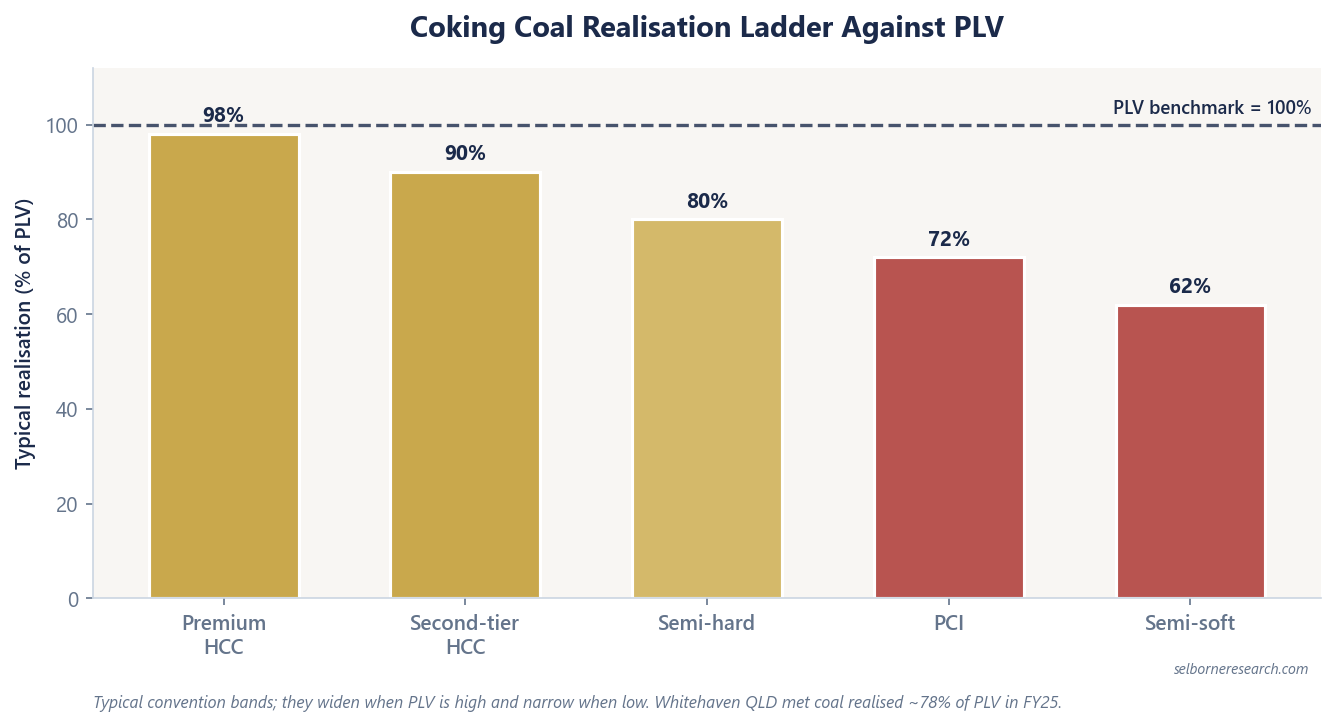
The bands are not academic. Whitehaven’s Queensland metallurgical coal realised about 78% of the PLV index in the year to mid-2025, which places its book squarely in the second-tier-to-semi-hard range rather than at the premium. Applied to a US$196/t PLV average, that 78% is roughly US$153/t realised, and it is the realised number, not PLV, that goes into the margin against the mine’s FOB cost. Quoting a producer’s economics against the full PLV price when it sells a 78%-of-PLV product overstates its revenue by nearly a quarter.
PCI Is a Different Kind of Coal
One tier on the ladder does not belong to the coking family at all, and it is worth separating. PCI coal is injected as a powder straight into the base of the blast furnace to burn in place of coke, so it is valued on how much coke it displaces rather than on the coke it makes: roughly one tonne of PCI replaces 0.8 tonnes of coke. That is why PCI is priced off, but distinct from, the coking coal benchmark, and why a producer’s PCI tonnes should be modelled on their own relativity rather than lumped into a single “met coal” price. Treating PCI as though it were discounted coking coal misreads both its price and its demand driver, which is the coke rate a steelmaker is trying to lower, not the coke blend it is trying to build.
So value a coking coal producer on realisation, never on the raw PLV headline. Take PLV as the benchmark, apply the quality relativity for the actual product mix, and only then set the realised price against the mine’s cost. A mine at the bottom of the cost curve selling a 60%-of-PLV semi-soft can be a worse business than a higher-cost mine selling premium hard coking coal, and you cannot see that until you price the quality.
Steel & Bulk Commodities Primer
A tonne of coal earns a percentage of PLV, not PLV. The primer models realisation into the met-coal DCF.
The Excel model is the primer's three worked DCFs live across 13 sheets: change the mid-cycle spread, utilisation or discount rate and the valuation moves.
Frequently Asked Questions
- What is PLV coking coal?
- PLV is Platts Premium Low Vol, the benchmark price for the best hard coking coal, assessed FOB Australia. It is normalised to a defined quality: about 71% coke strength after reaction (CSR), 21.5% volatile matter, 9.3% ash, 0.5% sulphur, 0.045% phosphorus and a maximum fluidity around 500 ddpm. Almost every other coking or injection coal is priced as a discount to PLV, so the benchmark and a cargo's realisation against it, expressed as a percentage of PLV, together tell you what the coal actually sold for.
- What is CSR in coking coal?
- CSR is coke strength after reaction: a measure of how well the coke made from the coal holds up under the heat and chemical attack inside a blast furnace. It is the single most important coking-quality parameter, because strong coke keeps the furnace burden permeable and lets the furnace run hard. Premium hard coking coal is normalised to roughly 71% CSR. A coal that makes weaker coke commands a lower price, because the steelmaker has to blend it down or accept a slower furnace.
- Why do semi-soft and PCI coals sell at a discount to PLV?
- Because they do less of the job. Semi-soft coking coal has weaker caking and lower CSR, so a steelmaker can only use it to dilute a premium blend, not to replace it. PCI (pulverised coal injection) coal is not a coking coal at all: it is injected into the blast furnace to replace some of the coke rather than to make it, with roughly one tonne of PCI replacing 0.8 tonnes of coke. Both are worth having, but neither delivers premium coke, so both realise a fraction of the PLV price, typically well below it.