Royalty Rate Benchmarks: Typical Rates by Commodity
Typical royalty rate bands by commodity and type: precious, base and bulk NSR ranges, the GOR-NSR-NPI hierarchy, and financing versus government royalties.
Educational analysis for professional use. This guide is not investment advice or a recommendation to buy or sell any security, and it is not personalised.
A Royalty Rate Means Nothing on Its Own
A 2% royalty and a 2% royalty can be worth entirely different amounts. The rate is only the first of four things that set a royalty’s value: the rate, what the rate is a percentage of, the commodity it sits on, and whether it is a private financing royalty or a government charge. Quote a royalty by its headline rate alone and you have said almost nothing, which is why a benchmark table has to hold all four together rather than rank a column of percentages.
This guide sets out the typical bands so you can tell a rich royalty from a thin one at a glance, and then check the three things the headline rate leaves out. It is the reference behind the NSR versus NPI mechanics: that guide explains what each royalty type pays on; this one benchmarks what the rates actually are.
The Type Decides What the Rate Multiplies
Before comparing rates, fix what each is a percentage of, because the same headline number is worth different amounts across royalty types. A gross overriding royalty (GOR) pays on gross revenue with no deductions. A net smelter return (NSR) pays on revenue after limited, defined deductions for smelting, refining and transport. A net profits interest (NPI) pays on profit after the operator’s costs, on a base the operator largely controls.
| Type | Pays on | Relative value at the same headline rate |
|---|---|---|
| Gross overriding royalty (GOR) | Gross revenue, no deductions | Highest |
| Net smelter return (NSR) | Revenue after smelting, refining, transport | Middle, the market standard |
| Net profits interest (NPI) | Profit after operator’s costs | Lowest, typically discounted 20-30% to an equivalent NSR |
So a 2% GOR is worth more than a 2% NSR, which is worth more than a 2% NPI. Never compare rates across types without converting to one basis first; the NSR vs NPI guide sets out the conversion.
Typical Rate Bands by Commodity
Within the NSR standard, the typical rate band moves with the commodity, because both the metal’s unit value and the size of the deductions differ. The bands below are working conventions for private royalties, not fixed rules, and any individual deal can sit outside them.
| Commodity group | Typical private NSR band | Notes |
|---|---|---|
| Precious metals (gold, silver) | ~1.0-2.5% (range 0.5-3%) | High unit value, small deductions when a mine pours dore |
| Base metals (copper, zinc) | ~0.5-2.0% | Larger concentrate treatment and refining charges eat the net |
| Bulk (iron ore, coal) | Often a GOR or fixed $/t, not an NSR | Low unit value makes a percentage-of-net awkward |
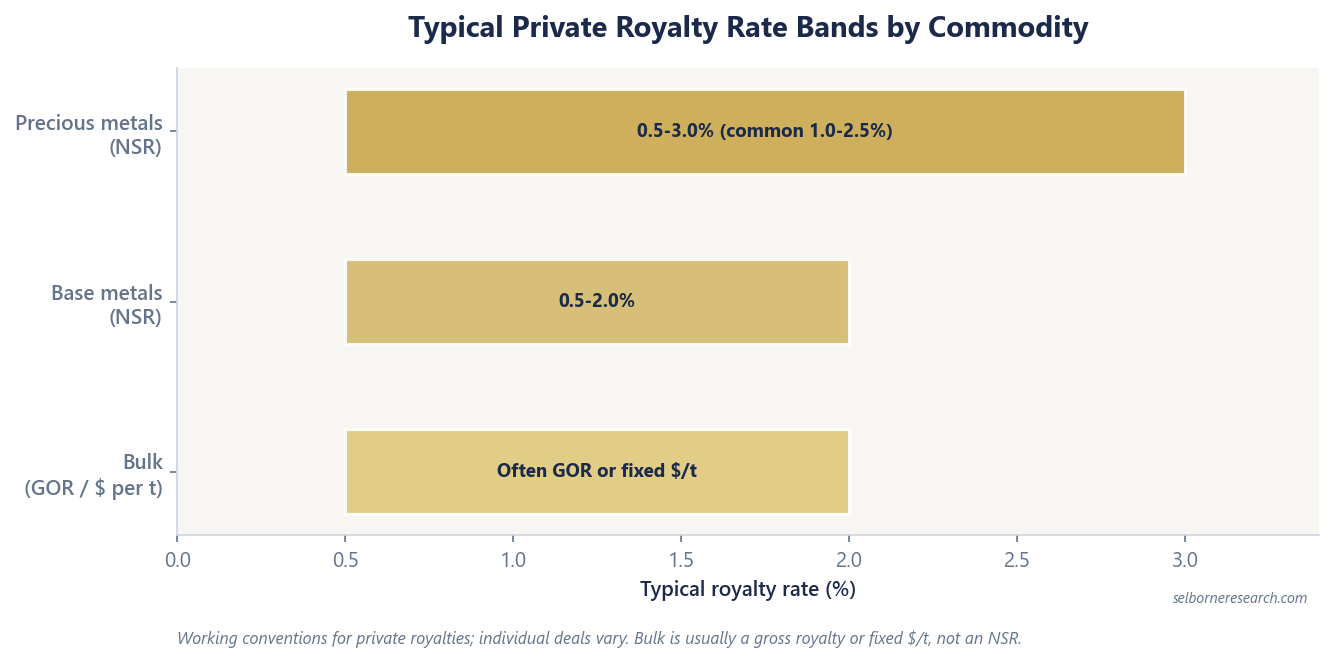
Two patterns fall out of this. Precious metals carry the highest percentages because the metal is dense value and the deductions are small, so the net a royalty pays on is close to the gross. Base metals carry lower percentages because concentrate ships with heavy treatment and refining charges, so the net is a smaller slice of the gross and a given percentage buys less. Bulk commodities often abandon the NSR format entirely: iron ore and coal are low value per tonne and sold on their own contract terms, so a gross royalty or a fixed dollar-per-tonne amount fits better than a net-of-deductions percentage.
Financing, Vendor and Government Royalties
A royalty’s rate also reflects how it came into being, and the three origins price very differently. A financing royalty is created when an investor pays cash up front to fund a mine and takes a share of its revenue in return; these are what royalty and streaming companies mostly own, and they sit at the low single-digit rates above. A vendor royalty is retained by a previous owner when a project changes hands, often on similar terms. A government royalty is a statutory charge the state levies on production regardless of any financing, and it is a different order of magnitude, frequently mid-single-digit to double-digit percentages, and in some coal jurisdictions a sliding scale that climbs steeply as the price rises.
The distinction matters twice over. First, the government royalty is a cost to the mine that a private royalty holder’s cash flow sits behind, so a rising statutory rate squeezes the operator, not the royalty holder. Second, when you see a headline royalty percentage, check which kind it is: a 7% figure is almost certainly a government statutory rate, not a private royalty a streaming company could hold, and reading one as the other misprices the asset by a wide margin.
Reading a Royalty Rate Without Being Misled
So put the four things together before you value any royalty. Take the rate, confirm the type to know what it multiplies, place it in the commodity band to see whether it is rich or thin for what it sits on, and identify the origin to know whether it is a private cash flow or a state charge. A benchmark table is useful precisely because it stops you reading a bare percentage as if it were comparable across all four axes when it is comparable across none of them.
The rate is where the analysis starts, not where it ends. A 1.5% precious-metals NSR on a long-life mine can be worth far more than a 3% base-metals NPI on a short one, and the headline rates point the wrong way. Benchmark the rate, then model the royalty on its own terms.
Royalty & Streaming Sector Primer
A royalty rate means nothing until you know what it multiplies. The primer builds royalties into a per-share NAV.
The Excel model is the primer's two NAVs live across 10 sheets: change the gold price, delivery percentage or discount rate and the valuation moves.
Frequently Asked Questions
- What is a typical royalty rate in mining?
- For the private royalties that royalty and streaming companies hold, most net smelter return (NSR) rates on precious metals projects sit between about 0.5% and 3%, with 1% to 2.5% the common range. Base metals royalties tend to run a little lower, and bulk commodities like iron ore and coal are often structured as a gross royalty or a fixed dollar-per-tonne amount rather than a percentage. Rates above about 3% start to weigh on mine economics and often carry a buy-back clause. Government statutory royalties are a separate matter and are materially higher.
- Do royalty rates differ by commodity?
- Yes. Precious metals carry the highest typical NSR percentages, because the metal is valuable per tonne and the deductions are small when a mine pours dore. Base metals sit lower, and the deductions are larger because concentrate carries heavy treatment and refining charges. Bulk commodities are frequently structured as a gross royalty or a fixed amount per tonne rather than an NSR, because the low unit value makes a percentage-of-net awkward. So the headline rate is only comparable within a commodity, and only once you know what it is a percentage of.
- What is the difference between a financing royalty and a government royalty?
- A financing royalty is a private contract: an investor pays cash up front and receives a percentage of the mine's revenue or metal for the life of the asset, and these are what royalty and streaming companies own, typically at low single-digit rates. A government royalty is a statutory charge the state levies on production regardless of any financing, and it is usually much larger, often mid-single-digit to double-digit percentages depending on the jurisdiction and, for coal in some states, a sliding scale that rises steeply with the price. The two stack: a mine pays the government royalty and any private royalty on top.