Wheaton Precious Metals (WPM)
Wheaton Precious Metals research profile covering stream economics, portfolio assets, margins and royalty-and-streaming valuation.
Educational analysis for professional use. This profile is not investment advice or a recommendation to buy or sell any security, and it is not personalised.
Snapshot
The Streaming Model
Wheaton buys a slice of a mine's future metal for a large payment up front, then pays a second, much smaller amount every time an ounce is delivered. That second payment, the delivery price, is what makes the model. On most of the older contracts it is a fixed dollar figure written into the deal, a few hundred dollars an ounce for gold and a few dollars for silver, and it stays there however high the metal goes. Streams on that fixed-price structure produced roughly 83% of 2025 revenue. Newer deals, including the enlarged Antamina silver stream, instead set the delivery price at 20% of spot, so the cost climbs with the metal rather than staying put. That distinction decides how the whole company behaves in a price move, and it is worth knowing before reading anything else here. Wheaton does not operate mines, fund exploration, or maintain pits and plants; that burden sits with the stream counterparties.
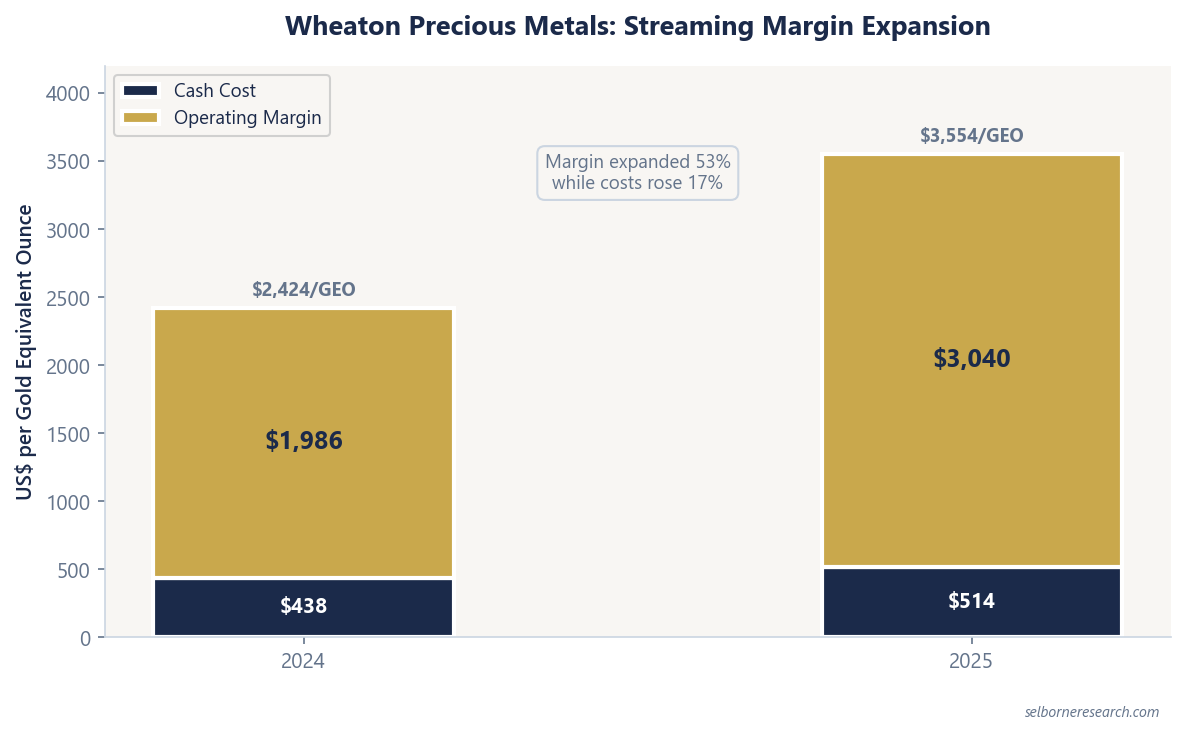
The margin that model throws off is extraordinary. In 2025, cash costs averaged $514 per gold equivalent ounce against an average realised price of $3,554/GEO, producing a cash operating margin of $3,040 per ounce sold. That is remarkable for any business, let alone one with near-zero sustaining capex.
Wheaton produced 689,864 GEOs in 2025, above its own guidance ceiling of 670,000. Revenue hit $2,314.6 million, up 80% year on year. After a busy first half of 2026 the portfolio runs to 57 assets: 22 operating mines, 20 development projects and 15 at exploration or other stages, spread across Peru, Mexico, Chile, Brazil, Canada, Zambia, Australia and elsewhere. Its largest single asset, the Salobo gold stream operated by Vale, accounted for 44.9% of 2025 revenue at $1,039.9 million, unusually heavy for a single stream.
What to Watch in the Financials
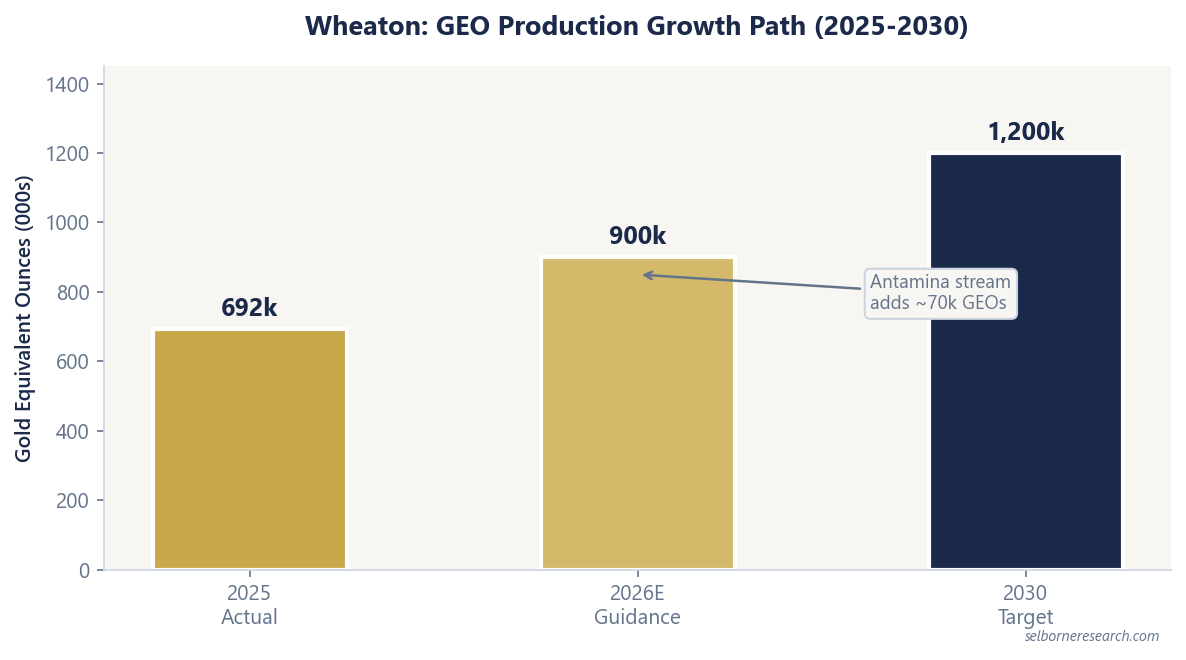
GEO production growth, read carefully. The 2026 guidance of 860,000-940,000 GEOs looks like 24-36% growth over 2025's 689,864, and a good part of it is not growth at all. A gold equivalent ounce is a conversion, not a physical thing: silver and other metals are restated as gold at whatever price ratio the company strikes them at. Wheaton reported its 2025 actuals at $2,600 gold and $30 silver, about 87 silver ounces to the gold ounce. It guides 2026 at $4,800 and $80, a ratio of 60:1. Silver was roughly a third of 2025 revenue, and at 60:1 the identical silver converts into about 44% more gold-equivalent ounces. So the step is part new metal and part arithmetic, and the same trap applies to any two streamers quoting GEOs at different ratios.
The real new metal is mostly Antamina. Wheaton bought BHP's silver interest in the Peruvian mine for $4.3 billion, the largest upfront payment in streaming history, closing on 1 April 2026 and doubling its share of Antamina's payable silver from 33.75% to 67.5%. It adds around 70,000 GEOs in 2026, and unlike the legacy book it carries a delivery price of 20% of spot. Wheaton funded it with cash, a new $1.5 billion two-year term loan drawn on completion, and a draw on its revolver. At 30 June 2026 debt stood at $2.0 billion against $100 million of cash, so net debt of $1.9 billion, with $2.6 billion of liquidity still available. The net-cash balance sheet is gone, though the borrowing is small against a portfolio throwing off more than $3 billion a year of cash margin. Blackwater, Mineral Park, Goose and Platreef ramp-ups add more, partly offset by Constancia now the Pampacancha pit is depleted. Management targets 1.2 million GEOs by 2030.
Cash cost per GEO. This number went from $438 in 2024 to $514 in 2025, then $621 across the first half of 2026. That is not deals being struck on worse terms. It is the percentage-of-spot streams doing exactly what they are written to do: when the delivery price is 20% of the metal price, a silver price near $70 costs Wheaton around $14 an ounce where a legacy contract costs it six. Doubling the Antamina interest enlarges that slice from here. The number to watch is not the absolute cost but the mix, because every ounce that moves from a fixed-dollar contract to a percentage one gives up some of the operating leverage that makes streaming worth owning.
Operating margin trajectory. The cash operating margin expanded 53% to $3,040/GEO in 2025, from $1,986 the year before, because metals prices rose far faster than the fixed delivery prices underneath them. Q4 2025 reached $3,941/GEO. The question is what happens on the way back down. On a fixed-price stream the fall is close to one for one: at $3,554 realised against a $514 cost, a 30% price fall takes roughly a third off the margin per ounce, because the cost does not move to meet it. On a percentage-of-spot stream the cost falls with the price, so the margin percentage survives and only the dollars shrink. The more of the book that sits in the second category, the less violent the swing in either direction. You can work the sensitivity yourself using the AISC framework in our mining guides.
Peer Context: Wheaton vs Franco-Nevada
Franco-Nevada is the natural comparison. Both are large-cap precious metals financiers, but the models differ in ways that matter. Franco-Nevada holds 435 royalty and streaming assets spanning gold, silver, base metals, and energy. Wheaton holds 57, almost entirely precious metals streams. Franco-Nevada reported $1.8 billion in 2025 revenue from 519,106 GEOs sold. Wheaton reported $2.3 billion from 651,311 sold, out of 689,864 produced. Wheaton is now larger by market cap (roughly $52 billion vs Franco-Nevada's $41.5 billion), a reversal from historical norms.
The structural difference: a royalty takes a slice of the mine's revenue or profit, so Franco-Nevada's returns partly depend on how well the operator controls costs. A stream instead fixes Wheaton's own cost side. When gold rises, nearly all of the upside flows to Wheaton on the legacy contracts, because a delivery price written as $400 or $500 an ounce does not move with the metal. That gives Wheaton more leverage to prices, for better or worse. Franco-Nevada compensates with far greater diversification, no debt, and $3.4 billion in available capital. It is the more defensive holding of the two. Wheaton is the higher-beta bet on precious metals.
Key Risks
Precious metals price sensitivity. This is the dominant risk. Most of Wheaton's margin is the gap between a delivery price of roughly $500 an ounce and whatever gold fetches on the day, and on those contracts every dollar gold falls is a dollar off the margin per ounce, with no cost lever to pull. Free cash flow drops hard. The percentage-of-spot streams behave differently, absorbing part of the fall through a lower delivery price, so the portfolio is a little less geared than it was before Antamina closed. A little. This is still a business whose earnings are a leveraged view on the gold and silver price, and nothing in the contracts changes that.
Salobo and Vale counterparty concentration. Salobo generated 44.9% of Wheaton's 2025 revenue, and the top three assets together (Salobo, plus Peñasquito silver at 13.0% and Antamina silver at 9.9%) made up 67.8%. Vale-operated assets account for 49% of revenue. That is a lot riding on a handful of mines, nearly half of it on one operator. And a streamer has no way to fix a mine it does not run: if Salobo goes down for maintenance, a labour dispute or a Brazilian regulatory decision, Wheaton's deliveries stop and its only remedy is whatever the contract says. Vale's operational track record is mixed, though the Salobo III expansion did pass its throughput test in late 2023. Doubling the Antamina silver interest dilutes Salobo's weight from 2026, but the portfolio stays concentrated by streaming-company standards.
New deal competition. The $4.3 billion Antamina deal signals that large streams now command serious capital. Mining companies have more financing options than a decade ago, including traditional debt markets, private equity, and competing streamers. If miners demand higher upfront payments or lower ongoing delivery percentages, future deal returns compress. Depletion is not the pressing worry here: the company puts the reserve life of its portfolio at around 27 years. The worry is what the next $4 billion earns. Wheaton has to keep deploying capital to grow at all, and the returns on money spent in a $4,500 gold market will not look like the returns on money spent in a $1,200 one.
Jurisdiction risk. Peru and Mexico host several of Wheaton's largest streams, including Antamina and Peñasquito. Both countries have seen recent regulatory shifts around mining taxation and permitting. New royalty regimes or export restrictions could alter the economics of existing deals, even if Wheaton's contracts provide some legal insulation.
The Bull and Bear Cases
The bull case is metals leverage with volume growth layered on top. What has to go right: gold stays supported by central bank buying and inflation-hedging demand, the largely fixed-price contract book keeps converting that into 80%+ cash margins with minimal capex, the 2026 ramp (guidance 860,000-940,000 GEOs) lands, and the path to the 2030 target of 1.2 million GEOs keeps adding ounces from Antamina and the development book. Deal sourcing has to stay productive; Antamina is the latest proof point.
The bear case is metals prices and deal economics. What has to go wrong: gold retreats enough to compress the fixed-cost margin, or competition forces higher upfront payments and thinner terms on the next large stream. The dividend is not the pressure point: at roughly 0.7% of the share price it costs a small fraction of the cash coming in. What falls is the share, because one bought for gold leverage gets the leverage in both directions. Sustained high prices and continued deal execution on favourable terms are the assumptions the growth case carries; either breaking is the downside path.
Royalty & Streaming Sector Primer
Wheaton buys its metal well below spot and keeps the gap. The primer builds that margin into a portfolio NAV.
The Excel model is the primer's two NAVs live across 10 sheets: change the gold price, delivery percentage or discount rate and the valuation moves.