Devon Energy (DVN)
Devon Energy research profile covering the Coterra merger, the Delaware Basin position, capital returns, drilling costs and how to read an E&P's breakeven.
Educational analysis for professional use. This profile is not investment advice or a recommendation to buy or sell any security, and it is not personalised.
Snapshot
Start With What Devon Now Owns
Devon is not the company most write-ups still describe. Its all-stock merger with Coterra Energy closed on 7 May 2026. The combined business produced 1.36 million barrels of oil equivalent a day in the second quarter, on only eight weeks of Coterra volumes, against roughly 840,000 for Devon alone in 2025. The third quarter, the first with the merged business running for all of it, is guided to 1.66-1.69 million, which is the number to hold in your head as the size of the company. Former Devon holders own about 54% of the result, former Coterra holders 46%. Anything written about Devon before May 2026 describes a materially different business.
The asset base is anchored by roughly 750,000 net acres in the core of the Delaware Basin, the western half of the Permian, which makes Devon one of the largest operators there by acreage. Around that sit the Anadarko Basin in Oklahoma, the Eagle Ford, the Powder River and the Williston, plus the piece that changes the shape of the company: Coterra's Marcellus Shale gas position in Pennsylvania. Management targets $1 billion of annual pre-tax synergies by the end of 2027, with more than 350 integration projects running.
Two weeks after the merger closed, Devon paid $2.6 billion at a federal lease sale for 16,300 net undeveloped acres in Lea and Eddy Counties, New Mexico. That is about $160,000 an acre, buying roughly 400 drilling locations normalised to two-mile laterals, so around $6.5 million of land cost per well before a drill bit turns. Federal leases carry a lighter royalty than private acreage in the basin usually does, which is part of what justified the price. The rest of the justification is scarcity: core Delaware inventory is the thing every Permian operator is short of, and Devon paid cash for roughly a year's worth of drilling locations to get it.
The commodity mix moved with the merger. Devon standalone ran about 46% oil by volume. Full-year 2026 guidance, which averages a standalone first quarter with a merged second half, is 495,000-505,000 barrels of oil a day inside 1.364-1.398 million BOE, with 3,300-3,400 million cubic feet a day of gas. That puts oil at roughly 36% of volumes, gas at about 40% and NGLs at the remainder, and the second quarter's actual split was much the same. Oil still supplies most of the revenue, because a barrel sells for several times the six thousand cubic feet of gas that counts as one BOE. What changed is the exposure: Devon now lives with Henry Hub and with Appalachian gas differentials in a way it did not before.
The Variable Dividend, and Why It Stopped
Devon popularised the fixed-plus-variable dividend among large-cap US shale producers, and the model is worth understanding even though Devon has stopped running it. A fixed quarterly payment, set low enough to survive a downcycle, sat underneath a variable payment funded from whatever free cash flow was left over that quarter. The fixed piece was $0.24 a quarter through 2025, raised 9% from $0.22 at the start of that year.
In practice the variable tracked the oil price with a quarter's lag, and the tracking was violent. Devon paid $1.3 billion of variable dividends in 2023, $377 million in 2024, and nothing at all in 2025. That pattern is why the model fell out of favour across the sector. A payment that swings from large to zero does not buy an income investor's multiple, because the market prices it as a windfall rather than a dividend. Buybacks return the same cash with more discretion over timing, and they shrink the share count permanently.
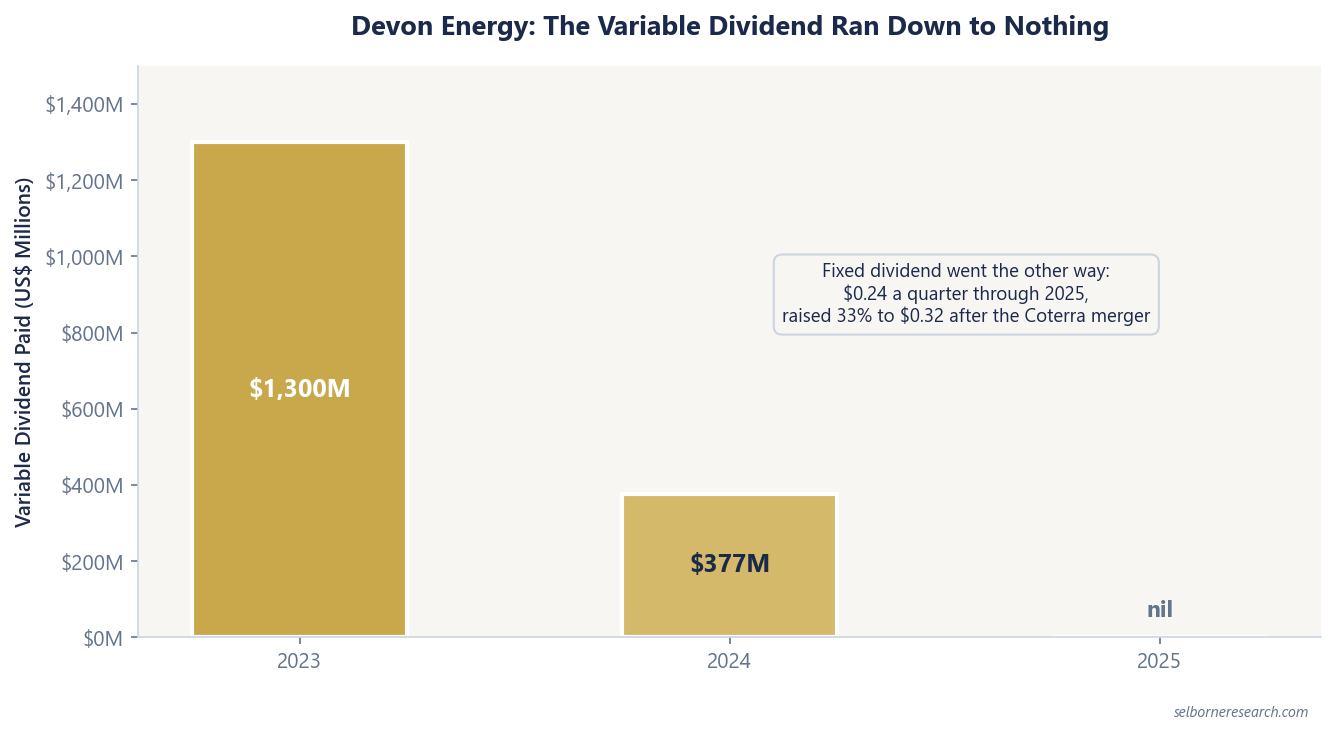
So in 2025 Devon paid only the fixed $0.24 a quarter and put the surplus into repurchases, taking the share count down about 5%. Free cash flow was $3.1 billion for the year and $2.2 billion went back out as dividends, buybacks and debt retirement. The cash engine ran fine; the shape of the return changed.
Post-merger the framework is simpler. The fixed quarterly dividend rose 33% to $0.32, a little above the $0.315 signalled at announcement, which annualises to $1.28 and yields roughly 3% at the current share price. Alongside it sits an $8 billion repurchase authorisation running to 30 June 2029, worth about a sixth of the market value. The board says it expects to review the dividend annually. There is no formal variable component any more, and no stated percentage of free cash flow committed to buybacks, so the payout is now a judgement call each quarter rather than a formula.
Costs, Reserves, and the Word "Breakeven"
Devon replaced 193% of its 2025 production at a finding and development cost of $6.14 per BOE, exiting the year with 2.4 billion BOE of proved reserves. Both figures are Devon standalone, booked before Coterra arrived.
Read a replacement rate carefully. Reserve additions include revisions to barrels already on the books, and revisions move with the price used to book them at least as much as with drilling: a strong price year makes previously uneconomic barrels economic, and the replacement rate flatters. The $6.14 is drill-bit F&D, the capital spent on drilling and completion divided by the reserves that spending added. It excludes what a company pays to buy reserves, so nothing like the $2.6 billion lease purchase sits inside it. Two companies quoting F&D on different treatments of revisions and acquisitions are not quoting the same metric.
Devon's often-quoted corporate breakeven of roughly $45 WTI comes from a May 2025 investor deck and has not been restated since, not in the FY2025 annual report, not in the February 2026 results, and not since the merger closed. Treat it as dated rather than current. It is also a narrower claim than it sounds: a corporate breakeven is the oil price at which company-wide cash flow covers sustaining capital and, usually, the dividend. It excludes growth drilling entirely, and every company writes its own definition. It is a different number from the price a single new well needs to pay back, and a different number again from the cash cost of keeping an existing well flowing. The shale breakevens guide separates the three.
What to Watch in the Financials
Four numbers carry most of the quarter: operating cash flow, capital expenditure, free cash flow, and how the returns split between dividend, buybacks and debt. The second quarter of 2026 gives the shape. Operating cash flow was $3.7 billion, adjusted free cash flow $1.7 billion, and the reinvestment rate 43%, down from the mid-50s Devon ran a couple of years ago. That reinvestment rate is the number to track: it is the share of cash flow going back into the ground, and it sets how much is left for anyone else.
You can size the oil sensitivity yourself, which is more useful than a company slide. Second-quarter oil production of 503,000 barrels a day is about 180 million barrels a year, so a $10 move in WTI is roughly $1.8 billion of revenue before royalties and tax, and closer to $1 billion of cash once both come out. The run rate is higher again now Coterra is inside a full quarter. Gas now matters too: 3,300 million cubic feet a day is about 1.2 trillion cubic feet a year, so 50 cents on the gas price is worth several hundred million on the same rough basis. Neither figure is a forecast. They are the multiplications that tell you how fast the commodity reaches the dividend.
Watch per-unit cash costs in the earnings supplement, meaning lease operating expense, gathering and transport, and production taxes. Two things can push them: post-merger integration failing to land, and the Marcellus, where gas sells at a discount to Henry Hub because Appalachian pipeline capacity is tight. Judge the $1 billion synergy target the same way. It should show up as lower cost per BOE and lower capital per foot drilled, not as a bar on a slide. The F&D cost benchmarks guide sets out how to compare these across the sector.
On the balance sheet, Devon ended the second quarter with $11.4 billion of debt against $1.0 billion of cash, and retired the remaining $750 million term loan in July. It targets roughly $9 billion of total debt by the end of 2027, mostly through maturities it does not intend to refinance. That is a comfortable position for a producer this size, and it is what lets the buyback run without a covenant argument.
Peer Context: Why the Breakeven Ladder Misleads
Devon, EOG Resources, Diamondback and ConocoPhillips are the names that come up together, and the usual way of ranking them is by published corporate breakeven. That ranking is close to meaningless, and it is worth seeing why, because the same trap applies across the sector.
Diamondback states its breakeven as the WTI price that generates cash equal to the capital needed to hold oil production flat plus its base dividend, assuming a $3 gas price and $20 NGLs at a stated strip date. Move any one of those three assumptions and the headline number shifts by dollars with nothing having happened in the field. Devon's $45 rests on a different set of assumptions and is over a year old. A third operator may exclude the dividend altogether. Lining the four figures up in a bar chart compares four different calculations and reads as a quality ranking.
What does compare across these companies is the reinvestment rate, cash cost per BOE produced, and F&D once you have checked the two companies treat revisions and acquisitions the same way. Those are computed from filed figures rather than chosen by management. Devon's distinguishing features against this peer group are its Delaware acreage depth and, since May, a gas weighting none of the pure Permian names carry.
On valuation, the arithmetic is simple enough to do in your head. A market capitalisation near $47 billion plus about $10.4 billion of net debt gives an enterprise value around $58 billion, against annualised second-quarter operating cash flow of roughly $15 billion. That is under four times, and the second quarter carried only eight weeks of Coterra, so a full-quarter run rate makes it lower still. US E&Ps trade on multiples like this because the market is pricing both the commodity and the fact that a large share of that cash flow has to go straight back into drilling. The NAV versus EV/DACF guide covers what the multiple leaves out.
Risks
Integration. Merging two large E&Ps is operationally awkward and the $1 billion synergy target assumes headcount reductions, rig consolidation and procurement savings that take 12 to 18 months to land. Devon carried $174 million of after-tax restructuring costs in the second quarter alone. Culture, field operations and systems migrations have derailed E&P mergers before, and the evidence either way shows up in per-unit costs rather than in commentary.
Gas exposure is new. Gas is now roughly 40% of Devon's volumes, and the Marcellus is what took it there: a business with a different cost structure, a different decline profile and a different price. Appalachian gas sells below Henry Hub because pipeline capacity out of the basin is constrained, and that discount widens when regional production runs ahead of takeaway. A weak gas year now dilutes returns in a way it could not have done for Devon in 2024.
Spacing and parent-child interference. When operators drill infill wells near existing ones, pressure depletion around the older well can cut the newer well's recovery. Industry work on the Permian has put the gap at roughly 20-30% on average, and it worsens the tighter the spacing. Devon's multi-zone Delaware development leans on tight spacing to stretch inventory life. If interference bites harder than modelled, F&D drifts upward and the cost advantage narrows. Per-well productivity in the quarterly supplement is where this surfaces first, and it is also part of why the company paid $160,000 an acre for undrilled rock.
Commodity and regulation. A sustained move below $50 WTI would compress the buyback first, since it is discretionary, and pressure capex next. The fixed dividend is designed to survive that, but no producer is immune to a long downcycle. Methane and flaring rules continue to tighten, and the Anadarko in particular faces produced-water disposal constraints that raise cost per well.
Devon must keep drilling just to hold production flat. The primer costs that reinvestment inside a reserve-based NAV.
The Excel model is the primer's reserve-based NAV live across 15 sheets: change the oil price, decline rate or discount rate and the valuation moves.