EOG Resources (EOG)
EOG Resources research profile covering multi-basin oil and gas development, well economics, capital discipline and valuation.
Educational analysis for professional use. This profile is not investment advice or a recommendation to buy or sell any security, and it is not personalised.
Snapshot
Business Overview
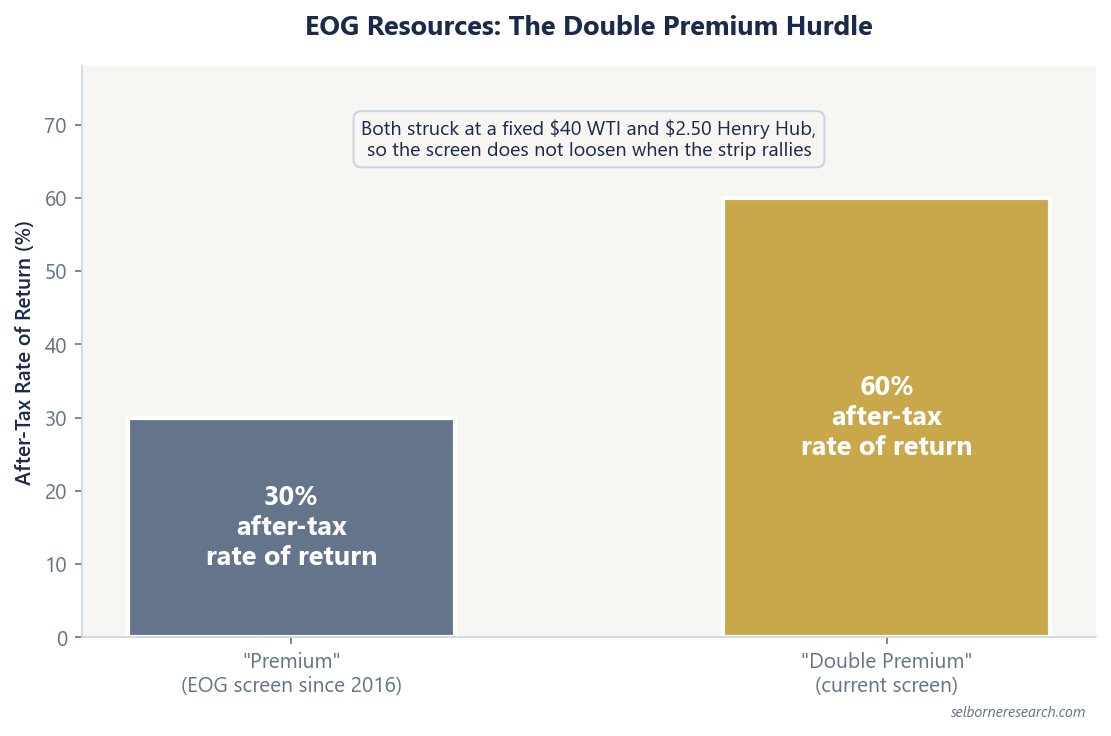
EOG Resources will not drill a well unless it clears a 60% after-tax rate of return at $40 WTI and $2.50 Henry Hub. That is the "double premium" standard, twice the 30% hurdle EOG had applied since 2016. The two prices are the part people miss: they are fixed well below anything the market has paid in years, so the screen is deliberately harsh and does not loosen when the strip rallies. Every capital allocation decision flows from it, and it shapes the company more than any acreage count.
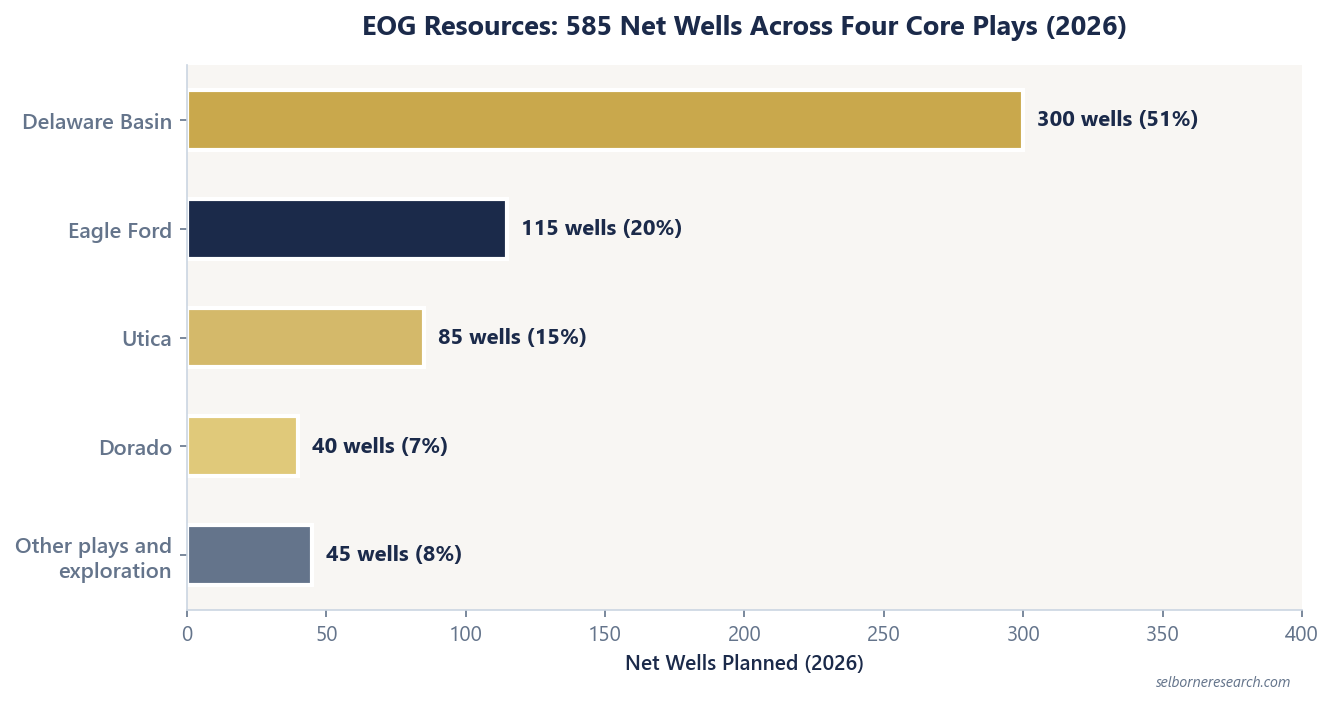
The asset base behind that filter is genuinely multi-basin. The Delaware Basin, EOG's slice of the Permian, remains the anchor; Eagle Ford in South Texas still pulls weight. Dorado, the dry gas play, exited 2025 at roughly 750 MMcf/d gross, with management aiming at 1 Bcf/d by the end of 2026. Utica became a core position when EOG closed the Encino acquisition in 2025, which added 675,000 net core acres and more than 2 billion BOE of undeveloped net resource, taking the combined Utica position to around 1.1 million net acres. The 2026 programme runs to 585 net wells: roughly 300 in the Delaware, 115 in the Eagle Ford, 85 in the Utica and 40 at Dorado, with the balance in smaller domestic plays and international exploration.
Production hit 1,232.2 MBOED in 2025 and proved reserves climbed 16% to 5.5 billion BOE, about twelve years of output at that rate. The reserve replacement figure needs unpacking. Additions from all sources, excluding revisions caused by price, replaced 254% of production. But 748 million BOE of those additions were bought rather than drilled, almost all of it Encino. Strip the purchases out, as EOG's own adjusted disclosure does, and replacement was 89%. The drill bit did not quite hold the reserve base flat last year.
What to Watch in the Financials
F&D cost. Finding and development cost is the money spent divided by the barrels added, and it is only useful when you know which barrels are in the denominator. EOG's last clean drill-bit read was $6.68/BOE for 2024. The 2025 all-in figure is not the same animal: it carries the $5.6 billion Encino cheque in the numerator and 748 million bought BOE in the denominator, so it says more about the price of the acquisition than about the cost of a well. The organic read is the one to build on, and for 2025 it is 401 million BOE added by drilling and revision against 450 million produced. Well costs themselves fell 7% across the portfolio in 2025 on longer laterals and completion efficiency, so the drilling side is improving even as the ratio muddies. Our F&D benchmarks guide sets out which version to compare against which.
Reserve replacement ratio. Same trap, same fix: read it organically. Above 100% excluding acquisitions, the drill bit is adding more than the wells are taking out; below it, the company is living off the reserve base. A single year proves little, because a run of good wells shows up as an upward revision and flatters the ratio, so watch it on a rolling three-year view. EOG's 89% for 2025 is not alarming on its own, but two or three years of it would be. Our reserves report guide walks through how to pull the split from a 10-K.
Return on capital employed. EOG posted 19% ROCE in 2025 against a three-year average of 24%, and the gap between those two numbers is the point. ROCE on an E&P is a commodity price read as much as a capital discipline read, so the average tells you what the last three years of oil paid, not what the assets will earn next. What travels across the cycle is the ordering: EOG earns roughly double ConocoPhillips's 10% on capital employed, and that ordering has held for years. A company earning 19% on its capital base deserves a different multiple from one earning 10%, which is the link the NAV vs EV/DACF guide works through.
Shareholder returns. EOG generated $4.7 billion of free cash flow in 2025 and handed all of it back through dividends and buybacks, against a stated policy floor of 70%. The dividend yield sits around 3% and total shareholder yield runs north of 6% once repurchases are counted. Net debt of $4.54 billion, under half a turn of EBITDA, means none of that is being funded with borrowing.
Peer Context: EOG vs Devon and ConocoPhillips
EOG's 19% ROCE in 2025 sits well clear of ConocoPhillips at 10%, and the reason is mostly structural. ConocoPhillips produces 2,375 MBOED across global operations, including long-dated Alaskan and LNG projects that absorb capital for years before they earn anything, and every dollar of that sits in the denominator. Devon Energy is the closer comparison: a Lower 48 business spanning the Delaware, Anadarko, Williston and Eagle Ford, enlarged by the 2024 purchase of Grayson Mill's Williston position and again by the all-stock merger with Coterra that closed on 7 May 2026, which added Marcellus gas and took the combined company to roughly 1.67 million BOE/d.
Cash operating costs averaged $10.09/BOE in 2025, and that figure covers lifting, gathering, transport and production taxes, not the cost of finding the next barrel. Do not read it as a breakeven. Breakeven only means something once you say which one, because the three in common use are miles apart. A Dorado gas well pays back at about $1.40/Mcf. The corporate breakeven, the WTI price at which EOG covers its whole 2026 capital programme and the regular dividend without borrowing, is around $50. That second number is the one that decides whether the dividend is safe, and it is the one management quotes.
Key Risks
Inventory depth is self-graded. The double-premium count rests on EOG's own type curves for wells it has not drilled, and no auditor signs it. That is not a criticism of EOG specifically, it is true of every shale inventory claim, but it means the number moves with results rather than with prices. The inventory now spans four plays at different stages of proof. The Delaware is the most tested; the Utica has barely been drilled under EOG's completion design. If Utica wells come in below the 60% return threshold, or if tighter Permian spacing steepens decline curves, locations quietly drop out of the premium bucket. The 85 Utica wells planned for 2026 are the first real read.
Gas is becoming the second story. Dorado exited 2025 at roughly 750 MMcf/d gross and is aimed at 1 Bcf/d, while the Utica brings substantial dry gas of its own. Management is building towards around 900 MMcf/d of LNG-linked sales by 2027, priced off a mix of Henry Hub, JKM and Brent. Spreading the benchmark helps, but it does not remove the exposure: it swaps a single US gas price for three prices EOG does not control. If Henry Hub sits below $3 for a stretch and LNG export margins compress with it, the gas-weighted barrels drag on a portfolio still valued largely on its oil.
Commodity price. At a sustained $40 to $45 WTI, free cash flow compresses hard and the shareholder return runs dry long before the balance sheet does; sub-0.5x leverage leaves plenty of room. Note what does not happen: because the double-premium hurdle is measured at a fixed $40 WTI, a fall in the strip does not disqualify a single location. What it takes away is the cash to drill them. The inventory stays on the page while the programme shrinks, and that is a distinction worth holding on to when a management team points at inventory years during a downturn.
Capital intensity at scale. The 2026 capital plan is $6.5 billion, targeting 5% oil growth and 13% total growth once Encino volumes are counted. That is a lot of capital to deploy well across 585 net wells and four core plays. About 45% of 2026 well costs are already locked in, which protects the margin on that portion, but execution risk rises with complexity. If service cost inflation returns, clearing the double-premium bar gets harder, and the bar does not move.
Regulatory and permitting risk. EOG's low-cost structure absorbs compliance costs better than most, but emissions regulations, flaring restrictions, and water management rules are tightening. Over a 12-year reserve life, policy shifts on permitting or fiscal terms could reshape project economics, particularly for the longer-cycle Utica and Dorado gas plays.
EOG screens wells against a return hurdle before it drills them. The primer scores that discipline on the recycle ratio.
The Excel model is the primer's reserve-based NAV live across 15 sheets: change the oil price, decline rate or discount rate and the valuation moves.