Cobre Panama and Royalty Concentration Risk
What Franco-Nevada's $1.17B Cobre Panama impairment teaches about single-asset concentration in royalty and streaming portfolios, with FY2025 peer data.
Educational analysis for professional use. This guide is not investment advice or a recommendation to buy or sell any security, and it is not personalised.
Top-Asset Share, Not Asset Count
Diversification across hundreds of assets does not protect a royalty company from a government shutting its single largest one. Top-asset share, not asset count, is the risk metric that matters.
Franco-Nevada held interests in over 400 assets when Panama’s Supreme Court halted Cobre Panama in November 2023. The portfolio breadth was real. It made no difference to the asset that was lost: the company wrote its stream investment down by US$1,169.2 million, to a carrying value of nil, within weeks. The mechanics of how royalties and streams generate cash are covered separately; here the question is what happens when the cash stops.
What Happened: The Timeline
The striking feature is the pace: the write-off took one quarter, while the remedy has so far taken two and a half years and is still incomplete.
| Date | Event |
|---|---|
| Nov 2023 | Panama’s Supreme Court rules Law 406 (the mine’s contract law) unconstitutional. Production halts. |
| Dec 2023 | Franco-Nevada impairs its Cobre Panama stream investment by US$1,169.2M, writing the carrying value to nil. |
| Jun 2024 | Franco-Nevada files for arbitration with ICSID under the Canada-Panama Free Trade Agreement (27 June). |
| Mar 2025 | First Quantum, the operator, discontinues its ICC arbitration and suspends its own FTA arbitration as engagement with the government progresses (31 March). |
| Jun 2025 | Franco-Nevada agrees to suspend its ICSID arbitration as negotiations progress (18 June). Suspended, not withdrawn. |
| FY2025 | A US$4.8M partial impairment reversal is booked against concentrate shipments. |
| Apr 2026 | Panama issues Resolution No. 27 (7 April), authorising removal, processing, and export of pre-suspension ore stockpiles. The operator states this “does not constitute a mine reopening”. |
| Q3 2026 onwards | Franco-Nevada expects ~23,100 oz of gold and ~265,000 oz of silver in stream deliveries from the stockpiles, the majority arriving in 2027. |
| Each results date | Franco-Nevada reassesses what the stream is worth. An impairment reverses as the cash flows come back, so watch the carrying value rather than the headlines. |
The arbitrations were filed and then parked. Both Franco-Nevada and First Quantum chose negotiation over legal confrontation once the political climate shifted, which tells you the treaty claim is leverage rather than a payment schedule. It has cost both of them real money and returned nothing so far.
The April 2026 authorisation covers only ore mined before the shutdown. Until the government decides on the mine itself, Franco-Nevada’s 2026 guidance of 510,000-570,000 gold-equivalent ounces, the common unit royalty companies use to add up production across metals, excludes Cobre Panama entirely. The market gets the stockpile ounces as upside; the mine restart remains a political event no model can schedule.
Why Diversification Failed
The portfolio did exactly what it was designed to do, and it still could not insure against a binary political outcome at the largest asset.
The royalty model’s diversification argument is sound against ordinary operating risk. A pit-wall failure at one mine, a grade shortfall at another: across 400-plus assets these wash out. But government action is not an ordinary operating risk. It is binary and hits the whole asset in one stroke. Nothing else in the portfolio correlates with it. When the asset hit is your biggest revenue contributor, the loss lands directly on NAV and no amount of breadth dilutes it.
There is also a timing asymmetry worth internalising. The impairment was recognised in the same quarter as the shutdown. The recovery path runs on political time: arbitration filed seven months later, suspended a year after that, first meaningful deliveries expected almost three years after the halt, and a restart decision still pending as of mid 2026. Investors who treated the FTA arbitration as a near-term catalyst misread the clock. Legal remedies against a sovereign are measured in years, and the parties themselves preferred to put the lawyers on hold and negotiate.
The Screening Framework
Concentration is measurable from filings, so screen it before anything else. These are working conventions we state rather than published standards:
| Screen | Threshold | Reading |
|---|---|---|
| Top-3 asset share of revenue | Below 50% | Healthy |
| Top-3 asset share of revenue | Above 60% | Concentration risk |
| Single asset share of NAV | 25-30% cap | Above this, the “diversified” label stops applying |
A company breaching these screens is not uninvestable. It means the market’s diversification premium is partly unearned, and the valuation should carry a discount that reflects single-asset and single-jurisdiction exposure. The same portfolio detail feeds the EV/GEO accretion test: a deal that adds GEOs while deepening reliance on one mine is lower quality than the headline multiple suggests.
How the Peer Group Screens, FY2025
The FY2025 filed figures put real distance between the names. Franco-Nevada, post Cobre Panama, is now the least concentrated senior; Wheaton is the most concentrated, with the mines Vale operates supplying about half its revenue.
| Company | Largest asset | Largest asset share | Top-3 share | Basis |
|---|---|---|---|---|
| Franco-Nevada (FNV) | Candelaria | 12.8% of revenue | 31.5% | Revenue |
| Royal Gold (RGLD) | Mount Milligan | 21.7% of revenue | 41.9% | Revenue |
| Triple Flag (TFPM) | Northparkes | 29.1% of GEOs (28.2% of revenue) | 57.8% | GEOs |
| OR Royalties (OR) | Canadian Malartic | 39.7% of GEOs | 65.2% | GEOs |
| Wheaton (WPM) | Salobo | 44.9% of revenue | 67.9% | Revenue |
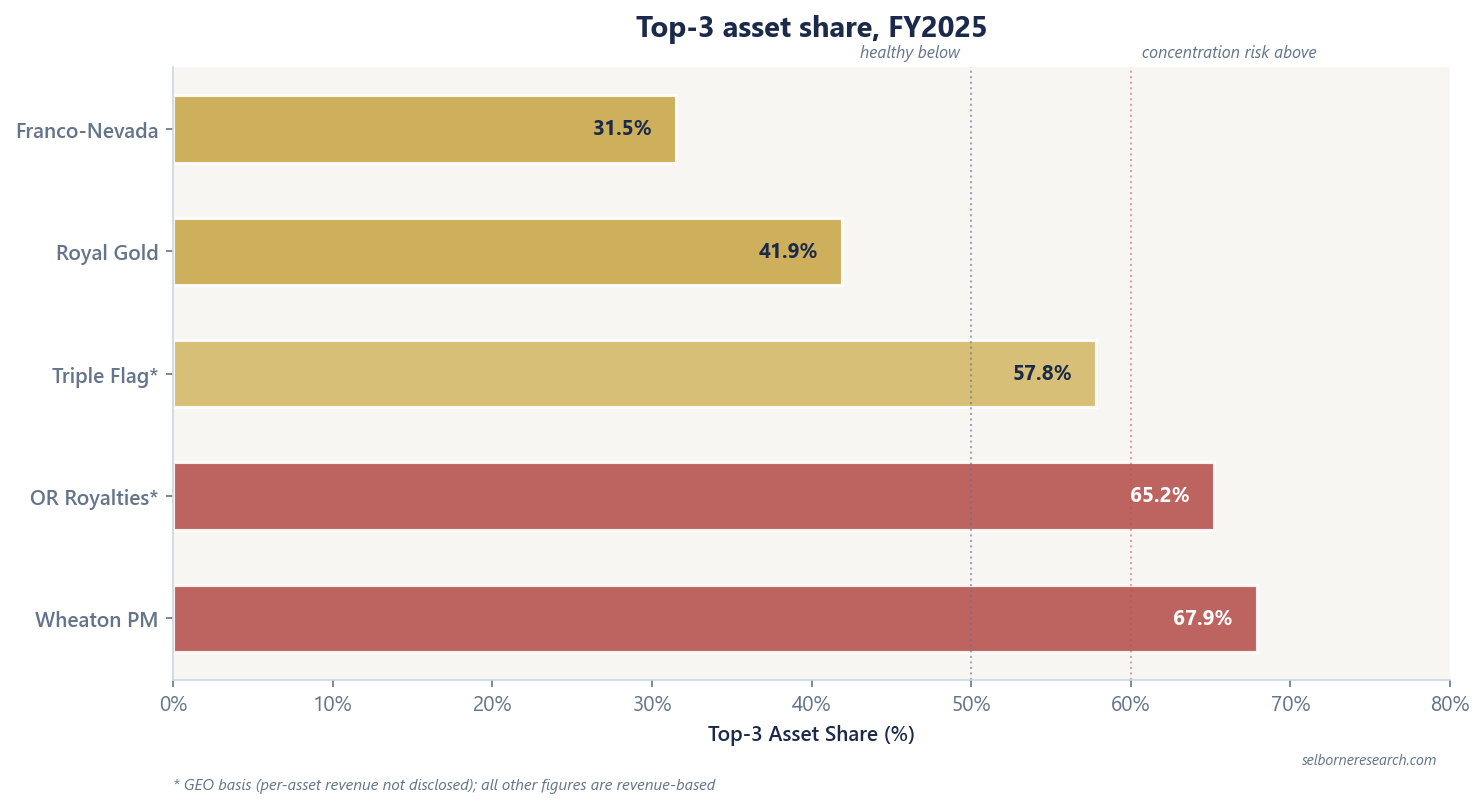
Applying the screens: FNV and RGLD pass comfortably. TFPM sits just inside the 60% line at 57.8%. OR and WPM breach it, and both also breach the single-asset guideline, with Canadian Malartic at 39.7% of OR’s GEOs and Salobo at 44.9% of Wheaton’s revenue. Wheaton also carries an operator concentration on top: the mines Vale runs supplied 49% of FY2025 revenue, so one counterparty sits behind half the book. None of this says Salobo will suffer Cobre Panama’s fate. Brazil is not Panama and Vale is not First Quantum. It says that if something did, the portfolio offers far less protection than a 48-asset count implies.
Two cautions when running this screen yourself. Check the basis, because OR and TFPM disclose per-asset GEOs rather than revenue, and the two measures can diverge when metal mixes differ. And read the trend, not just the level. TFPM’s Cerro Lindo stream contributed 23.1% of FY2025 GEOs, but it takes 65% of payable silver only until 19.5 million ounces have been delivered, and 25% after that. The threshold was passed in April 2026, so the stream’s share is falling mechanically.
The Irony in Franco-Nevada’s Numbers
Franco-Nevada’s clean 31.5% top-3 concentration exists partly because the government of Panama removed what was the largest asset from the revenue line.
That is the uncomfortable footnote to the table above. Franco-Nevada’s FY2025 revenue of US$1,822.8M and its 519,106 GEOs sold include just 11,208 GEOs from Cobre Panama (residual concentrate shipments). Concentration screens are snapshots; the same screen run in 2022 would have flagged Cobre Panama’s weight, and an investor who took the 25-30% single-asset NAV cap seriously would have discounted FNV’s NAV for it before the Supreme Court forced the issue. The screen works. It only works if you run it before the government does.
A restart, if it comes, would push Cobre Panama back towards the top of FNV’s portfolio and re-concentrate the book. That is a good problem, recovered NAV is recovered NAV, but it illustrates that concentration risk is dynamic and should be re-measured every reporting period.
Putting It into a Valuation
Concentration feeds the model in two places: the discount rate on the dominant asset, and the risking applied to its NAV contribution.
In a sum-of-parts NAV, the dominant asset should carry a discount rate that reflects its jurisdiction on a standalone basis, not the portfolio’s blended quality. Where a single asset exceeds the 25-30% NAV guideline, sensitise the whole valuation to that asset going to zero; the Cobre Panama precedent makes this a scenario with a base rate, not a hypothetical. Tax structure can concentrate alongside revenue too, since the dominant asset often sits in one tax jurisdiction; the streaming tax-rate trap covers how that flows through NAV. The full sum-of-parts framework, including the discount-rate tiers and risking factors, is in the Royalty & Streaming Sector Primer.
Cobre Panama showed that losing one asset out of more than four hundred can cost US$1.17 billion.
Royalty & Streaming Sector Primer
A court ruling can erase a royalty book's biggest revenue source. The primer risks each asset separately.
The Excel model is the primer's two NAVs live across 10 sheets: change the gold price, delivery percentage or discount rate and the valuation moves.
Frequently Asked Questions
- What happened to Franco-Nevada's Cobre Panama stream?
- In November 2023 Panama's Supreme Court ruled Law 406, the contract law governing the Cobre Panama mine, unconstitutional, and production halted. Franco-Nevada wrote its Cobre Panama stream investment down by US$1,169.2 million at 31 December 2023, taking the carrying value to nil. The mine has remained in preservation and safe management since, and Franco-Nevada's 2026 guidance of 510,000-570,000 gold-equivalent ounces excludes Cobre Panama entirely.
- Is Cobre Panama restarting in 2026?
- Not yet. In April 2026 Panama's Ministry of Commerce and Industries issued Resolution No. 27 authorising the removal, processing, and export of ore stockpiled before the 2023 suspension. The operator's release states this does not constitute a mine reopening. Franco-Nevada expects roughly 23,100 ounces of gold and 265,000 ounces of silver in stream deliveries from the stockpiles starting Q3 2026, with the majority in 2027. A decision on the mine itself is a separate political question, and political questions do not run to an analyst's timetable.
- Will Franco-Nevada reverse the Cobre Panama impairment?
- Partially, it already has: a US$4.8 million reversal was booked in 2025 against concentrate shipments. Franco-Nevada has said the April 2026 stockpile authorisation is an indicator of further reversal and that it will reassess the recoverable amount of the Cobre Panama cash-generating unit at its Q2 2026 results, around August 2026. That reassessment may reverse part or all of the original US$1,169.2 million charge, depending on what cash flows can be supported.
- What is a safe level of asset concentration for a royalty company?
- There is no regulatory standard, but a common screening threshold is that the top three assets below 50% of revenue is healthy and above 60% signals concentration risk, with a single asset capped at 25-30% of NAV. Against FY2025 filings, Franco-Nevada (top-3 31.5%) and Royal Gold (41.9%) pass; Triple Flag (57.8%) sits just inside the line, while OR Royalties (65.2%) and Wheaton (67.9%) breach it. Wheaton is the most concentrated of the group: its Vale-operated mines alone were 49% of revenue.