Teck Resources (TECK)
Teck Resources research profile covering copper growth, Quebrada Blanca execution, merger risk and diversified-miner valuation.
Educational analysis for professional use. This profile is not investment advice or a recommendation to buy or sell any security, and it is not personalised.
Snapshot
The Copper Pivot
Teck sold its steelmaking coal business to Glencore in July 2024 for US$7.3 billion, and what is left is a copper and zinc producer whose growth case rests on one mine. Quebrada Blanca, in northern Chile, is among the largest copper mines built this decade, and it is only now settling into steady operation. The coal money went into finishing it and into paying down debt. Copper exposure with a single large ramp-up as the catalyst; that is the thesis.
The market trades Teck as if QB were the whole company, and it is not. Group copper production was 453.5 thousand tonnes in 2025: QB 190, Highland Valley in British Columbia 127, Teck's 22.5% share of Antamina in Peru 86, and Carmen de Andacollo in Chile 51. Zinc added another 565 thousand tonnes, four-fifths of it from Red Dog in Alaska. Adjusted EBITDA was C$4,333 million and the year ended in a small net cash position.
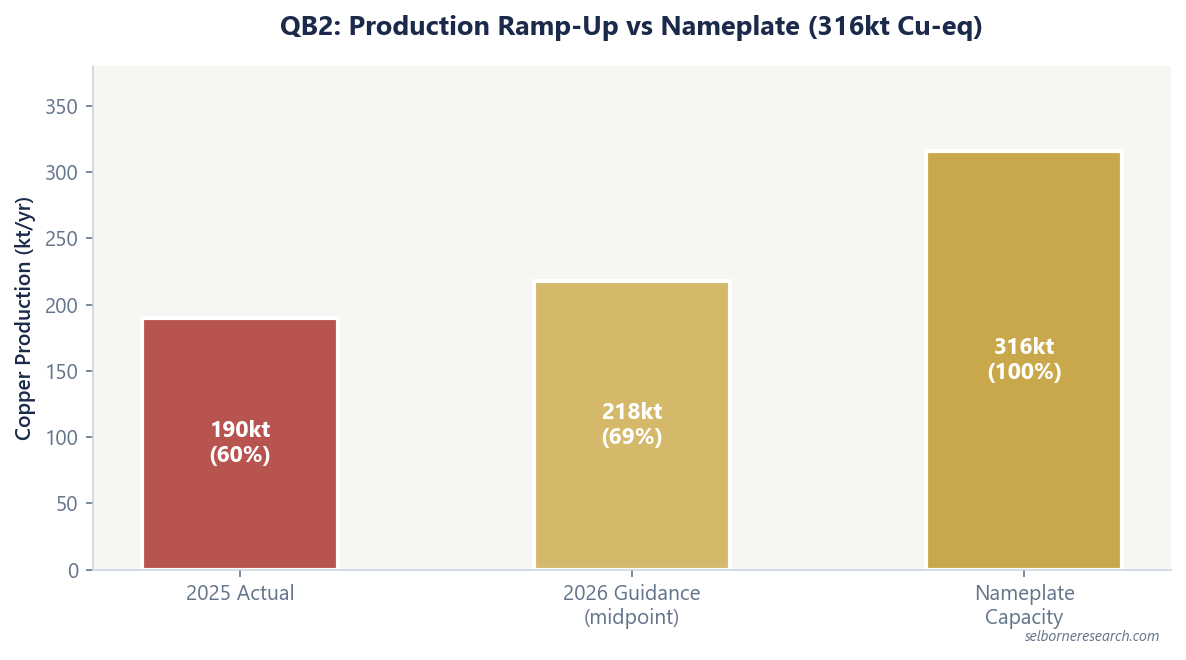
QB's 190 thousand tonnes sat against a design capacity of 316 thousand tonnes of copper-equivalent a year, from a concentrator built to treat 140,000 tonnes of ore a day. The gap was the tailings management facility, the engineered structure that holds the ground-up rock left once the copper has been taken out. It has to be raised in stages ahead of the tailings arriving, so when construction of those rock benches fell behind, the mill had to slow to match. That constraint has eased. QB produced 55,800 tonnes in the second quarter of 2026 with no tailings-related downtime at the concentrator, its third stable quarter in a row, and a second cyclone station due late in 2026 should lift sand deposition rates further.
What to Watch in the Financials
QB against its guidance range. Teck guides QB to 200–235 thousand tonnes in 2026. The first two quarters came in at 55,500 and 55,800 tonnes, which annualises inside the range rather than above it, so QB has stopped disappointing without yet surprising. Group guidance of 455–530 thousand tonnes rises to 505–580 in 2027 and then falls back to 435–510 in 2028. That dip is not a QB problem: Highland Valley steps down while its life-extension project is built.
Which cost number you are reading. Copper miners do not report AISC per ounce; that is a gold convention. Teck reports cost per payable pound on two bases and the difference is large. Total cash cost was US$2.55/lb in 2025. Net cash unit cost was US$2.03/lb, the same costs after subtracting the cash margin earned on the zinc, molybdenum, silver and gold that come out of the same rock. Guidance for 2026 is $2.25–2.55 total and $1.85–2.20 net, and QB on its own ran at $1.83/lb in the second quarter against $2.45 a year earlier. The catch in any net figure is that it moves when by-product prices move: a weaker molybdenum or zinc price raises Teck's reported copper cost with nothing having changed at the mine. Neither number is a margin. Both are costs, and the margin is whatever the copper price leaves on top.
Anglo American merger. Shareholders of both companies approved the deal in December 2025, and Canada cleared it under the Investment Canada Act days later, with commitments including C$4.5 billion of Canadian spending over five years across the Highland Valley extension, Trail and Galore Creek. China and South Korea are the approvals still outstanding. Teck says the merger should close within the 12 to 18 months from its September 2025 announcement, and Anglo's chief executive has put the window between September 2026 and March 2027. The copper logic is specific rather than general: Anglo's Collahuasi mine sits next to QB in the same corner of northern Chile, and the two companies expect about US$1.4 billion a year of additional EBITDA from 2030 by running the pair together. If it fails, Teck goes back to its own assets and its own balance sheet.
Peer Context
Teck sits in an awkward middle among the copper majors: not large enough to set the benchmark, not cheap enough to be defended on cost. Freeport-McMoRan sold 3.6 billion pounds of copper in 2025, roughly 1.6 million tonnes, at a net unit cash cost of US$1.65/lb. Southern Copper mined about 956 thousand tonnes at US$0.58/lb. Teck produced 453.5 thousand tonnes at US$2.03/lb.
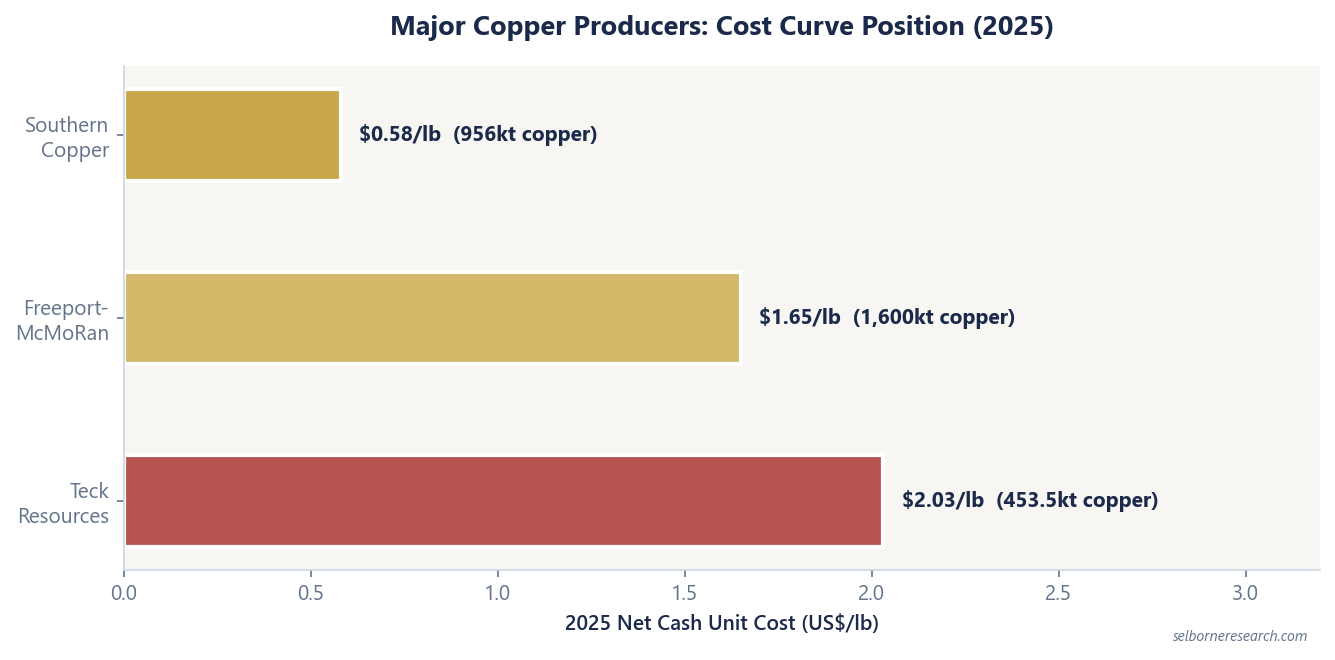
Southern Copper's figure is the one to read slowly, because it shows what a net cost can hide. Its cash cost before credits was US$2.17/lb in 2025, not far below Teck's US$2.55. Almost the entire gap in the net numbers is silver, zinc and molybdenum revenue rather than cheaper mining, which is why a cost table is only worth reading when every row is on the same basis. The growth case for Teck still turns on QB: at anything near design throughput, volumes rise and unit costs fall together, because the fixed cost is already being paid. Until then the screen runs against what the fleet produces now.
Key Risks
QB tailings. The facility is no longer stopping the mill, but it is not finished. Teck is weighing whether to pull material placement planned for 2027 into this year by building the next rock bench early, roughly US$100 million of additional 2026 capital, so the permanent tailings pipeline can go in sooner. That is what an easing constraint looks like: it turns from lost tonnes into capital and sequencing. If deposition rates disappoint again, production and unit costs miss together, because the same fixed cost is spread over fewer pounds.
Anglo merger regulatory hurdles. China and South Korea have not cleared the deal, and both have used competition review in mining to extract concessions before. If approval drags past the stated window, deal fatigue sets in and the merger premium erodes. If it fails outright, Teck loses the Collahuasi combination and funds Highland Valley and Galore Creek from its own cash flow, a tighter proposition.
Copper price. The price has been the whole story. LME copper averaged US$6.05/lb in the second quarter of 2026, 40% above the US$4.32 of a year earlier, and Teck's quarterly adjusted EBITDA went from C$0.7 billion to C$2.2 billion. It works the same way in reverse. Group production of 453.5 thousand tonnes is about a billion payable pounds a year, so fifty cents on the copper price is worth roughly US$500 million of annual revenue, and mine costs barely move with the price, so most of that lands in EBITDA. A return to last year's US$4.32 would take out something like C$2.4 billion a year, against 2025 adjusted EBITDA of C$4.3 billion. Shareholders do not carry all of it either way: partners own 40% of QB.
Where the assets are. Chile holds a little over half of Teck's copper: QB, which Teck owns 60% of and consolidates in full, and Carmen de Andacollo. Royalty and tax reform, water, and permitting are the political risks there; the ordinary ones are more mundane, and extreme rain with closed access roads partially suspended Carmen de Andacollo in July 2026. Peru enters through the 22.5% of Antamina. Canada is Highland Valley, no longer the depleting asset it was: the board sanctioned an extension in July 2025 that runs the mine to 2046 for C$2.1–2.4 billion, so the question there is the spend and the build rather than the ore. Alaska is Red Dog, and that one is genuinely finite, with zinc guidance falling from 462.7 thousand tonnes in 2025 to 230–270 thousand by 2028.
Teck sold the coal and kept the copper. The primer costs copper per pound, then folds it into a group NAV.
The Excel model is the primer's two NAVs live across 12 sheets: change the gold price, ramp or discount rate and the valuation moves.