Chemicals · Commodity Chemicals
Steam Cracker Yields by Feedstock
Ethane turns 80% of its weight into ethylene, gas oil 25%. How yields fall as the feed gets heavier, what else comes out, and how many tonnes of feed it takes.
Selborne Research · Commodity Chemicals coverage: 7 guides, 6 company profiles, a primer and Excel model
Educational analysis for professional use. This guide is not investment advice or a recommendation to buy or sell any security, and it is not personalised.
On this page
The Feed Decides What a Cracker Sells
A steam cracker’s feed decides what the plant sells, and that matters as much as what its ethylene costs. Ethane turns 80% of its weight into ethylene. Gas oil, at the heavy end, turns 25% into ethylene and spreads the rest across propylene, butadiene, aromatics (benzene, toluene and xylenes), fuel gas and heavy oil. An ethane cracker is an ethylene plant with a few by-products. A naphtha or gas oil cracker is a multi-product plant, and ethylene is under a third of what it makes.
So ranking feeds by ethylene yield is half the comparison. The other half is what the heavier feeds make instead, and what those products sell for.
What a Steam Cracker Does, and What “Yield” Means
A steam cracker mixes a hydrocarbon feed with steam and heats it in furnace tubes to 750-875°C, hot enough to break the molecules into smaller ones. The cracked gas is quenched to stop further reaction, compressed, and separated at temperatures down to about −150°C into ethylene, propylene and the other products. Naphtha and gas oil crackers need an extra first step to strip out the fuel oil before the light gases are separated; ethane crackers do not.
Yield is tonnes of a product per tonne of feed, by weight. Two bases circulate, and they give very different numbers:
- Once-through (per-pass) yield is what one trip through the furnace produces. Chemistry papers often quote it on a molar basis.
- Ultimate yield is what the whole plant produces after the ethane and propane left in the cracked gas are separated and fed back to the furnaces until none is left. Comparisons between feeds use this basis, and so does this page.
Published ranges on the ultimate basis put ethane at 80-84% ethylene and naphtha at 29-34% (Ren, Patel and Blok, Energy, 2006). The US Department of Energy’s 2022 ethane market report quotes the same ranges.
Yields by Feed, Lightest to Heaviest
| Feed | Ethylene | Propylene | Butadiene | Aromatics | Hydrogen and methane | Other by-products and losses | Feed per tonne of ethylene |
|---|---|---|---|---|---|---|---|
| Ethane | 80.3% | 1.6% | 2.3% | 0% | 12.1% | 3.7% | 1.25 t |
| Propane | 46.5% | 12.5% | 4.8% | 0% | 28.2% | 8.0% | 2.15 t |
| Butane | 44.1% | 15.1% | 4.4% | 0% | 21.8% | 14.6% | 2.27 t |
| Naphtha | 32.4% | 16.8% | 5.0% | 10.4% | 15.0% | 20.4% | 3.09 t |
| Gas oil | 25.0% | 14.4% | 5.0% | 12.4% | 12.2% | 31.0% | 4.00 t |
Typical ultimate yields, share of feed by weight, with uncracked ethane and propane recycled. Source: Neelis, Patel, Gielen and Blok (2005), Resources, Conservation and Recycling 45, Table 5, reproduced by Lawrence Berkeley National Laboratory (2008) and the US Department of Energy (2022). “Other” covers the remaining four-carbon molecules (C4s), liquids with five or more carbon atoms, pyrolysis fuel oil (the heaviest residue of cracking) and 0.5% losses; each row sums to 100%. Feed per tonne of ethylene is 1 divided by the ethylene yield. No company’s plant is shown: these are industry-typical values.
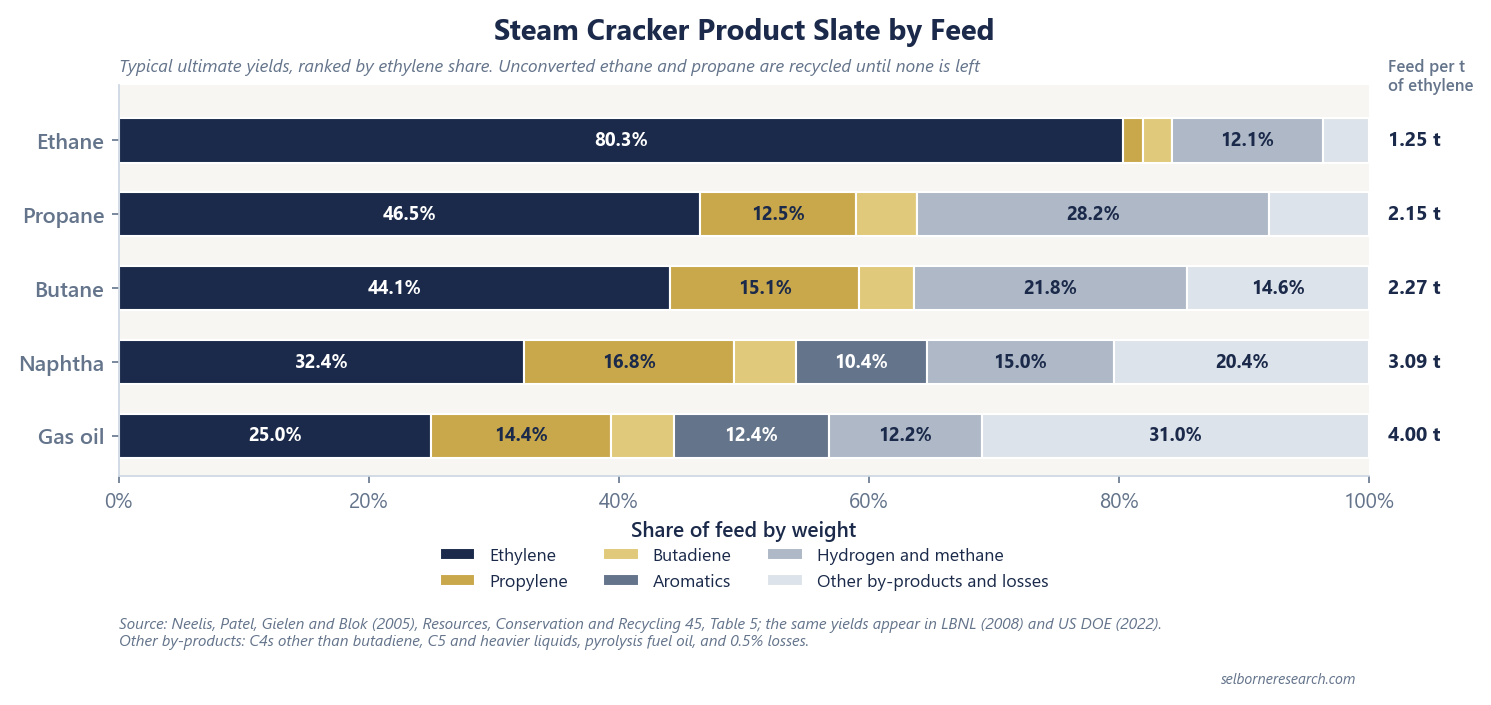
The two gas liquids in the middle behave differently from each other. Propane gives up more of its weight to hydrogen and methane than any other feed. Butane makes more propylene and more heavy by-products instead. Aromatics appear only once the feed is a liquid.
Heavier Feed, More Tonnes per Tonne of Ethylene
The right-hand column turns yield into the number a cost comparison starts from. On feed tonnage alone, a naphtha cracker buys about two and a half times as much material per tonne of ethylene as an ethane cracker, and a gas oil cracker more than three times.
Everything it buys beyond the ethylene has to be sold, burned or sent back to a refinery. For every tonne of ethylene a naphtha cracker also makes about 2.1 tonnes of something else: 0.52 t of propylene, 0.15 t of butadiene, 0.32 t of aromatics, 0.46 t of hydrogen and methane, and 0.63 t of other C4s, heavier liquids and fuel oil. A gas oil cracker makes 3.0 tonnes of something else. An ethane cracker makes a quarter of a tonne, most of it hydrogen and methane.
Much of the hydrogen and methane never reaches a customer. It is burned to supply the heat the cracking reaction absorbs, so a feed with a large fuel-gas yield partly fuels its own furnaces.
Co-Product Credits Narrow the Gap
Measured by ethylene alone, ethane beats naphtha by 2.5 times. Measured by all the high-value chemicals a cracker makes (ethylene, propylene, butadiene and aromatics), the gap shrinks to 1.3 times: 84.2% of the feed for ethane against 64.5% for naphtha. Propane, butane and naphtha all land within a point of each other on that wider measure, at 63.5-64.5%. These are the source’s printed totals; the naphtha components in the table add to 0.1 point more because each is rounded.
That is the co-product credit. Margin calculations for a cracker price the ethylene and then add the value of the other products, which the US Energy Information Administration (EIA) says are mainly propylene, butadiene, benzene and xylene. The net feed cost of a tonne of ethylene is the cost of the feed it took less what the co-products from that feed sell for.
Those credits are priced in their own markets. A glut of ethylene does not raise the price of propylene or benzene, so the credit does not grow when ethylene is the product in surplus. In the US, the EIA notes that cracking ethane has historically earned higher margins than cracking naphtha after co-product credits are counted.
Feed Flexibility Is Worth Something on Its Own
A cracker built for liquids has the equipment to handle heavier feeds, including the first-stage fractionation that strips out fuel oil and the separation columns for three- and four-carbon products. An ethane cracker needs little of that, because under 8% of what it makes has three or more carbon atoms. The liquid cracker can move along the table as relative prices change: toward lighter feeds when gas liquids are cheap, toward naphtha when propylene and aromatics are worth more.
Feed choice also sets the product mix. A plant running ethane makes almost no propylene or butadiene: 0.02 t of propylene per tonne of ethylene. Where the feedslate, the mix of feeds a cracker runs, has moved to ethane, propylene has to come from elsewhere. Lawrence Berkeley National Laboratory reported in 2008 that more than half of US propylene came from refinery streams, with metathesis, a process that turns ethylene and butenes into propylene, among the other routes.
What the Yield Table Does Not Tell You
The five rows are typical values, and a real plant can differ from them. Yields shift with the exact feed (naphthas vary) and with operating conditions such as furnace temperature and the amount of steam mixed in.
The table is in tonnes, so it says nothing about margins. Turning it into a cost per tonne of ethylene needs a price for the feed and for every co-product, and the answer changes whenever those prices move.
Companies disclose feedslates rather than yields. In the US about 78% of ethylene was made from ethane in 2019 (US Department of Energy, 2022). Dow reported more than 80% light-feed cracking in its Q3 2025 earnings presentation. LyondellBasell cracks ethane and other gas liquids in the Americas and naphtha in Europe. Westlake cracks ethane at Lake Charles and Calvert City. Read each against the table to see the product mix it implies.
Commodity Chemicals Sector Primer
Yield sets how much feed each tonne of ethylene needs. The primer and model net feedstock out of each producer's margin, compare their cash costs and value each.
- 15 sections, from how a spread business earns to a year-by-year reversion DCF and leverage on mid-cycle EBITDA
- 42 pages
- an ethane-advantaged polyethylene producer, a methanol producer and a chlor-alkali and PVC producer
- 3 producer engines
- listed producers across the ethylene, vinyl, methanol and acetyls chains on filed FY2025 figures
- 6-company screen
The Excel model is the primer's cycle-normalisation valuation live across 12 sheets: three producer tabs (ethane-advantaged polyethylene, methanol, and chlor-alkali and PVC), each reverting its spread and utilisation from trough to mid-cycle through a ten-year free-cash-flow schedule with working capital and sustaining capex; a valuation summary setting each DCF beside the through-cycle multiple screen; cycle scenarios, a cost-curve position, a leverage screen on mid-cycle EBITDA and two live sensitivity grids. Change the spread, the WACC or the exit multiple and the value moves.
See what's in the Commodity Chemicals Sector Primer →£25 PDF · £59 with the Excel model · £159 for all three Chemicals industries
Frequently Asked Questions
- What is the ethylene yield from ethane compared with naphtha?
- Published ranges put ethane at 80-84% ethylene by weight and naphtha at 29-34%, both as final yields after separation and recycling. A widely reproduced set of typical yields gives 80.3% for ethane and 32.4% for naphtha, with propane at 46.5%, butane at 44.1% and gas oil at 25.0%. Actual yields move with the exact feed and with operating conditions such as furnace temperature and the amount of steam mixed with the feed.
- What does a propane cracker produce besides ethylene?
- On typical ultimate yields, a tonne of propane makes 465 kg of ethylene, 125 kg of propylene and 48 kg of butadiene. Another 282 kg comes out as hydrogen and methane, much of which is burned to heat the furnaces, and the remaining 80 kg is heavier by-products and losses. Propane gives up more of its weight to fuel gas than any of the other four common feeds.
- How many tonnes of naphtha does it take to make a tonne of ethylene?
- About 3.1 tonnes at a typical ethylene yield of 32.4%, against 1.25 tonnes of ethane at 80.3%. The naphtha cracker therefore sells about 2.1 tonnes of other products for every tonne of ethylene, including roughly half a tonne of propylene, which is why its economics depend on co-product prices in a way an ethane cracker's do not.
- What is the difference between once-through and ultimate yield?
- Once-through, or per-pass, yield is what a single trip through the furnace produces, and chemistry papers often quote it on a molar basis. Ultimate yield is what the whole plant produces after uncracked ethane and propane are separated and sent back to the furnaces until none is left, measured by weight. Comparisons of feeds use ultimate yield, and mixing the two bases makes a recycled feed such as ethane look worse than it is.
Read next
Ethane vs Naphtha: Feedstock Advantage
Ethane yields 80-84% ethylene vs naphtha 29-34%; US ~78% ethane feedslate; why USGC sits low on the global curve and naphtha units idle first.
Chemical Industry Cost Curves
Feedstock as the primary axis of the ethylene cost curve; oil-vs-gas shifts; naphtha co-products; marginal producers idle first in downturns.
See it applied
These company profiles apply the concepts from this guide to real public companies.