Chemicals · Industrial Gases
Industrial Gas Business Models
On-site, merchant and packaged gas supply: contract lengths, minimum-purchase floors versus no-commitment merchant, and the filed mix at the four majors.
Selborne Research · Industrial Gases coverage: 7 guides, 4 company profiles, a primer and Excel model
Educational analysis for professional use. This guide is not investment advice or a recommendation to buy or sell any security, and it is not personalised.
On this page
Three Modes, Three Cash-Flow Profiles
How a gas company delivers its gas decides how much of its revenue survives a downturn. The supply mode sets the contract length, and whether the customer must pay for a minimum volume when its own plant runs slow.
On-site plants, also called tonnage, sit on or next to the customer and feed it by pipeline, under long contracts with minimum purchases or fixed monthly fees. Merchant, or bulk, supply trucks liquid gas to the customer’s storage tank. Packaged supply means cylinders and dewars (insulated flasks for liquid gas). Linde and Air Products file no minimum purchase for either of the last two.
Contract Structure by Mode
| Mode | Typical contract length | Minimum purchase / fee floor | Price escalation |
|---|---|---|---|
| On-site / tonnage | 10-20 years | Yes: minimum purchases or fixed monthly charges | Index-linked; energy costs passed to the customer |
| Merchant / bulk | 3-7 years | None filed by Linde or Air Products | List prices and surcharges |
| Packaged / cylinder | 1-3 years or purchase order | None | List prices and surcharges |
Sources: Linde’s and Air Products’ FY2025 10-Ks (Air Products: 15-20 years for large on-site plants, 10-15 for small ones); Air Liquide’s annual report, which puts Large Industries, its on-site unit, at contracts of 15 years or more with take-or-pay clauses and energy costs re-invoiced to the customer.
Revenue Mix: Filed Peer Contrast
| Company | Year to | On-site / Large Industries | Merchant / bulk | Packaged | Other |
|---|---|---|---|---|---|
| Linde (LIN) | 31 Dec 2025 | 24% ($8,083M) | 30% ($10,159M) | 35% ($11,853M) | 11% (incl. engineering) |
| Air Products (APD)‡ | 30 Sep 2025 | 51% ($6,180M) | 44% ($5,337M) | - | 4% equipment ($520M) |
| Air Liquide (AI)* | 31 Dec 2025 | 27% (€7,110M LI) | 47% (€12,132M IM) | within IM | 26% Healthcare and Electronics |
| Nippon Sanso (4091.T)† | 31 Mar 2026 | 12% | 30% bulk | 26% | specialty gases 8%; equipment and installation 25% |
‡Shares of $12,037M of sales, computed from the dollar figures; the 10-K’s own table rounds on-site up to 52% so that its column sums to 100.
*Shares of Gas & Services revenue (€26,085M), as Air Liquide prints them; Engineering & Technologies (€855M) sits outside. LI is Large Industries, IM Industrial Merchant, which covers bulk, cylinders and small on-site plants. Air Liquide’s FY2024 Universal Registration Document split Industrial Merchant at bulk 31%, packaged 27%, small on-site 6%.
†Share of revenue excluding the Thermos consumer business (¥1,326.3bn of ¥1,359.6bn), from Nippon Sanso’s results presentation; its shares sum to 101% on rounding. Nippon Sanso says “Bulk” and “Package” for merchant and packaged; the equipment figure combines industrial-gas and electronics equipment, installation and other.
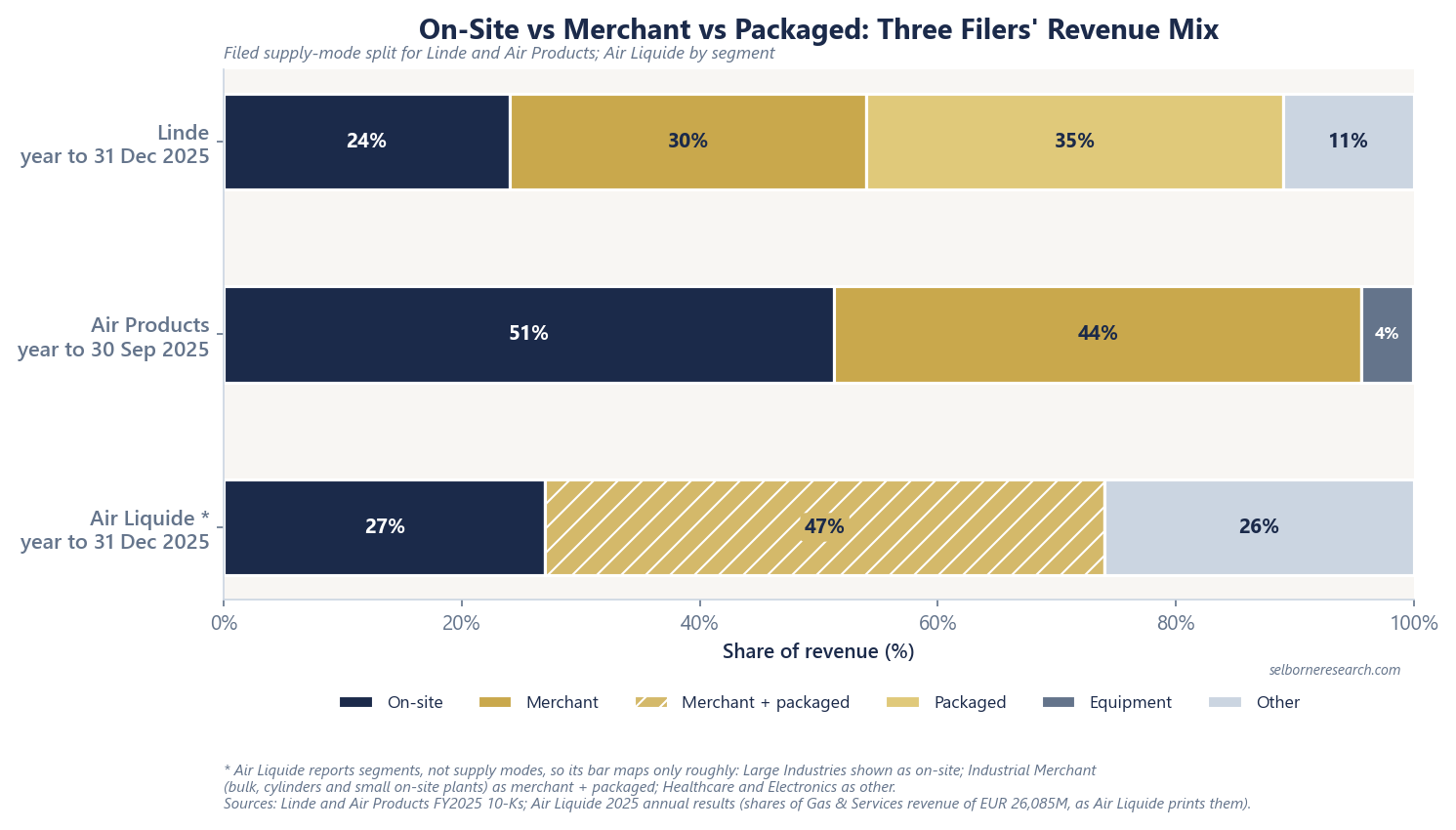
Linde earns more from cylinders than from on-site plants; Air Products leans on on-site plants. Cylinder and bulk revenue depends on delivery density and pricing, on-site revenue on contract floors, so the two earn differently through a downturn.
What Each Mode Means for a Model
On-site revenue lasts because of minimum purchases or fixed fees, whatever the customer’s plant ran at this quarter. Air Products’ $26bn of remaining performance obligations at 30 September 2025, contracted revenue not yet earned on its on-site and equipment contracts, measures that base.
Merchant has no minimum volume and most delivery cost is fixed, so lost tonnes hit profit hard. The share of lost revenue that comes straight off profit is the decremental margin. The primer uses an illustrative 40-60% or more for merchant and packaged on dense routes, against close to zero on contracted on-site minimums.
Packaged is the short-contract end: cylinders and dewars for laboratories, hospitals and welding shops. Linde’s packaged share is the highest filed by the four majors (Air Products does not split packaged out of merchant), so list-price discipline matters more there than at on-site-heavy peers.
Industrial Gases Sector Primer
Contracted on-site cash flow valued year by year with a renewal value, the merchant and packaged slice on a market multiple, a backlog adder and a downturn test.
- 15 sections, from the three supply modes to a sum-of-the-parts valuation, a downturn test and ROCE against WACC
- 43 pages
- a packaged-and-merchant global leader and an on-site-heavy major
- 2 worked archetypes
- the listed gas majors on filed supply-mode mix, return on capital and backlog
- 4-company screen
The Excel model is the primer's sum-of-the-parts valuation live across 11 sheets: two archetypes (a global leader and an on-site-heavy major), each splitting EBITDA by supply mode, valuing the contracted on-site slice as escalated year-by-year cash flow over the contract plus a renewal value and the cyclical slice on a market multiple, adding a backlog value and deducting net debt; an on-site contract schedule; a supply-mode downturn test; ROCE against WACC; and a live sensitivity grid. Change the on-site share, the contract discount rate or the cyclical multiple and the value moves.
See what's in the Industrial Gases Sector Primer →£25 PDF · £59 with the Excel model · £159 for all three Chemicals industries
Frequently Asked Questions
- What are the three industrial gas supply modes?
- On-site (also called tonnage): plants on or next to the customer's site, delivering by pipeline, typically on 10-20 year contracts with minimum purchase requirements. Merchant (bulk): liquid gas trucked to the customer's storage tank, on 3-7 year contracts, generally with no minimum volume. Packaged: cylinders and dewars, on 1-3 year contracts or purchase orders, with no minimum purchase requirements at Linde and Air Products.
- How does Linde's supply-mode mix differ from Air Products?
- FY2025 filed mix: Linde on-site 24%, merchant 30%, packaged 35%, other 11%. Air Products on-site 51%, merchant 44%, sale of equipment 4%. Linde leans on cylinders and bulk deliveries; Air Products earns roughly half its revenue from on-site plants with take-or-pay or fixed-fee terms.
- How does Air Liquide map its segments to on-site and merchant?
- Air Liquide reports segments, not supply modes. In FY2025 Large Industries, €7,110M or 27% of Gas & Services revenue as Air Liquide prints it, maps to large on-site plants; Industrial Merchant, €12,132M or 47%, covers bulk, packaged and small on-site. Large Industries contracts run at least 15 years with take-or-pay clauses and energy pass-through.
- Why does supply-mode mix matter for valuation?
- On-site revenue sits under long minimum-purchase floors that protect cash flow when the customer's plant runs slow. Merchant and packaged earnings depend on route density and list-price discipline but carry no volume floor. A company with 51% of revenue on-site (Air Products) behaves differently in a downturn from one with 35% in cylinders (Linde), even within the same small group of majors.
Read next
Take-or-Pay Contracts in Industrial Gases
AI Large Industries take-or-pay; LIN minimum purchases; APD fixed monthly fees; ~$62bn and ~$26bn RPOs; why wording differs but the cash-flow floor is the same.
ROCE and the Gases Oligopoly
Four filers, four definitions of return on capital (LIN 24.2%, AI 11.2%, APD 10.1%, NSHD 7.1%), and why each is read against its own cost of capital.
Project Backlog vs RPO in Industrial Gases
Why a gases backlog counts capital still to spend and remaining performance obligations count revenue owed, what each filer puts in them, and one plant worked through both.
Industrial Gas Margins by Company
EBITDA and operating margins at four gases majors, each on its own basis, and why energy billed on at cost moves the percentage but not the profit.
See it applied
These company profiles apply the concepts from this guide to real public companies.