Energy · Refining
Refinery Operating Cost per Barrel: FY2025 Ranked
FY2025 refinery operating cost per barrel for seven US refiners, from Valero at $4.93 to PBF at $8.38, with each company's definition beside the figure.
Selborne Research · Refining coverage: 6 guides, 6 company profiles, a primer and Excel model
Educational analysis. This guide is not investment advice or a recommendation to buy or sell any security, and it is not personalised.
On this page
A Dollar a Barrel Is a Large Gap
Seven US refiners reported FY2025 operating costs between $4.93 and $8.38 for every barrel they ran. For Valero and Marathon, each running close to 3 million barrels a day, a dollar a barrel is a large sum. Cost is the half of refining economics a management team controls, because the crack spread (the margin between crude and the products made from it) is set by the market.
No two refiners define the number the same way. Par Pacific says so in its own 10-K: “different companies within the industry calculate it in different ways.”
FY2025 Operating Cost per Barrel, Ranked
Every figure is the company’s own FY2025 cost per barrel of refinery throughput, from its 10-K or fourth-quarter results filed in January and February 2026. All exclude depreciation and amortisation.
| Rank | Company | FY2025 $/bbl | FY2024 $/bbl | What the company counts |
|---|---|---|---|---|
| 1 | Valero (VLO) | 4.93 | 4.64 | Refining operating expenses, adjusted to exclude $50m of employee retention and separation costs |
| 2 | Marathon Petroleum (MPC) | 5.59 | 5.34 | Refining operating costs, excluding planned turnaround costs ($1.39/bbl, reported separately) |
| 3 | CVR Energy (CVI) | 6.25 | 5.86 | Petroleum segment direct operating expenses |
| 4 | Phillips 66 (PSX) | 6.83 | 6.69 | Refining controllable costs: operating plus SG&A expenses, including turnaround expense |
| 5 | Par Pacific (PARR) | 6.92 | 6.94 | Refining production costs: personnel, repairs and maintenance, insurance, utilities and other direct costs |
| 6 | HF Sinclair (DINO) | 7.67 | 8.12 | Refining segment operating expenses |
| 7 | PBF Energy (PBF) | 8.38 | 7.52 | Refinery operating expense |
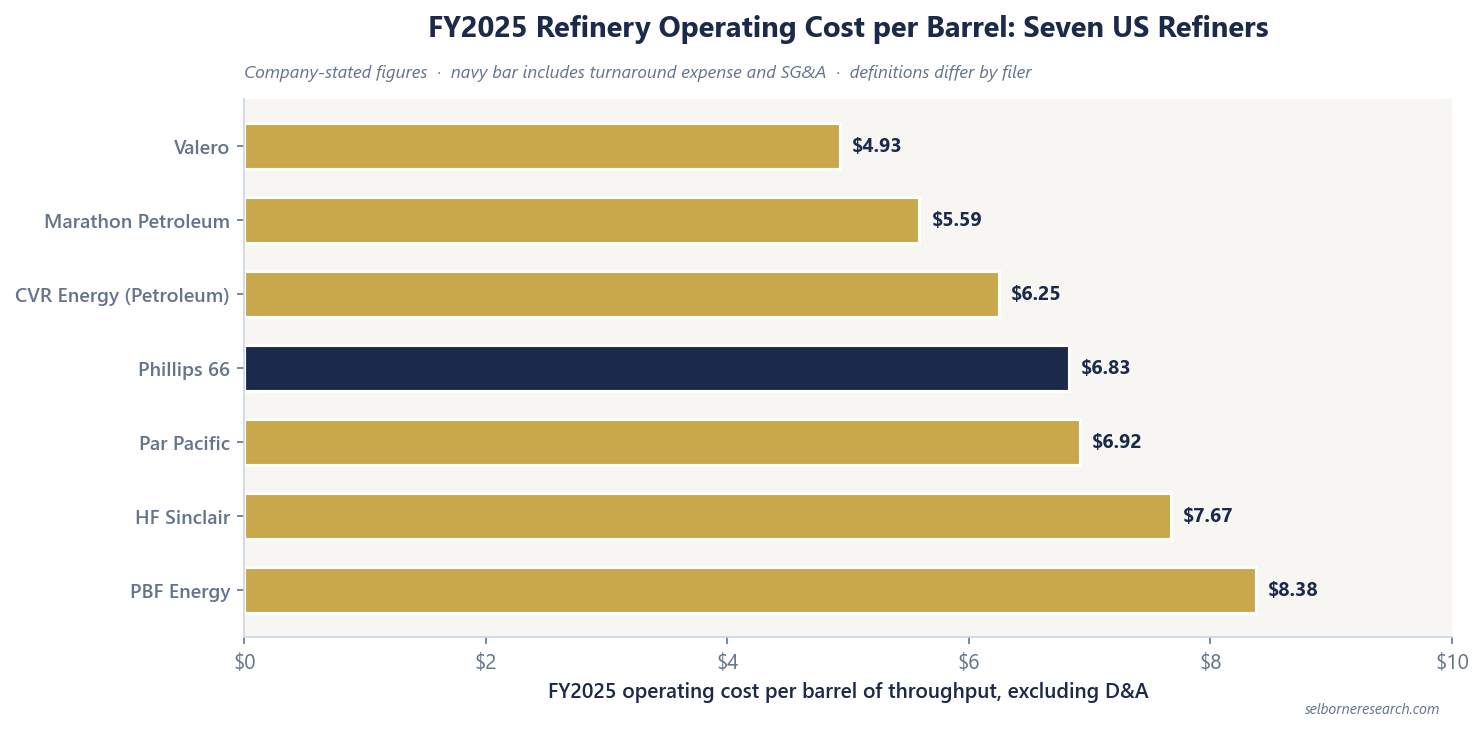
The two largest systems have the lowest costs. Valero and Marathon each ran close to 3 million barrels a day, so fixed costs, from staff to insurance, spread across more barrels. Both also keep turnaround costs out of the figure.
Five of the seven reported a higher cost per barrel than in FY2024. HF Sinclair and Par Pacific were the exceptions.
Turnarounds Are the Biggest Definitional Gap
A turnaround is a planned shutdown of a unit for major maintenance, every few years. Refiners account for it in three ways, and the choice can move the figure by more than a dollar.
- Deferred and amortised. Valero, PBF Energy, HF Sinclair, CVR Energy and Par Pacific capitalise turnaround spending and write it off over the years to the next one. It lands in depreciation and amortisation, outside these five companies’ figures.
- Expensed, on a separate line. Marathon Petroleum expenses turnarounds but excludes them from its $5.59. Its turnaround cost, $1.39 a barrel, is reported on a separate line.
- Expensed, inside the figure. Phillips 66 includes $494m of turnaround expense in its $6.83.
So Phillips 66’s fourth place partly reflects a cost the other six refiners keep out of their figures.
Volume Can Move the Figure as Much as Spending
PBF Energy is the clearest case. A fire at its Martinez refinery on 1 February 2025, early in a planned turnaround, took barrels out of the year. Total throughput fell from 330.9 million barrels to 304.0 million, and cost per barrel rose from $7.52 to $8.38.
CVR Energy rose from $5.86 to $6.25. Its 10-K puts the increase down to lower throughput during a major turnaround at its Coffeyville refinery, which ran from the first quarter of 2025 into April, partly offset by lower operating expenses.
Check throughput before reading a rise as a cost problem.
Other Differences to Check
- SG&A. Phillips 66’s controllable costs include selling, general and administrative expenses. Most others report refinery operating cost alone.
- Adjustments. Valero’s $4.93 is adjusted. It excludes $50m of employee retention and separation costs from refining operating expenses of $5,426m.
- Scope. HF Sinclair’s consolidated $7.67 averages two regions: $6.16 in the Mid-Continent and $8.83 in the West. CVR’s figure covers its petroleum segment only.
- Missing filers. Delek US reports cost per barrel for each refinery but no company total, so it is not ranked here. Its four refineries ran between $4.86 and $7.11 in FY2025.
Using the Ladder in a Mid-Cycle Build
The mid-cycle EBITDA guide deducts $6.50 a barrel for cash operating cost and corporate overhead. That sits mid-table. Valero, Marathon and CVR Energy reported less, and Phillips 66, Par Pacific, HF Sinclair and PBF Energy more. Phillips 66’s figure includes SG&A; most others exclude it.
Before using any of these figures in a model, settle three things: whether turnarounds are inside the number, whether overhead is, and whether the year’s throughput was normal.
Operating cost per barrel is the line between a refining margin and EBITDA. The primer carries it into a mid-cycle earnings build.
- 15 sections, 3-2-1 crack
- 44 pages
- three refiner archetypes + integrated sum-of-parts
- 3 worked DCFs
- capture %, mid-cycle EV/EBITDA, leverage
- 6-company screen
The Excel model is the primer's three refiner DCFs live across 12 sheets: change the crack spread, capture rate or exit multiple and the valuation moves.
See what's in the Refining Sector Primer →£25 PDF · £59 with the Excel model · £159 for all three Energy industries
Frequently Asked Questions
- What does it cost to run a refinery per barrel?
- Seven US refiners reported FY2025 operating costs between $4.93 and $8.38 per barrel of throughput, excluding depreciation. Valero was lowest and PBF Energy highest. Each figure is the company's own, and the definitions differ, so check them before comparing.
- Which refiner had the lowest operating cost per barrel in FY2025?
- Valero, at $4.93 per barrel of throughput on its adjusted basis, followed by Marathon Petroleum at $5.59. They are also the two largest systems in the set, each running close to 3 million barrels a day. Marathon's figure excludes planned turnaround costs, which it reports separately at $1.39 a barrel.
- Do refinery operating costs include turnarounds?
- It depends on the company. Valero, PBF Energy, HF Sinclair, CVR Energy and Par Pacific defer turnaround spending and amortise it, so it sits in depreciation and amortisation rather than operating cost. Marathon Petroleum expenses it but reports it on a separate line. Phillips 66 includes turnaround expense in its controllable costs, which lifts its figure against the others: $494m of turnaround expense sits inside its FY2025 number.
- Why did PBF Energy have the highest refinery operating cost per barrel?
- Part of it is volume. A fire at its Martinez refinery on 1 February 2025, early in a planned turnaround, cut throughput, and fixed costs spread over fewer barrels raise the cost per barrel. PBF's figure rose from $7.52 in FY2024 to $8.38 in FY2025 while total throughput fell from 330.9 million to 304.0 million barrels.
Read next
Mid-Cycle EBITDA: Valuing Refiners Through the Cycle
LTM multiples whipsaw at crack extremes; normalise off the $25/bbl planning crack + 92% utilisation; 5–7× band.
Crack Spread Capture Rate: Comparing Refiners Properly
Capture = realised ÷ indicator; worked capture examples and the 85 to 110% reading band. Never rank $/bbl against capture %.
The 3-2-1 Crack Spread: Calculation and What It Misses
EIA formula (2 gasoline + 1 ULSD − 3 LLS per bbl); what the indicator ignores (RINs, basis, complexity, turnarounds).
See it applied
These company profiles apply the concepts from this guide to real public companies.
Also in Refining
- The 3-2-1 Crack Spread: Calculation and What It Misses
- Nelson Complexity Index: Why Refinery Complexity Matters
- Crack Spread Capture Rate: Comparing Refiners Properly
- Refinery Operating Cost per Barrel: FY2025 Ranked
- RIN Costs and the RFS: the Refiner's Hidden Line Item
- Mid-Cycle EBITDA: Valuing Refiners Through the Cycle