Technology · Software
Current Share of RPO by Software Company
The share of RPO due within a year is a read on contract duration. Ranked across five filers; Constellation discloses no split.
Selborne Research · Software coverage: 11 guides, 6 company profiles, a primer and Excel model
Educational analysis. This guide is not investment advice or a recommendation to buy or sell any security, and it is not personalised.
On this page
A Lower Current Share Usually Means Longer Contracts
Current remaining performance obligations divided by total RPO is a duration read. When more of the contracted book sits beyond twelve months, the current share falls. When contracts are shorter, more of the RPO falls inside the year and the share rises. Demand can be unchanged either way; only the contracting shape moved.
The RPO hub defines the stock. This page ranks the share.
Ranked Current Share of RPO
Five filers disclose a current split. Constellation Software does not, so it is absent from the ladder. “About” marks the filer’s own rounded wording; Salesforce is exact arithmetic on filed dollars.
| Rank | Company | Fiscal year | Total RPO | Current RPO / share | Basis |
|---|---|---|---|---|---|
| 1 (highest current share) | Salesforce | FY2026 | $72.4B | $35.1B = 48.5% | Exact: $35.1B ÷ $72.4B |
| 2= | ServiceNow | FY2025 | $28.2B | about 46% | Filer rounded “about” |
| 2= | Snowflake | FY2026 | $9.8B | about 46% | Filer rounded “about” |
| 4 | SAP | FY2025 | €90.5B | about 39% | Filer rounded “about” |
| 5 (lowest current share) | Microsoft | FY2026 | $684B | about 30% | Filer rounded “about” |
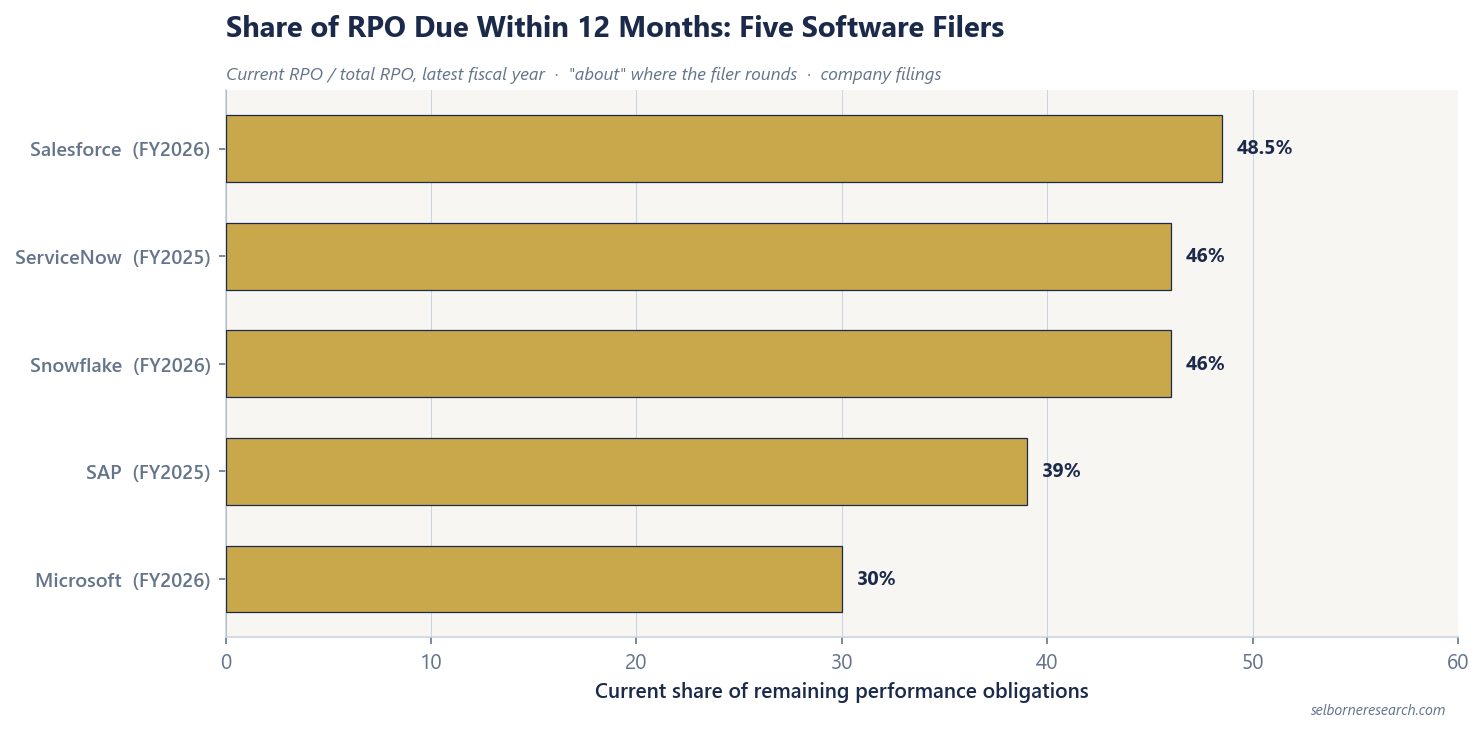
Salesforce’s 48.5% is the only exact percentage in the table because both the numerator and the denominator are printed as dollars. ServiceNow and Snowflake land on the same rounded “about 46%”. SAP’s about 39% and Microsoft’s about 30% sit further out on the duration scale.
How to Read the Ladder
Microsoft’s about 30% current share on $684B of RPO means most of that contracted stock sits beyond the next year. That is consistent with long commercial commitments at platform scale; it is not, on its own, a statement about next year’s growth rate. Salesforce’s higher current share means a larger fraction of its $72.4B is scheduled inside twelve months, including the $35.1B current RPO that grew 16% year on year.
SAP’s about 39% sits between those poles and should be read beside its licence-to-cloud transition: cloud backlog due within twelve months was €21.05B in FY2025, a related near-term contracted cloud figure to read alongside the RPO share.
What the Ladder Does Not Say
It does not rank growth quality, retention or cash conversion. Two companies can share an “about 46%” current share (ServiceNow and Snowflake) with very different product mixes: one mostly seat subscription, one mostly consumption. The share only answers how much of today’s contracted revenue is timed inside a year.
When a filing changes contract length, expect the share to move before you rewrite the demand story. Recompute from dollars when both sides are disclosed; keep the “about” label when that is all the filer gave you.
Current RPO share is a contract-duration input; the primer uses it to shape how fast contracted revenue converts in the near-term schedule.
- 17 sections, from the recurring-revenue roll-forward and retention disclosure to stock pay, the Rule of 40, usage pricing, the licence-to-cloud transition and serial acquirers
- 42 pages
- a seat SaaS grower, a usage-priced platform, a licence-to-cloud platform and a vertical-software acquirer, all fictional
- 4 worked valuations
- listed software companies on filed margins, stock pay, free cash flow and backlog, each with its fiscal year
- 6-company screen
The Excel model is the primer's recurring-revenue DCF live across 13 sheets: a seat SaaS grower, a usage-priced platform, a licence-to-cloud platform and a vertical-software acquirer, all fictional, plus a column for a company of your own in any of the four business models. Revenue rolls forward from gross and net retention and new-customer revenue, fading to terminal levels that set perpetual growth. Margins move in a straight line to year 10, and stock pay is charged as a cost or counted through dilution. A licence base migrates to the cloud at a conversion ratio you set, and an acquirer's deals earn their own margin. A reverse DCF reads the growth a price requires, and the sensitivity grids re-run the model in every cell.
See what's in the Software Sector Primer →£25 PDF · £59 with the Excel model · £159 for all three Technology industries
Frequently Asked Questions
- What does current share of RPO mean?
- It is current remaining performance obligations divided by total remaining performance obligations: the percentage of contracted revenue expected to be recognised within twelve months. A lower share usually means a larger portion of the book sits on longer-dated contracts.
- Which software company has the lowest current RPO share in this set?
- Microsoft reports that about 30% of its FY2026 RPO of $684B is expected in the next twelve months, the lowest current share among the five filers that disclose a split. Constellation Software files no RPO split here.
- How is Salesforce current RPO share calculated?
- Salesforce discloses current RPO of $35.1B and total RPO of $72.4B for FY2026. Dividing gives 48.5%, exact arithmetic on filed dollars.
- Why do some filers say "about 46%" instead of an exact percentage?
- ServiceNow, Snowflake, SAP and Microsoft disclose the current portion as a rounded share in narrative form. Treat those as the filer's own rounded figures unless they also print both dollar amounts.
Read next
RPO and cRPO in Software
ASC 606 requires disclosure of contracted revenue not yet recognised. Current RPO is the next twelve months; contract length moves RPO without changing demand.
Licence-to-Cloud Transitions and the Revenue Dip
Upfront licence revenue becomes ratable cloud revenue, so reported revenue and margin can dip before recovering. SAP as the worked case.
See it applied
These company profiles apply the concepts from this guide to real public companies.
Also in Software
- Net Revenue Retention: How Filers Define It
- Gross vs Net Revenue Retention
- Usage-Based Pricing and Net Retention
- Rule of 40: Which Margin Goes In
- Stock Pay as a Share of Revenue in Software
- Software FCF Before vs After Stock Pay
- RPO and cRPO in Software
- Current Share of RPO by Software Company
- Licence-to-Cloud Transitions and the Revenue Dip
- Reverse DCF for Software Stocks
- Vertical Software Acquirers: Return on Acquired Capital