Technology · Software
Stock Pay as a Share of Revenue in Software
Stock-based compensation is a real operating cost under ASC 718. Across six filers it ranges from nil to over a third of revenue.
Selborne Research · Software coverage: 11 guides, 6 company profiles, a primer and Excel model
Educational analysis. This guide is not investment advice or a recommendation to buy or sell any security, and it is not personalised.
On this page
Stock Pay Is an Operating Cost, Even When No Cash Leaves That Day
ASC 718 requires public companies to measure share-based awards at grant-date value and expense them over the service period. The cash-flow statement then adds the expense back when reconciling net income to operating cash flow, which is why reported free cash flow often looks as if stock pay never happened. Owners still bear it: new shares dilute them, or buybacks spend cash to mop the dilution up.
The weight of that cost is not uniform. In software it runs from nothing to more than a third of revenue, which is why a Rule of 40 sum that ignores it can flatter one name and punish another for a definitional choice.
Ranked: Stock Pay as a Share of Revenue
Figures are stock-based compensation from the cash-flow statement divided by revenue, beside GAAP operating margin for the same fiscal year.
| Rank | Company | Fiscal year | Stock pay % of revenue | GAAP operating margin |
|---|---|---|---|---|
| 1 | Constellation Software | FY2025 | nil | n/a (expenses by nature) |
| 2 | Microsoft | FY2026 | 3.7% | 46.8% |
| 3 | SAP | FY2025 | 4.6% | 26.1% |
| 4 | Salesforce | FY2026 | 8.5% | 20.1% |
| 5 | ServiceNow | FY2025 | 14.7% | 13.7% |
| 6 | Snowflake | FY2026 | 34.1% | -30.6% |
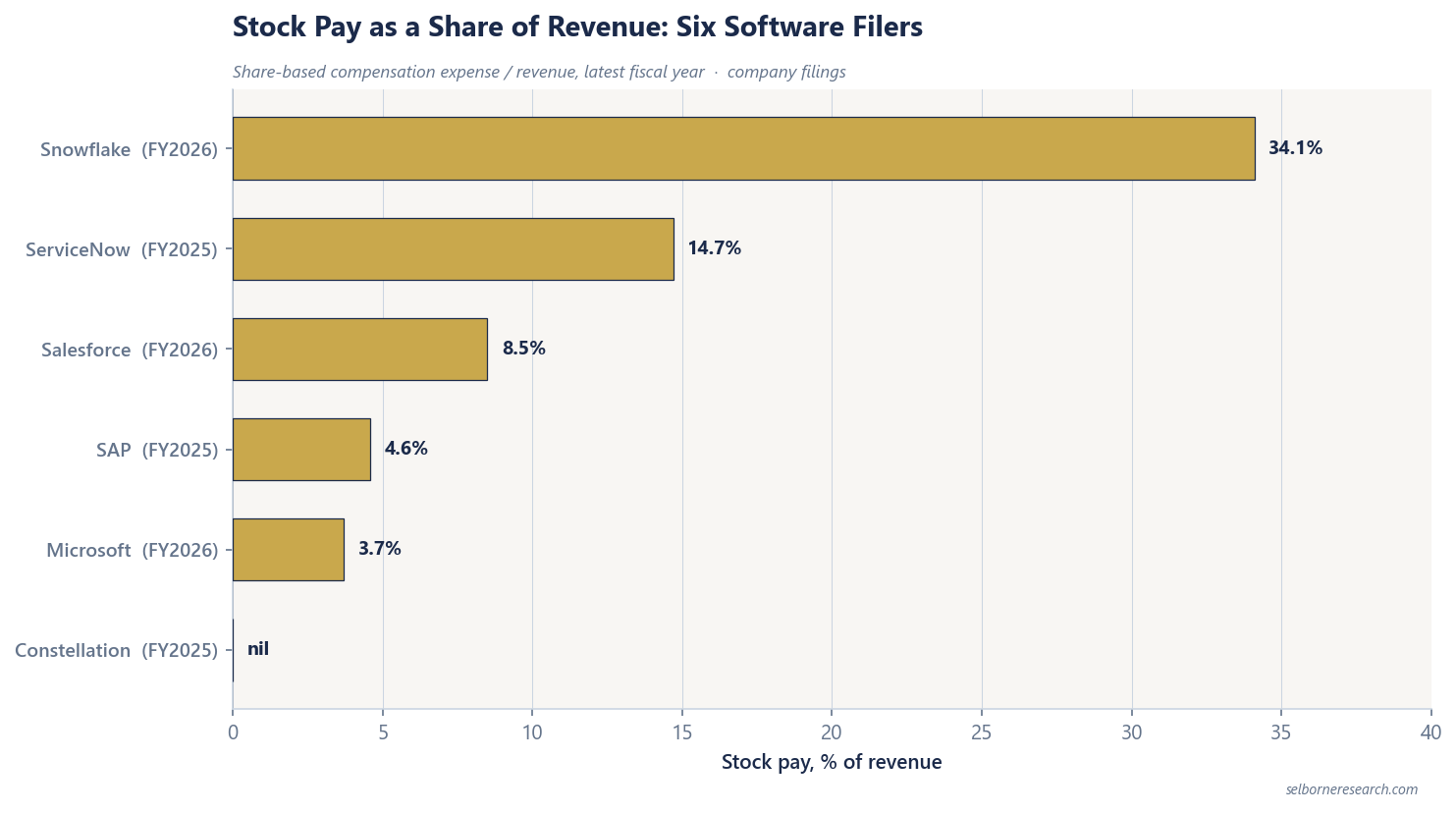
Snowflake’s GAAP operating loss and its 34.1% stock-pay ratio are the same story told twice: equity compensation is large relative to the revenue base. Constellation sits at the other end because it does not run an option plan; executives buy shares with part of the cash bonus instead.
What the Ladder Is For
It ranks a cost intensity, not a preference order. A company can show a wide GAAP operating margin and still carry material stock pay (Microsoft at 3.7% of revenue beside a 46.8% operating margin). Another can show a thinner GAAP margin partly because stock pay is heavy (ServiceNow at 14.7% of revenue beside a 13.7% operating margin). Reading margin without the stock-pay column hides that mix.
The companion page on free cash flow before versus after stock pay converts the same expense into a cash-flow gap.
ASC 718 in One Paragraph
FAS 123R, issued in December 2004 and now ASC 718, ended the old practice of leaving most employee option grants out of earnings. The SEC moved calendar-year filers to compliance in the first quarter of 2006. Since then the expense itself is settled; the software valuation debate is whether a model charges it in free cash flow or lets the share count rise. Doing neither treats it as free.
Stock pay as a percent of revenue is a first input to software free cash flow; the primer charges it as an operating cost in the multi-period model.
- 17 sections, from the recurring-revenue roll-forward and retention disclosure to stock pay, the Rule of 40, usage pricing, the licence-to-cloud transition and serial acquirers
- 42 pages
- a seat SaaS grower, a usage-priced platform, a licence-to-cloud platform and a vertical-software acquirer, all fictional
- 4 worked valuations
- listed software companies on filed margins, stock pay, free cash flow and backlog, each with its fiscal year
- 6-company screen
The Excel model is the primer's recurring-revenue DCF live across 13 sheets: a seat SaaS grower, a usage-priced platform, a licence-to-cloud platform and a vertical-software acquirer, all fictional, plus a column for a company of your own in any of the four business models. Revenue rolls forward from gross and net retention and new-customer revenue, fading to terminal levels that set perpetual growth. Margins move in a straight line to year 10, and stock pay is charged as a cost or counted through dilution. A licence base migrates to the cloud at a conversion ratio you set, and an acquirer's deals earn their own margin. A reverse DCF reads the growth a price requires, and the sensitivity grids re-run the model in every cell.
See what's in the Software Sector Primer →£25 PDF · £59 with the Excel model · £159 for all three Technology industries
Frequently Asked Questions
- Is stock-based compensation a real cost in software?
- Yes. Under ASC 718 (formerly FAS 123R), awards are measured at grant-date value and expensed over the service period. The expense is non-cash in the period, but it is compensation: either it dilutes existing owners or the company spends cash later to offset that dilution.
- How large is stock pay as a share of revenue in software?
- In this six-company set the filed range runs from nil at Constellation Software (no stock options) to 34.1% of revenue at Snowflake in FY2026. Microsoft was 3.7%, SAP 4.6%, Salesforce 8.5% and ServiceNow 14.7% in the fiscal years shown.
- Where is stock-based compensation found in a filing?
- The cash-flow statement shows stock-based compensation as an add-back to net income in operating cash flow. The income statement expenses it inside cost of revenue and operating expense lines. The share of revenue is stock pay divided by revenue for the same fiscal year.
- Why does Constellation Software show nil stock pay?
- Constellation does not grant stock options. Executives must invest 75% of the after-tax bonus in shares held in escrow for an average of at least four years, which is a purchase of shares rather than an ASC 718 option grant line.
Read next
Rule of 40: Which Margin Goes In
Growth plus margin depends on which margin you choose: FCF, FCF after stock pay, or operating margin. The 40% bar is shown on a fictional company.
Software FCF Before vs After Stock Pay
Reported free cash flow adds stock pay back. A consistent valuation either charges that cost or counts the dilution, never neither.
See it applied
These company profiles apply the concepts from this guide to real public companies.
Also in Software
- Net Revenue Retention: How Filers Define It
- Gross vs Net Revenue Retention
- Usage-Based Pricing and Net Retention
- Rule of 40: Which Margin Goes In
- Stock Pay as a Share of Revenue in Software
- Software FCF Before vs After Stock Pay
- RPO and cRPO in Software
- Current Share of RPO by Software Company
- Licence-to-Cloud Transitions and the Revenue Dip
- Reverse DCF for Software Stocks
- Vertical Software Acquirers: Return on Acquired Capital