Chemicals · Specialty Chemicals
Lithium Carbonate vs Lithium Hydroxide
Carbonate and hydroxide differ in feed, cathode and price, yet producers report both in LCE. What each is, and how to convert any lithium tonnage to LCE.
Selborne Research · Specialty Chemicals coverage: 7 guides, 6 company profiles, a primer and Excel model
Educational analysis for professional use. This guide is not investment advice or a recommendation to buy or sell any security, and it is not personalised.
On this page
Two Products, One Reporting Unit
Lithium carbonate and lithium hydroxide are two products made from one element. They tend to start from different raw materials, go into different battery cathodes and trade on separate price assessments. Producers still report both in a single unit, lithium carbonate equivalent (LCE), so one company’s volume or realised price compares with another’s only after every tonne has been converted. Skip the conversion and a hydroxide producer’s volume reads 13.6% larger than the lithium it actually sold.
Lithium carbonate (Li₂CO₃) is a salt. Battery-grade lithium hydroxide is sold as the monohydrate, LiOH·H₂O, a crystal carrying one water molecule for each lithium atom. Both also come in technical grade for glass, ceramics and greases, but batteries took 88% of global lithium use in 2025 on the US Geological Survey’s estimate. The specialty vs commodity guide covers why a company selling them behaves more like a commodity producer than a formulator.
Carbonate and Hydroxide Side by Side
| Lithium carbonate | Lithium hydroxide monohydrate | |
|---|---|---|
| Formula | Li₂CO₃ | LiOH·H₂O |
| Lithium by mass | 18.8% | 16.5% |
| Tonnes of LCE per tonne | 1.000 (the unit itself) | 0.880 |
| Usual feed route | Brine, evaporated and processed; also hard-rock concentrate | Hard-rock spodumene concentrate; some brine operations |
| Main battery use | Lithium iron phosphate (LFP) and lithium cobalt oxide cathodes | High-nickel cathodes: nickel-manganese-cobalt (NMC) and nickel-cobalt-aluminium (NCA) blends |
| Where its price is set | Its own price series, spot and contract | Its own price series, spot |
Lithium content and LCE factors computed from the standard atomic weights of IUPAC, the international chemistry standards body, with the arithmetic below. The USGS Mineral Commodity Summaries 2026 lists separate price series for battery-grade carbonate (spot in China, and a contract series), for hydroxide (spot in China) and for spodumene concentrate at 6% lithium oxide (Australia).
The Cathode Decides Which One Is Wanted
A battery maker picks the lithium compound to suit the cathode it makes. High-nickel cathodes, meaning nickel-manganese-cobalt blends from NMC622 upwards and nickel-cobalt-aluminium (NCA), are made with hydroxide. LFP and lithium cobalt oxide are made with carbonate. The International Energy Agency (IEA), in its 2021 report on critical minerals, and Albemarle, in its product note of October 2025, draw the same line.
So demand for each product follows the battery mix, and the mix has moved a long way. LFP went from under 10% of the global electric car battery market in 2020 to nearly half in 2024, on the IEA’s count by battery capacity. In China it met nearly three-quarters of domestic battery demand; in the United States it stayed below 10%, and in the EU it passed 10%. A producer’s split between hydroxide and carbonate therefore decides which cathode makers it can sell to, and in which regions.
Brine and Rock: Where Each Starts
Brine producers pump lithium-bearing salt water into ponds and let the sun concentrate it. At Albemarle’s Salar de Atacama operation in Chile the evaporation takes 18 to 24 months, and the concentrated brine is processed into lithium carbonate and lithium chloride at La Negra nearby. Hard-rock producers mine spodumene, a lithium-bearing mineral, and upgrade it to a concentrate, benchmarked at 6% lithium oxide (Li₂O). A conversion plant then turns that concentrate into a lithium chemical.
Albemarle’s network shows the pattern and its exceptions. Concentrate from its Greenbushes and Wodgina mines in Western Australia goes to conversion plants in Australia and China that make hydroxide, though one Chinese plant, Qinzhou, makes both products. Its Silver Peak brine operation in Nevada makes technical-grade carbonate and hydroxide. Brine tends to end as carbonate; rock can end as either.
Lithium Carbonate Equivalent, and How to Convert
LCE is the tonnage of lithium carbonate that would contain the same lithium. It counts lithium atoms and weighs them as carbonate. Every factor is a ratio of molar masses, computed from IUPAC’s abridged standard atomic weights: lithium 6.94, carbon 12.011, oxygen 15.999 and hydrogen 1.0080.
| Material | Molar mass, g/mol | Arithmetic | Tonnes of LCE per tonne |
|---|---|---|---|
| Lithium carbonate, Li₂CO₃ | 73.888 | 2 × 6.94 + 12.011 + 3 × 15.999 | 1.000 |
| Lithium metal, Li | 6.94 | 73.888 ÷ (2 × 6.94) | 5.323 |
| Lithium oxide, Li₂O | 29.879 | 73.888 ÷ 29.879 | 2.473 |
| Anhydrous lithium hydroxide, LiOH | 23.947 | (73.888 ÷ 2) ÷ 23.947 | 1.543 |
| Lithium hydroxide monohydrate, LiOH·H₂O | 41.962 | (73.888 ÷ 2) ÷ 41.962 | 0.880 |
| Spodumene concentrate, 6% Li₂O | n/a | 0.06 × 2.473 | 0.148 |
Carbonate and oxide hold two lithium atoms per formula unit, while hydroxide and the metal hold one, which is why the hydroxide rows use half the carbonate mass. The concentrate figure assumes the plant recovers all the lithium; real plants recover less.
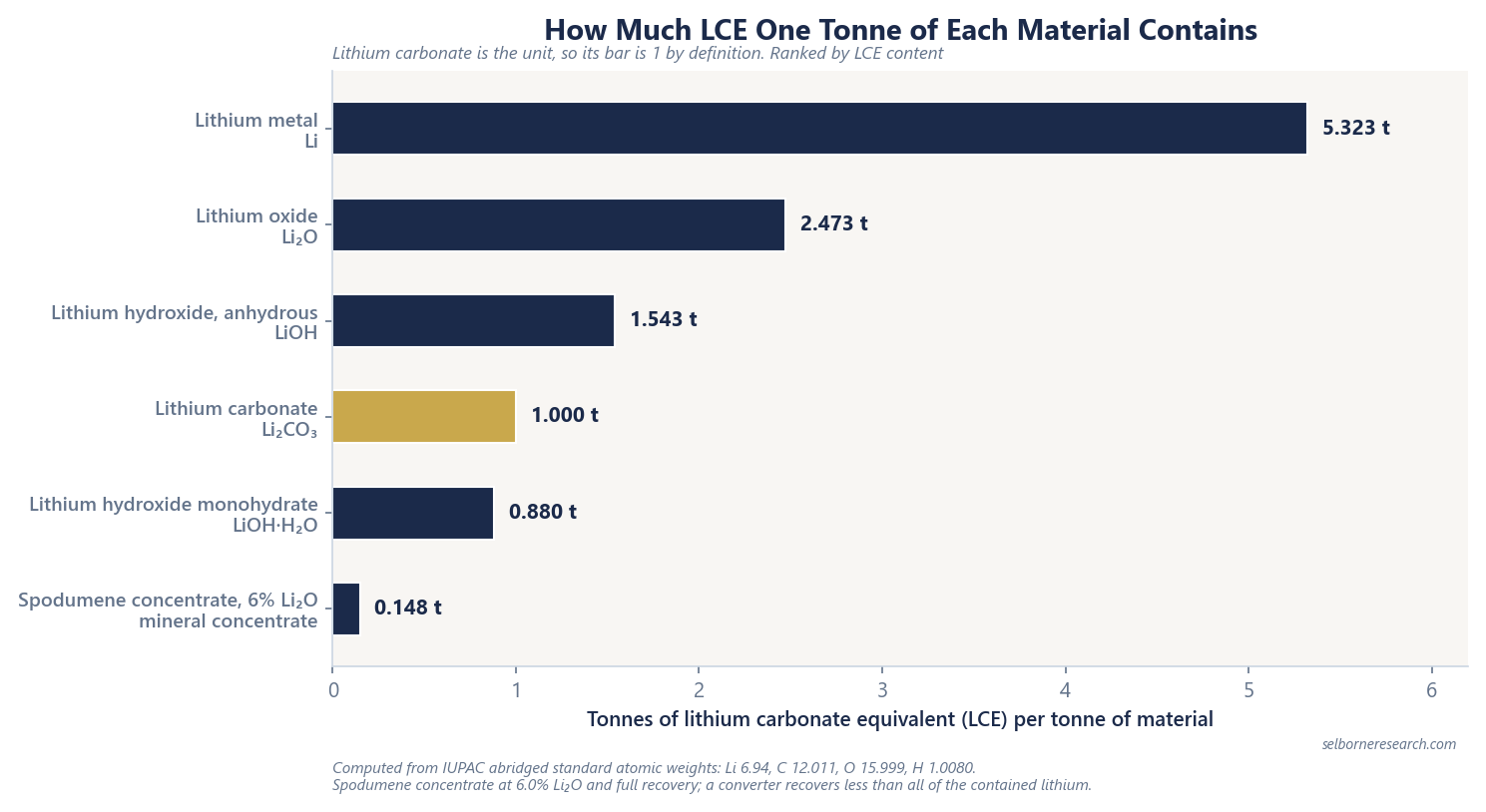
The factors are chemistry, so filers agree on them. Albemarle’s 10-K reports mine output in tonnes of lithium metal and gives the conversion as 0.1878 tonne of lithium metal per tonne of LCE, the inverse of 5.323. Its attributable production of 42 thousand tonnes of lithium metal in FY2025 is about 224 thousand tonnes of LCE. The USGS publishes world figures in lithium content: 290,000 tonnes of mine production outside the United States in 2025, or 1.54 million tonnes of LCE. Three unit errors recur:
- Adding hydroxide tonnes to carbonate tonnes. Counting a tonne of monohydrate as a full tonne of LCE overstates the lithium.
- Applying the anhydrous factor to monohydrate. 1.543 against 0.880 overstates by 75%.
- Treating concentrate tonnes as lithium. It takes about 6.7 tonnes of 6% concentrate to make one tonne of LCE before any plant losses.
Worked Example: One Producer, Two Products
Take a fictional producer that sold 40,000 tonnes of lithium hydroxide monohydrate and 30,000 tonnes of lithium carbonate in a year, for $800M of revenue.
| Hydroxide | Carbonate | Total | |
|---|---|---|---|
| Tonnes sold, thousand | 40.0 | 30.0 | 70.0 |
| Tonnes of LCE per tonne | 0.880 | 1.000 | |
| LCE, thousand tonnes | 35.2 | 30.0 | 65.2 |
Divide $800M by 65.2 million kilograms and the realised price is $12.27 per kilogram of LCE. Add the product tonnes instead and volume reads 70.0 thousand tonnes, 7.4% too high, while the price falls to $11.43, 6.9% too low. Revenue is unchanged, but every per-kilogram figure a model runs on is wrong: price, cash cost and margin.
A concentrate line converts the same way. If the producer also sold 100,000 tonnes of 6% concentrate, that adds 14.8 thousand tonnes of LCE, and a blended realised price that includes it drops, because concentrate earns less per kilogram of contained lithium than a finished chemical.
Realised Price vs Index Price
A realised price is what a producer collected: segment sales divided by volume in LCE. A market price is an assessment of what traded. Albemarle publishes both. Its Q4 2025 earnings presentation gives the FY2025 average realised price of its Energy Storage segment as $11.50 per kilogram of LCE, counting salts (its word for lithium chemicals such as carbonate and hydroxide) and spodumene by contained lithium. The same slide prints an observed market average of $10 per kilogram, a blend of spot and regional indices. Three things separate the two numbers.
Contract terms. Albemarle sells partly under index-referenced and variable-priced contracts, which its 10-K says keep the business generally aligned with market pricing. Its February 2026 outlook assumes about 40% of 2026 salts volume on long-term agreements with price floors. A floor holds a realised price above the index whenever the index sits below it.
Timing. A contract priced on an index averaged over a past month or quarter settles after the market has moved, so realised prices trail the index in both directions.
Mix. Concentrate counted by its contained LCE sells for less per kilogram of lithium than a converted salt, and Albemarle’s slide says spodumene sales pull its blended price below the market figure in its scenarios. Carbonate and hydroxide are assessed separately too, and the 10-K notes that purity and performance move the price.
Hydroxide and carbonate are priced on different assessments, so a producer’s realised price per kilogram of LCE moves with its product mix as well as with the market.
Specialty Chemicals Sector Primer
Once every tonne is in LCE, a lithium producer can be modelled. The primer's workbook runs volume, realised price per kilogram and cash cost through a ten-year DCF.
- 15 sections, from pass-through and margin stability to a ten-year DCF and the ROIC test behind a premium multiple
- 40 pages
- a pricing-power coatings company and a commodity-linked lithium producer
- 2 worked archetypes
- listed specialty groups on filed organic growth, price contribution and margins
- 6-company screen
The Excel model is the primer's specialty-versus-commodity test live across 12 sheets: a pricing-power coatings archetype valued on a ten-year DCF with organic growth, a stable margin and working capital; a commodity-linked lithium archetype whose price reverts from a trough to a long-run level, valued on the same DCF with a market multiple as a cross-check; a raw-material pass-through test; a derived multiple from ROIC, growth and WACC; ROIC-versus-WACC and leverage screens; and a live sensitivity grid. Change the margin or the terminal growth rate and the value moves; change the pass-through rate and the margin a cost shock takes moves with it.
See what's in the Specialty Chemicals Sector Primer →£25 PDF · £59 with the Excel model · £159 for all three Chemicals industries
Frequently Asked Questions
- What is the difference between lithium carbonate and lithium hydroxide?
- They are different compounds of the same element. Lithium carbonate (Li2CO3) is 18.8% lithium by mass; battery-grade lithium hydroxide is sold as the monohydrate (LiOH·H2O), which is 16.5% lithium. Carbonate often comes from brine and goes into lithium iron phosphate (LFP) and lithium cobalt oxide cathodes. Hydroxide usually comes from hard-rock spodumene concentrate and goes into high-nickel cathodes: nickel-manganese-cobalt (NMC) blends from NMC622 upwards, and nickel-cobalt-aluminium (NCA). Each has its own market price assessments.
- How do you convert lithium hydroxide to LCE?
- Multiply tonnes of lithium hydroxide monohydrate by 0.880. The factor is half the molar mass of lithium carbonate divided by the molar mass of the monohydrate: (73.888 ÷ 2) ÷ 41.962 = 0.880, using the standard atomic weights published by IUPAC, the international chemistry standards body. It is halved because carbonate holds two lithium atoms and hydroxide one. Anhydrous hydroxide converts at 1.543, lithium metal at 5.323, lithium oxide at 2.473, and a 6% Li2O spodumene concentrate at about 0.148 tonne of LCE per tonne.
- Why is a producer's realised lithium price different from the market price?
- Because a realised price is what the producer collected across its contracts and products, divided by its volume in LCE, while a market price is an assessment of recent trades. Contracts that reference an index averaged over a past period settle after the market moves, price floors in long-term agreements hold a realised price up when the index is low, and concentrate counted by its contained LCE sells for less per kilogram of lithium than a finished chemical, which pulls a blended figure down.
Read next
Specialty vs Commodity Chemicals
Performance versus molecule-cost economics; S&P risk scores specialty '2' vs commodity '4'; filed margin spreads across SHW, ECL, PPG, DD, IFF and ALB.
Specialty Chemicals Gross Margins by Company
Six filers ranked on FY2025 gross margin with FY2024 beside it: why the order follows what each sells and how, where the bases differ, and when a change reflects price.
See it applied
These company profiles apply the concepts from this guide to real public companies.