Technology · Technology Hardware
Cash Conversion Cycle by Hardware Company
Seven hardware filers ranked by cash conversion cycle with DIO, DSO and DPO beside each figure, including why the short Jabil cycle follows receivables sold.
Selborne Research · Technology Hardware coverage: 8 guides, 7 company profiles, a primer and Excel model
Educational analysis. This guide is not investment advice or a recommendation to buy or sell any security, and it is not personalised.
On this page
Rank the Cycle, Not a Preference Order
Cash conversion cycle is DIO + DSO - DPO in days. Ranking seven hardware filers on that number shows who funds growth: brands whose suppliers carry the float sit at the bottom with negative cycles; equipment and component makers who carry more inventory sit at the top with long positive ones.
Every figure uses year-end balances and that fiscal year’s revenue and cost of revenue. Fiscal year-ends differ, so the table is a cross-section of latest filings, not a single calendar year.
Seven Filers, Ranked by Cash Conversion Cycle
| Rank | Company | Fiscal year | DIO | DSO | DPO | CCC (days) |
|---|---|---|---|---|---|---|
| 1 | Arista Networks | FY2025 | 253 | 77 | 74 | 256 |
| 2 | Amphenol | FY2025 | 86 | 75 | 67 | 94 |
| 3 | Cisco Systems | FY2026 | 93 | 43 | 55 | 81 |
| 4 | Seagate Technology | FY2026 | 86 | 46 | 96 | 36 |
| 5 | Jabil | FY2025 | 63 | 49 | 107 | 6 |
| 6 | Dell Technologies | FY2026 | 42 | 57 | 135 | -37 |
| 7 | Apple | FY2025 | 9 | 35 | 115 | -71 |
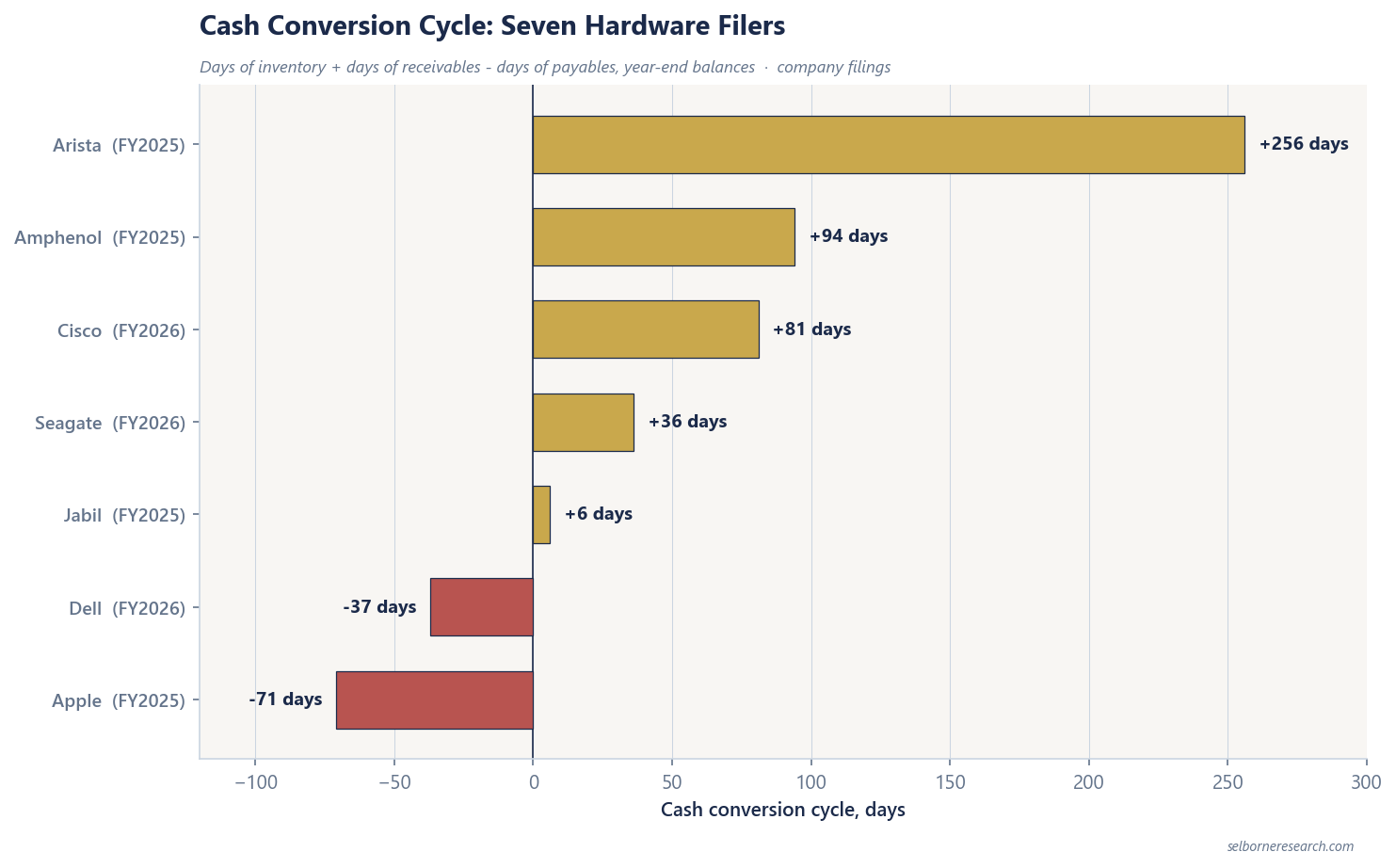
Arista’s 253 days of inventory dominate its 256-day cycle. Apple’s 9 days of inventory and 115 days of payables produce -71 days. The mechanism behind those signs is in Negative Cash Conversion Cycles in Hardware.
Jabil’s Six Days After Receivables Sold
Jabil’s FY2025 cycle of 6 days looks like a near-zero float. The filing also shows about $1.3B of receivables sold ($927M + $372M). Those sales shrink the receivables balance that enters DSO, so the filed cycle is shorter than the gross book would be.
That matters for any peer table that treats DSO as a pure operating choice. For a contract manufacturer, part of the short cycle can be a financing choice. The margin and return-on-capital side of that model is in EMS Economics: Thin Margins and ROIC.
How to Read the Ladder
The ladder ranks an operating funding structure. A long positive cycle means growth absorbs cash in inventory and receivables unless payables stretch to match. A negative cycle means supplier terms and thin inventory can fund growth, until purchase commitments or a demand drop reverse the cash story.
Seagate at 36 days sits in the middle of the set: enough inventory for a component maker, offset by payables near 96 days. Amphenol and Cisco sit higher because inventory days stay elevated relative to payables. Each rank is a filed operating fact for the fiscal year shown.
Where the Ranking Goes Wrong
Mixing fiscal years without labels is the first error. Apple’s FY2025 and Cisco’s FY2026 are both “latest” and still not the same period.
Treating Jabil’s 6 days as comparable to Apple’s -71 without the receivables-sold footnote is the second. One is a brand with thin inventory and long payables; the other is an EMS that has sold a slice of its receivable book.
The third is ignoring off-balance-sheet purchase commitments: inventory on the balance sheet can be a fraction of the obligations in the notes. Purchase Commitments vs Inventory in Hardware puts those two figures side by side.
Technology Hardware Sector Primer
The primer ranks working-capital days across hardware models and feeds those days into the multi-period free cash flow model.
- 17 sections, from units, price and the product cycle to working capital in days, mid-cycle margins and a reverse DCF
- 43 pages
- a device brand, a networking maker, a contract manufacturer and a storage maker, all fictional
- 4 worked valuations
- listed hardware makers on filed margins, working-capital days and purchase commitments, each with its fiscal year
- 7-company screen
The Excel model is the primer's product-cycle DCF live across 13 sheets: a device brand, a networking maker, a contract manufacturer and a storage maker, all fictional, plus a column for a company of your own in any of five business-model modes. Revenue is built from trend units, a yearly cycle index and price, with a recurring line on the installed base and an order book for networking; gross margin carries a fixed share of cost of goods, so it rises and falls with the cycle; working capital runs in days; capex funds growth; and the terminal value is struck on mid-cycle cash flow. A reverse DCF reads the margin and the unit growth a price requires, and the sensitivity grids re-run the model in every cell. Change the cycle, the days or the margin and the value moves.
See what's in the Technology Hardware Sector Primer →£25 PDF · £59 with the Excel model · £159 for all three Technology industries
Frequently Asked Questions
- What is the cash conversion cycle ranking across hardware companies?
- In this seven-filer set, cash conversion cycle runs from Arista Networks at 256 days (FY2025) down to Apple at -71 days (FY2025). Between them sit Amphenol at 94, Cisco at 81, Seagate at 36, Jabil at 6 and Dell at -37 days, each on its own fiscal year.
- Why is Jabil cash conversion cycle only 6 days?
- Jabil filed 63 days of inventory, 49 days of sales and 107 days of payables in FY2025, which nets to about 6 days. That cycle is after selling about $1.3B of receivables the company would otherwise carry, so the filed DSO is shorter than a gross receivables book would show.
- How do you compute cash conversion cycle for a peer table?
- For each filer, take year-end inventory, receivables and payables with revenue and cost of revenue for the same fiscal year. Days of inventory and payables use cost of revenue; days of sales use revenue. Cycle = inventory days + sales days - payables days. Label every row with its fiscal year.
- Does a short cash conversion cycle mean low risk?
- No. A short or negative cycle describes who funds working capital on the balance sheet. Purchase commitments disclosed in the filing can still be several times inventory, and a demand drop can leave the company obligated to buy stock it no longer needs.
Read next
Negative Cash Conversion Cycles in Hardware
How DIO, DSO and DPO combine into the cash conversion cycle, why some hardware brands run negative, and what one day of sales is worth on filed revenue.
Purchase Commitments vs Inventory in Hardware
Inventory sits on the balance sheet; purchase commitments sit off it and can dwarf it. Filer definitions differ, and write-downs follow a demand drop.
EMS Economics: Thin Margins and ROIC
Contract manufacturers can earn a return on capital with single-digit gross margins when capital turns fast. Jabil FY2025 as the worked case.
See it applied
These company profiles apply the concepts from this guide to real public companies.
Also in Technology Hardware
- Negative Cash Conversion Cycles in Hardware
- Cash Conversion Cycle by Hardware Company
- Purchase Commitments vs Inventory in Hardware
- EMS Economics: Thin Margins and ROIC
- Mid-Cycle Margins for Hardware Companies
- Gross Margin Ranges in Hardware Since FY2016
- Hardware Product vs Services Gross Margin
- PC and Smartphone Replacement Cycles