Technology · Technology Hardware
Gross Margin Ranges in Hardware Since FY2016
Hardware filers ranked by the width of their annual gross margin range since FY2016, an operating read of cyclicality with windows labelled where they differ.
Selborne Research · Technology Hardware coverage: 8 guides, 7 company profiles, a primer and Excel model
Educational analysis. This guide is not investment advice or a recommendation to buy or sell any security, and it is not personalised.
On this page
Range Width Is an Operating Measure of Cyclicality
Annual gross margin range, high minus low over a filed window, shows how far a hardware model’s economics swing when volume and price move. A component maker can span tens of points; a networking equipment maker with a recurring mix can sit inside three or four.
Ranked by Width of the Annual Gross Margin Range
| Rank | Company | Window | Gross margin range | Width (points) |
|---|---|---|---|---|
| 1 | Seagate Technology | FY2016-FY2026 | 18.3-45.6% | 27.3 |
| 2 | Amphenol | FY2016-FY2025 | 30.98-36.88% | 5.90 |
| 3 | Arista Networks | FY2016-FY2025 | 61.1-64.5% | 3.4 |
| 4 | Cisco Systems | FY2016-FY2026 | 62.0-64.9% | 2.9 |
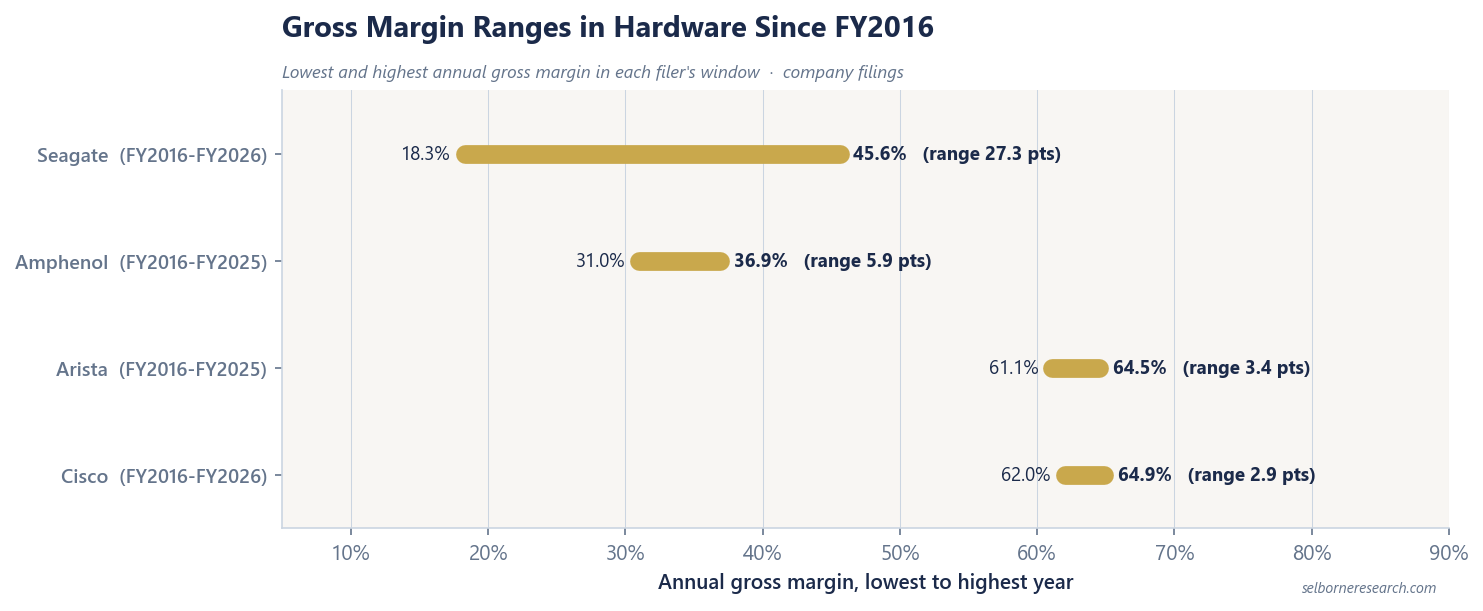
The windows differ by one year: Seagate and Cisco run through FY2026; Amphenol and Arista through FY2025. That gap matches each filer’s latest year in the set and is stated on every row.
Width arithmetic, high minus low: Seagate 45.6 - 18.3 = 27.3 points. Amphenol 36.88 - 30.98 = 5.90. Arista 64.5 - 61.1 = 3.4. Cisco 64.9 - 62.0 = 2.9.
What the Spread Shows
Seagate’s 18.3-45.6% band is the cyclical storage case: trough FY2023 and peak FY2026 sit inside the same decade. How to average that series for a mid-cycle print is the subject of Mid-Cycle Margins for Hardware Companies.
Amphenol’s 30.98-36.88% band is tighter. Connectors and sensors across end markets still move, but the annual gross margin stayed inside six points over FY2016-FY2025.
Arista and Cisco both live in the low-to-mid sixties. Their ranges overlap; both are narrow. Mix toward services and subscriptions may help explain why equipment gross margin is steadier than a pure component cycle (Hardware Product vs Services Gross Margin).
How to Use the Ladder
- Read width first, level second. A company can sit at a high average margin and still be cyclical if the range is wide; Seagate’s peak year is high and its range is still the widest here.
- Keep the window on the label. A FY2016-FY2025 range and a FY2016-FY2026 range are adjacent, not identical.
- Pair the range with a cycle average before forecasting. Width alone does not give the mid-cycle number.
- Do not treat a narrow networking range as proof that volume is stable; it shows gross margin held steady while other metrics (inventory days, commitments) still moved.
Where a Naive Ranking Goes Wrong
Comparing Seagate’s FY2026 print of 45.6% with Cisco’s FY2026 print of 64.5% without the historical band under each number hides that one name just traversed nearly thirty points and the other barely three.
Collapsing Amphenol and Arista into one “hardware” bucket is the other error. Their ranges are both narrower than Seagate’s and still not the same business: engineered components versus data-centre networking.
Technology Hardware Sector Primer
The primer uses filed margin history to separate steady equipment mix from cyclical component swings before the multi-period model sets a mid-cycle path.
- 17 sections, from units, price and the product cycle to working capital in days, mid-cycle margins and a reverse DCF
- 43 pages
- a device brand, a networking maker, a contract manufacturer and a storage maker, all fictional
- 4 worked valuations
- listed hardware makers on filed margins, working-capital days and purchase commitments, each with its fiscal year
- 7-company screen
The Excel model is the primer's product-cycle DCF live across 13 sheets: a device brand, a networking maker, a contract manufacturer and a storage maker, all fictional, plus a column for a company of your own in any of five business-model modes. Revenue is built from trend units, a yearly cycle index and price, with a recurring line on the installed base and an order book for networking; gross margin carries a fixed share of cost of goods, so it rises and falls with the cycle; working capital runs in days; capex funds growth; and the terminal value is struck on mid-cycle cash flow. A reverse DCF reads the margin and the unit growth a price requires, and the sensitivity grids re-run the model in every cell. Change the cycle, the days or the margin and the value moves.
See what's in the Technology Hardware Sector Primer →£25 PDF · £59 with the Excel model · £159 for all three Technology industries
Frequently Asked Questions
- Which hardware companies have the widest gross margin range?
- Among the four filers here, Seagate shows the widest annual gross margin range at 18.3% to 45.6% over FY2016-FY2026. Amphenol, Arista and Cisco sit in much narrower bands over their filed windows.
- What is the gross margin range for Cisco and Arista since FY2016?
- Cisco gross margin ran 62.0% to 64.9% over FY2016-FY2026. Arista ran 61.1% to 64.5% over FY2016-FY2025. Both networking names stay inside a few points across the decade.
- Why do the gross margin windows differ by one year?
- Seagate and Cisco series run through FY2026; Amphenol and Arista through FY2025, matching the latest year for each filer in the set. The one-year gap is labelled on every row so the ranges are not mistaken for an identical calendar window.
- Is a wide gross margin range the same as a low mid-cycle margin?
- No. Range width measures how far annual prints swung. Mid-cycle margin averages those prints. Seagate can show both a wide range and a mid-cycle average in the high twenties; the two numbers answer different questions.
Read next
Mid-Cycle Margins for Hardware Companies
A single year misleads for a cyclical hardware maker. How to average gross margin across a full cycle, with Seagate FY2016-FY2026 as the worked case.
Hardware Product vs Services Gross Margin
Services earn a far higher gross margin than hardware products, so mix moves the company margin. Filed product and services margins from four filers.
See it applied
These company profiles apply the concepts from this guide to real public companies.
Also in Technology Hardware
- Negative Cash Conversion Cycles in Hardware
- Cash Conversion Cycle by Hardware Company
- Purchase Commitments vs Inventory in Hardware
- EMS Economics: Thin Margins and ROIC
- Mid-Cycle Margins for Hardware Companies
- Gross Margin Ranges in Hardware Since FY2016
- Hardware Product vs Services Gross Margin
- PC and Smartphone Replacement Cycles