Technology · Semiconductors
The Wafer Fab Equipment Cycle
Equipment spend follows chipmaker capex, so it lags and leads the chip cycle. SEMI history and ASML backlog, bookings and service share.
Selborne Research · Semiconductors coverage: 9 guides, 6 company profiles, a primer and Excel model
Educational analysis. This guide is not investment advice or a recommendation to buy or sell any security, and it is not personalised.
On this page
Equipment Spend Is Chip Capex With a Lag
Wafer fab equipment makers sell tools when chipmakers expand or refresh plants. Orders arrive when boards approve capex and tools ship months later. Depreciation on those tools then sits in chip cost of goods for years. Equipment revenue therefore lags bookings, while bookings can lead chip sales when the industry funds capacity ahead of the wafers that capacity will produce.
SEMI worldwide equipment sales and WSTS chip sales give the industry path. ASML gives the company-level order book, installed-base service and customer concentration.
SEMI Equipment Sales Against WSTS Chip Sales
| Calendar year | Chip sales ($B) | Equipment sales ($B) | Equipment / chip sales |
|---|---|---|---|
| 2015 | 335.2 | 36.53 | 10.9% |
| 2016 | 338.9 | 41.24 | 12.2% |
| 2017 | 412.2 | 56.62 | 13.7% |
| 2018 | 468.8 | 64.53 | 13.8% |
| 2019 | 412.1 | 59.75 | 14.5% |
| 2020 | 440.4 | 71.19 | 16.2% |
| 2021 | 555.9 | 102.64 | 18.5% |
| 2022 | 574.1 | 107.6 | 18.7% |
| 2023 | 526.8 | 106.3 | 20.2% |
| 2024 | 630.5 | 117.1 | 18.6% |
| 2025 | 795.6 | 135.1 | 17.0% |
Equipment as a share of the same year’s chip sales ran from 10.9% (2015) to 20.2% (2023) and averaged 15.8% across 2015-2025. Shares are arithmetic from the SEMI and WSTS levels. Notice 2023: chip sales fell while equipment stayed heavy, so the ratio peaked as chipmakers kept funding plants into a softer year.
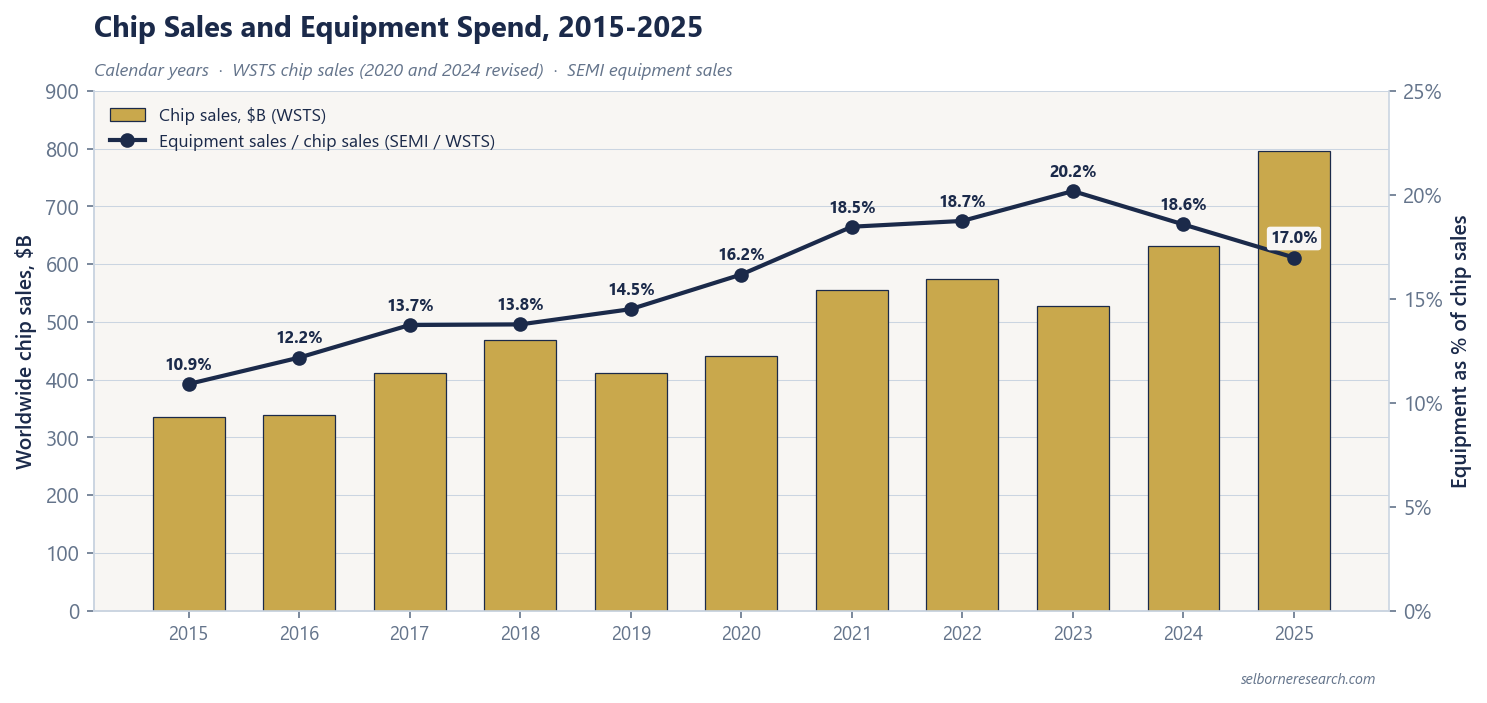
The same chip-sales history sits behind the semiconductor inventory cycle. Equipment is the capex reflection of that market.
ASML: Backlog, Bookings, Service and Concentration
| Item | FY2025 | Comparison |
|---|---|---|
| Revenue | €32.7B | |
| Gross margin | 52.8% | 44.7% in FY2019 |
| System backlog | €38.8B | €35.9B in FY2024 |
| Net bookings | €28.0B | €18.9B in FY2024 |
| Installed-base service and upgrades | 25.1% of sales | |
| Four customers | 61.2% of sales | |
| Capex / revenue | 4.8% |
Backlog here is ASML’s own system backlog (€38.8B), not its remaining performance obligation figure (€46.5B). Net bookings rose by about half year on year, to €28.0B. Service on the installed base was a quarter of sales, while system revenue follows the order book.
Four customers took 61.2% of sales. Capex at 4.8% of revenue looks light next to foundries because the heavy plant spend sits with the chipmakers ranked in capex to revenue by chip company; see capital intensity.
How to Read Equipment in a Chip Framework
- Treat equipment sales as a share of chip industry revenue (historically about 11% to 20%, average near 16%).
- Separate backlog and bookings from recognised system revenue; the lag is the point.
- Keep installed-base service as its own line so a down year in tools does not erase the whole company.
- Footnote concentration when a handful of chipmakers fund most of the leading-edge tools.
The chip inventory cycle asks whether customers are stocking or destocking devices. The equipment cycle asks whether those same customers are still writing cheques for fabs. Both can turn in the same year, and they need not turn together.
Equipment orders track customer capex with a shipment lag; the primer models backlog, tool revenue and installed-base service in the multi-period model.
- 17 sections, from the business models and the industry cycle to capital intensity, memory, inventory, equipment orders, stock pay and a reverse DCF
- 44 pages
- a chip designer, a foundry, a memory maker and an equipment maker, all fictional
- 4 worked valuations
- listed chip companies on filed margins, capital intensity, inventory days and stock pay, each with its fiscal year
- 6-company screen
The Excel model is the primer's through-cycle DCF live across 13 sheets: a chip designer, a foundry, a memory maker and an equipment maker, all fictional, plus a column for a company of your own in any of five business-model modes. Each mode turns the industry cycle into revenue its own way: units and selling prices, capacity times utilisation times revenue per wafer, bit demand against bit supply, orders and installed-base services, or wafer starts for a materials supplier. Depreciation sits in cost of goods for fab owners, capacity arrives two years after the capex that pays for it, and the terminal value is struck on mid-cycle cash flow. A reverse DCF reads the margin and the growth a price requires, and the sensitivity grids re-run the model in every cell.
See what's in the Semiconductors Sector Primer →£25 PDF · £59 with the Excel model · £159 for all three Technology industries
Frequently Asked Questions
- What is wafer fab equipment spending?
- Capital spending by chipmakers on tools that process wafers: lithography, etch, deposition, metrology and related systems. SEMI publishes worldwide equipment sales; those sales track chipmaker capex with a lag as tools ship against orders.
- How large is equipment spend relative to chip sales?
- From calendar 2015 to 2025, SEMI equipment sales ran from 10.9% to 20.2% of the same-year WSTS chip sales, averaging 15.8%.
- Why does equipment both lag and lead the chip cycle?
- Tools ship months after orders, so revenue lags bookings. Bookings and backlog rise when chipmakers fund new capacity, often before that capacity produces chips, so the order book can lead chip revenue.
- How important is service revenue for ASML?
- In FY2025, service and upgrades on the installed base were 25.1% of ASML sales. That line is tied to the installed base rather than to a single year of orders.
Read next
The Semiconductor Inventory Cycle
Chip revenue swings harder than end demand because customers build and drain inventory. WSTS history, Nvidia charges and Texas Instruments capacity.
Capital Intensity in Semiconductors
Capex to revenue sets what a chipmaker must earn. Spend reaches capacity about two years later; TSMC and Intel are the worked cases.
Capex to Revenue by Chip Company
Ranked capex as a share of revenue for six chip filers. Business model sets the order from foundry and IDM down to fabless and equipment.
See it applied
These company profiles apply the concepts from this guide to real public companies.