Agribusiness · Aquaculture
Salmon Farming Profit per kg by Country
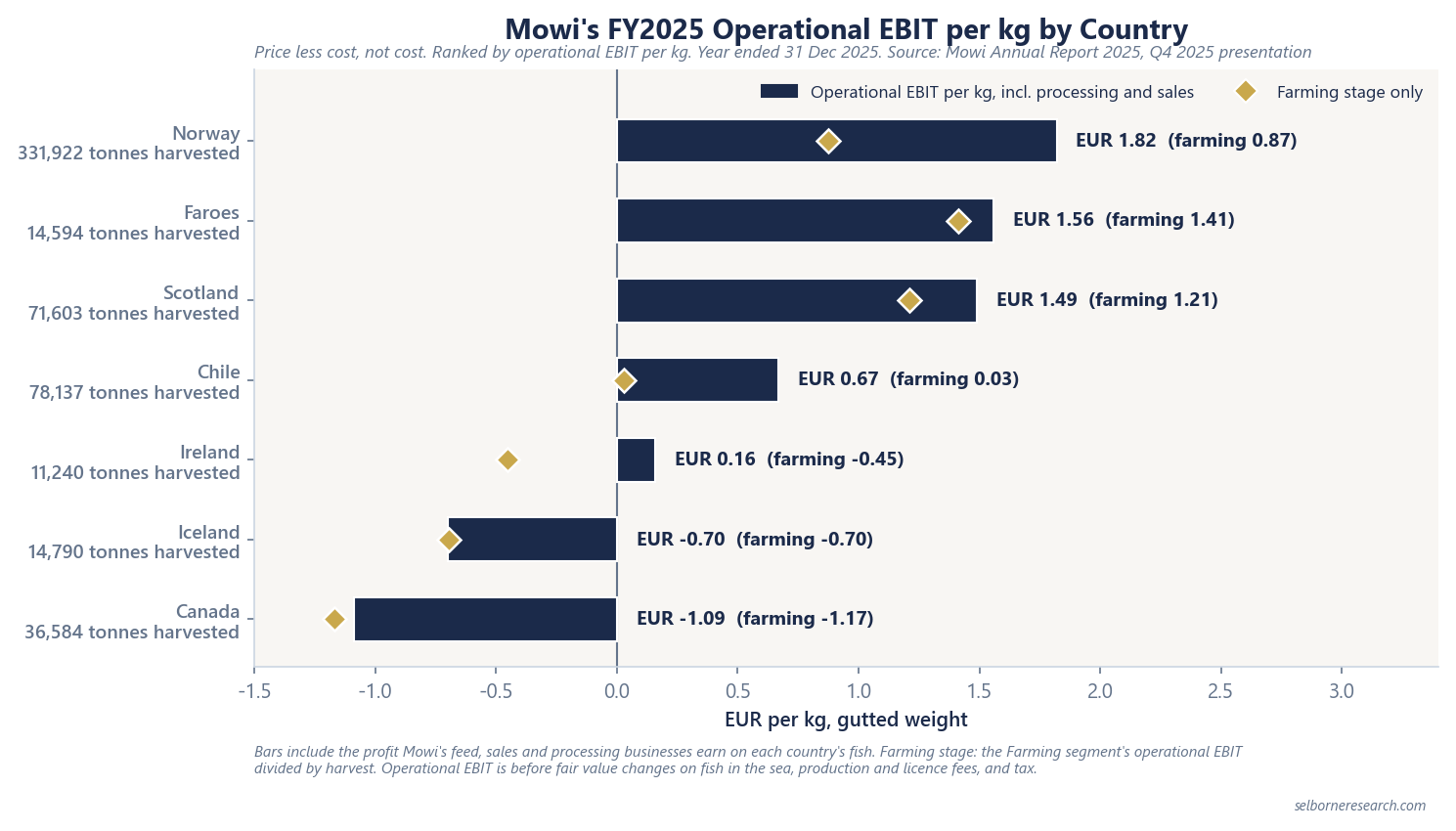
Mowi's FY2025 operational EBIT per kg ran from EUR 1.82 in Norway to minus EUR 1.09 in Canada. Why the order is price less cost, not a cost ranking.
Selborne Research · Aquaculture coverage: 7 guides, 6 company profiles, a primer and Excel model
Educational analysis for professional use. This guide is not investment advice or a recommendation to buy or sell any security, and it is not personalised.
On this page
A Country’s Profit per kg Is Price Less Cost
The country a salmon is farmed in sets both what it costs to grow and what it sells for, so a ranking of profit per kg by country ranks price less cost, not cost. Mowi, the largest salmon farmer, earned FY2025 operational EBIT of between EUR 1.82 a kg in Norway and minus EUR 1.09 a kg in Canada. Chile, which Mowi says was its lowest-cost country, came fourth of seven.
One farmer’s countries make the cleanest comparison, because every figure uses the same definition and currency. Operational EBIT is Mowi’s profit measure before changes in the estimated value of fish still in the sea, production and licence fees, and one-off items. Per kg means per kg of gutted weight: the fish bled and gutted, head on.
Mowi also credits each country with the profit its feed, sales and processing businesses earn on that country’s fish. The table shows that all-inclusive figure and, beside it, the farming stage alone.
FY2025 Operational EBIT per kg, Seven Countries
| Country | Harvest, tonnes | Operational EBIT, EUR M | EUR per kg | Farming stage, EUR per kg | FY2024, EUR per kg |
|---|---|---|---|---|---|
| Norway | 331,922 | 603.3 | 1.82 | 0.87 | 2.03 |
| Faroes | 14,594 | 22.8 | 1.56 | 1.41 | 2.42 |
| Scotland | 71,603 | 106.7 | 1.49 | 1.21 | 1.68 |
| Chile | 78,137 | 52.2 | 0.67 | 0.03 | 0.79 |
| Ireland | 11,240 | 1.8 | 0.16 | −0.45 | 1.57 |
| Iceland | 14,790 | −10.3 | −0.70 | −0.70 | 1.38 |
| Canada | 36,584 | −39.8 | −1.09 | −1.17 | 0.11 |
| Group | 558,870 | 726.8 | 1.30 | 0.61 | 1.65 |
Years to 31 December, from Mowi’s Annual Report 2025 and its Q4 2025 presentation. The farming-stage column is the Farming segment’s operational EBIT by country divided by harvest. The countries add to EUR 736.7M; the group total also carries a net EUR 10.1M not allocated to any country (EUR 14.4M of losses in other entities, less EUR 4.3M of sales and processing profit), and the rest is rounding. Norway includes Nova Sea from the fourth quarter, when Mowi took control of it; Iceland is Mowi’s subsidiary Arctic Fish.
Price Sets Part of the Order
Salmon from different countries is sold into different markets at different prices. Mowi measures its Norwegian, Scottish and Faroese salmon against a Norwegian reference price (which its report still labels Nasdaq, though SISALMONI replaced that index in 2024), and its Chilean and North American salmon against Urner Barry, a US price service. In Q4 2025 the Norwegian reference price was EUR 6.79 a kg gutted weight; the Chilean one, converted by Mowi to the same basis, was EUR 4.43.
That gap is why Chile ranks where it does. Its farms were Mowi’s cheapest to run in 2025, yet the farming stage earned EUR 0.03 a kg. Most of Chile’s EUR 52.2M came after the farm: EUR 41.2M, or 79%, from Consumer Products, the division that turns fish into fillets and packaged products for retailers. A Chilean fish earns little as a whole gutted salmon and more once it has been processed.
Norway shows the same split less sharply. Its farming stage earned EUR 0.87 a kg; feed, sales and processing added EUR 0.95 more. The Faroes and Scotland earned most of their margin at the farm.
What Mowi Says About Each Country’s Cost
Mowi publishes one cost figure for the whole group: EUR 5.49 a kg in FY2025, down from EUR 5.80 in FY2024. It calls it cost in box, the cost of one kg of gutted salmon packed in a box, including transport to the plant, primary processing, administration and exceptional mortality. For each country it describes the direction of cost and the cause in words. Fish deaths are the cause it names most often, and it puts a number on them: incident-based mortality, the cost of fish lost in specific events beyond normal losses through the cycle.
| Country | What Mowi says about FY2025 cost | Incident-based mortality, EUR M |
|---|---|---|
| Norway | Down 5%, as lower feed prices came through; mortality mainly from gill issues and knock-on effects of lice treatments | 49.2 |
| Faroes | Down slightly, on lower health and mortality costs and higher volume | 0 |
| Scotland | Down, mainly on lower feed cost | 14.8 |
| Chile | Lowest of the seven countries; improved on lower feed and mortality cost | 3.6 |
| Ireland | Up, on higher mortality and less income from selling eggs | not stated |
| Iceland | Up, on the cost of fish harvested and mortality; “still too high” | not stated |
| Canada | Up, on mortality in Canada East after low oxygen levels in a very warm summer | 35.2 |
From the country sections of Mowi’s Annual Report 2025.
Canada is the clearest case of biology setting the result. Mowi harvested more there in 2025 than in 2024, 36,584 tonnes against 30,426, and cost in Canada West fell, yet one mortality event in Canada East in September and October turned operational EBIT per kg from EUR 0.11 to minus EUR 1.09. The lice and mortality guide covers what drives these events.
One Year Is Not a Country’s Level
A single year’s order records that year’s biology and prices. Every one of Mowi’s seven countries earned less per kg in FY2025 than in FY2024, when the reference price was higher, but by very different amounts. Ireland fell from EUR 1.57 to EUR 0.16 in a year Mowi calls biologically troublesome. Iceland went from EUR 1.38 to minus EUR 0.70. On FY2024 figures the Faroes ranked first and Iceland fifth; on FY2025 figures they ranked second and sixth. Quote a country’s profit per kg with its year, and read two or three years before calling any country high- or low-margin.
Tax and Fees Sit Below the Line
Operational EBIT per kg is struck before tax, and tax on salmon farming differs by country. Since 1 January 2023 Norway has charged a 25% resource-rent tax on the seawater phase of salmon farming, on top of 22% corporate tax, 47% in all. Mowi’s feed, processing and sales are outside it, so a euro of Norwegian farming profit keeps less after tax than a euro earned by processing the same fish. Mowi also recognised EUR 48.5M of production and licence fees in FY2025, below operational EBIT; in Norway the production fee reduces the resource-rent tax payable.
What Profit per kg by Country Leaves Out
The table cannot be turned into a cost ranking. Backing out a country’s cost means subtracting its profit from the price it achieved, and Mowi does not publish achieved prices by country on one basis.
It also describes only one company’s farms. Bakkafrost farms in the Faroes and Scotland too. Its Scottish farming lost DKK 17.77 a kg in FY2025, after DKK 172M of incident-based mortality that included an outbreak of Pasteurella, a bacterial disease, at its Portree site. Mowi’s Scottish farms earned EUR 1.49 a kg in the same year. Two farmers in the same country can land on opposite sides of zero.
And figures from different farmers rarely share a definition or a currency, so read each on its own basis. The cost per kg guide sets out how each farmer draws the line.
Profit per kg is the gap between price and cost. The primer builds it for a fictional farmer, tests a downturn year and values the farm after tax.
- 15 sections, from how a salmon farmer earns to licence capacity, biological risk and a worked valuation
- 40 pages
- a low-cost scale farmer, a high-cost regional farmer and a farm you set up yourself
- 3 farm engines
- listed salmon farmers across Norway, the Faroes, Scotland and Chile on filed FY2025 figures
- 6-company screen
The Excel model is the primer's farming valuation live across 12 sheets: two hypothetical farmers and a farm you set up yourself, each valued on an after-tax DCF that includes Norway's resource-rent tax on salmon farming, with EV per kg and an EBIT multiple as cross-checks; a valuation summary, an EBIT-per-kg and cost-stack view, capacity against EV per kg, a cycle and biological downturn scenario and a live sensitivity grid of salmon price against farming cost. Change the price, the farming cost or the harvest and the value moves.
See what's in the Aquaculture Sector Primer →£25 PDF · £59 with the Excel model · £159 for all three Agribusiness industries
Frequently Asked Questions
- Which country is cheapest to farm salmon in?
- Mowi, which farms in seven countries, says its Chilean farms had the lowest cost of the seven in 2025, but it publishes no cost per kg for each country. Chile still came fourth of seven on operational EBIT per kg in FY2025, at EUR 0.67, because Chilean salmon sells at a lower reference price: EUR 4.43 per kg gutted weight in Q4 2025 against EUR 6.79 for Norwegian salmon.
- What was Mowi's operational EBIT per kg in Norway in 2025?
- EUR 1.82 per kg on 331,922 tonnes harvested in FY2025, down from EUR 2.03 in FY2024. That figure includes the margin Mowi's feed, sales and processing businesses earned on Norwegian fish. The farming stage alone earned EUR 0.87 per kg.
- Why did Mowi lose money per kg in Canada in 2025?
- Mostly because of fish deaths in Canada East. Low oxygen levels after a very warm summer caused a mortality event in September and October 2025, and Mowi recognised EUR 35.2M of incident-based mortality in Canada for the year, against EUR 11.3M in 2024. Operational EBIT per kg fell from EUR 0.11 in FY2024 to minus EUR 1.09 in FY2025.
- Is operational EBIT per kg before or after Norway's resource-rent tax?
- Before. Operational EBIT is struck before tax and before production and licence fees. Since 1 January 2023 Norway has taxed the seawater phase of salmon farming at 25% on top of 22% corporate tax, 47% in all, while activities outside the seawater phase, such as Mowi's feed, processing and sales, are not subject to the resource-rent tax. A euro of Norwegian farming profit keeps less after tax than the same euro earned downstream.
Read next
Salmon Farming Economics: Cost per kg
What Mowi's cost in box and Grieg's farming cost include, and why each farmer's EBIT per kg has to be read on its own definition before comparing farmers.
Biological Risk: Lice, Mortality, Regulation
Norwegian sea lice limits, traffic-light capacity effects, FY2025 mortality and survival markers at Mowi, Lerøy and Grieg, and how biology flows to EBIT/kg.
Operational EBIT vs Reported EBIT in Salmon Farming
How IAS 41 values fish still in the sea at forward prices, what operational EBIT removes, and the FY2025 reconciliations at five salmon farmers.
See it applied
These company profiles apply the concepts from this guide to real public companies.