Healthcare · Biotech
Biotech Cash Runway Explained
Cash runway for pre-profit biotech: liquidity divided by quarterly operating cash outflow, the 4- and 8-quarter reference points, and why net loss misleads.
Selborne Research · Biotech coverage: 7 guides, 6 company profiles, a primer and Excel model
Educational analysis for professional use. This guide is not investment advice or a recommendation to buy or sell any security, and it is not personalised.
On this page
Runway Tells You When the Cash Runs Out
A pre-profit biotech is a race between its cash and its operating outflow. Cash runway (quarters) = liquidity ÷ quarterly net cash used in operating activities.
Profitable companies such as Vertex or BioMarin have positive operating cash flow, so they do not need the metric. Clinical-stage companies do. Their value may rest on a risk-adjusted NPV (rNPV), which weights each drug programme by its odds of approval, but only if they survive to the trial results.
The Formula and What Not to Use
| Component | Source | Notes |
|---|---|---|
| Liquidity (numerator) | Balance sheet | Cash and equivalents plus short-term investments; match the company’s total liquid disclosure |
| Burn (denominator) | Cash flow statement | Net cash used in operating activities per quarter |
| Not burn | Income statement | GAAP net loss includes non-cash items such as stock-based compensation and depreciation |
One quarter can mislead, so for lumpy companies use the trailing four quarters of operating cash flow. Moderna, below, shows why.
Runway Screens
These are investor rules of thumb, not company guidance. Two US reporting rules sit behind them: the going-concern test (ASC 205-40), which makes management disclose substantial doubt that the company will last 12 months, and the liquidity section of management’s discussion and analysis (MD&A) in the 10-K, where management explains in words how it will fund the business.
| Runway (quarters) | Common reading | Interpretation |
|---|---|---|
| <4 | Acute financing risk | Going-concern doubt likely; near-term capital raise or strategic transaction |
| 4–8 | Watchlist | A share sale (dilution) or a partnership deal becomes a live question |
| >8 | Comfortable | More time for Phase III results at unchanged burn; still no protection against trial failure |
Filed Examples: From Four Years to Six Weeks
| Company | Liquidity | Quarterly operating cash outflow | Runway | Period |
|---|---|---|---|---|
| Moderna (MRNA) | $8,135M | ~$(468)M/qtr (FY2025 avg) | ~17.3 quarters | FY2025 |
| Processa Pharma | $1.7M | $(3.6)M/qtr | ~0.5 quarters | Q1 2026 |
Moderna’s ~17.3 quarters come from $8.1B of cash and investments over an average quarterly operating outflow of ~$468M ($(1,873)M FY2025 operating cash flow ÷ 4). Management guided to December 2026 cash of $5.5–6.0B, implying $2.1–2.6B of cash use in 2026, about $525–650M a quarter. At that pace the $8,135M lasts about 12.5–15.5 quarters, shorter than the FY2025 average suggests.
Processa’s Q1 2026 10-Q reported $1.7M of cash against $3.6M of quarterly operating outflow, and disclosed substantial doubt about its ability to continue as a going concern.
Worked Example: Two-Input Runway
| Input | Value |
|---|---|
| Cash + investments | $2,000M |
| Quarterly operating cash outflow | $150M |
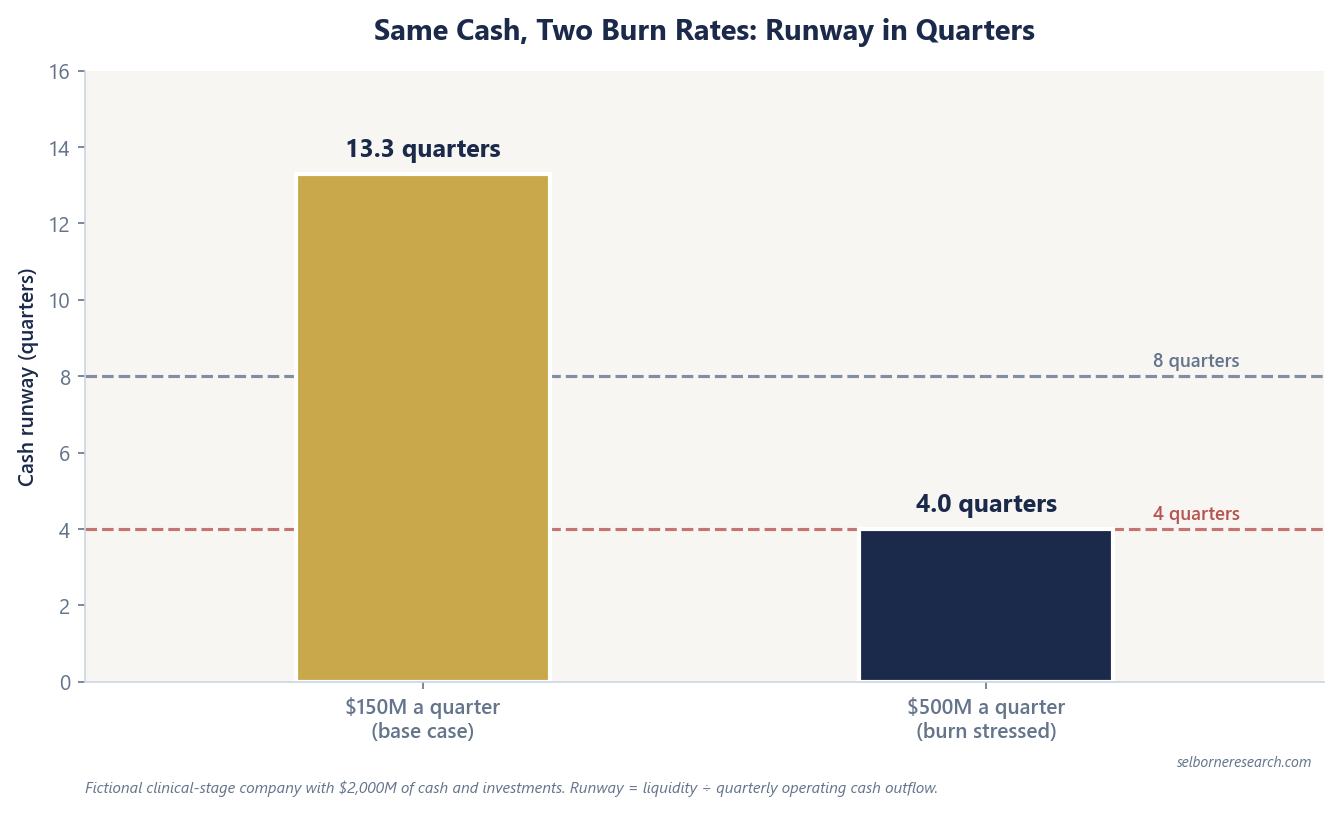
| Runway | $2,000M ÷ $150M = 13.3 quarters (~3.3 years) |
At 13.3 quarters the company clears the eight-quarter mark. A Phase III result due by the end of year three is funded, with just over a quarter to spare. A delay of a year at unchanged burn means raising money before the data arrive.
Change only the burn to $500M/qtr and runway collapses to 4.0 quarters, the one-year line the going-concern test uses. The survival date depends on burn; the odds of a distant trial succeeding do not move it.
Runway vs Net Loss: Moderna Q4 2025
| Metric | Q4 2025 |
|---|---|
| GAAP net loss | $(826)M |
| Net cash from operating activities | +$930M |
| FY2025 average quarterly operating cash flow | ~$(468)M |
Q4 was positive because Moderna collected money owed for autumn vaccine sales: receivables fell from $1,046M at 30 September to $184M at 31 December, which more than covered the quarter’s loss.
Divide $8.1B by the Q4 net loss and the survival date rests on non-cash charges. Use Q4 operating cash flow alone and the company looks cash-generative. The trailing four quarters settle it.
Where Runway Meets the Rest of the Model
Runway answers “does the company survive?” and rNPV answers “what is the pipeline worth if it does?” A deep pipeline with <4 quarters of cash still has to be financed first, and that dilution weighs on the equity whatever the odds of success.
Moderna is the filed teaching case for both: $8.1B of liquidity at 31 December 2025, and intismeran autogene, an individualised mRNA cancer vaccine, fully enrolled in a Phase III melanoma study as of February 2026. COVID vaccines were 93.1% of FY2025 revenue, so almost all of Moderna’s value beyond them has to come from programmes like that one. See the Moderna profile.
BioMarin sits on the profitable side: FY2025 GAAP net income of $349M, operating cash flow of +$828M, and VOXZOGO, its drug for the dwarfism condition achondroplasia, at 28.8% of revenue. Runway does not apply. See BioMarin.
A clinical-stage company's two programmes are valued year by year and its cash rolled forward to first sales, beside a franchise owner valued through its patent cliff.
- 15 sections, the clinical stage ladder to cash runway, multi-programme rNPV and a patent cliff
- 41 pages
- a two-programme clinical-stage company with its runway and dilution, a concentrated franchise owner and a diversified profitable company
- 3 worked companies
- profitable franchise owners and a cash-burner, on filed concentration, cash and burn
- 6-company screen
The Excel model is the primer's rNPV engine live across 13 sheets: a phase-by-phase PoS chain on BIO 2011-2020 rates, from Phase I to Approved; three worked companies, each switchable between clinical and commercial mode and valued year by year over 20 years, with later-phase R&D weighted by the odds of reaching it; a valuation summary with franchise floors; a runway calculator that rolls real cash forward, shows when it runs out if the lead fails, and prices the dilution from the raise; concentration and patent-cliff views; and a sensitivity grid. Change PoS, peak sales, R&D or the discount rate and the value moves.
See what's in the Biotech Sector Primer →£25 PDF · £59 with the Excel model · £159 for all three Healthcare industries
Frequently Asked Questions
- How do you calculate biotech cash runway?
- Cash runway in quarters equals liquidity (cash and cash equivalents plus short-term investments, matching the company's disclosure) divided by quarterly net cash used in operating activities from the cash flow statement. It is an investor rule of thumb, not a GAAP line item.
- Why is net loss not the same as cash burn?
- GAAP net loss includes non-cash charges such as stock-based compensation and depreciation. Operating cash flow strips those out. Working capital moves cash too. Moderna reported a $(826)M GAAP net loss in Q4 2025 but generated +$930M of operating cash flow in the same quarter, mostly by collecting money owed for autumn vaccine sales. One quarter misleads either way, so use the trailing four quarters.
- What runway length is comfortable for a clinical-stage biotech?
- Common investor screens (not filed guidance) treat fewer than 4 quarters as acute financing risk, 4–8 quarters as a range where dilution becomes likely, and more than 8 quarters as comfortable at unchanged burn. The reading depends on what the cash has to fund: a Phase III readout two years out needs more than eight quarters once delays are allowed for.
- When does ASC 205-40 going concern matter?
- When substantial doubt exists about operating for 12 months from the date the financial statements are issued, management must disclose it. Processa Pharma's Q1 2026 10-Q, for example, reported $1.7M of cash against $3.6M of quarterly operating cash outflow and disclosed substantial doubt. Runway screens align with that one-year liquidity window even though the metric itself is not codified in GAAP.
Read next
rNPV for Clinical-Stage Biotech
Single-asset rNPV for clinical biotech: PoS-weighted cash flows at 10.0–10.5% discount, a Phase II worked example at 15.1% PoS, equity equals rNPV plus net cash.
Biotech Partnership Economics
Biotech profit-share partnerships: Regeneron Dupixent $5.2B profit share versus Sanofi $17.8B global sales, the 3.4x booking trap, and rNPV on the economic share alone.
Platform vs Single-Asset Biotech
How programmes that share one technology fail together: a worked example of correlated pipeline risk, the sum-of-programmes floor, and what FDA platform designation does and does not do.
See it applied
These company profiles apply the concepts from this guide to real public companies.