Healthcare · Pharmaceuticals
Pharma Patent Expiry Dates by Company
Patent expiry and IRA Medicare price dates from six large pharma filings, product by product, and why one revenue-at-risk figure mixes two different events.
Selborne Research · Pharmaceuticals coverage: 7 guides, 6 company profiles, a primer and Excel model
Educational analysis for professional use. This guide is not investment advice or a recommendation to buy or sell any security, and it is not personalised.
On this page
A Patent Cliff Is a Date on One Product
A drugmaker does not lose exclusivity as a company. It loses it one product at a time, on dates written into its annual report. A single “revenue at risk” percentage adds those products together and hides what matters: when each one goes, and what ends.
Two kinds of event get mixed up. The first is the end of exclusivity: a compound patent expires, regulatory data protection runs out, or a settlement lets generic makers launch on an agreed date. Copies arrive, and the brand loses most of its volume and price (the erosion the patent cliff guide measures).
The second is a Medicare price set under the Inflation Reduction Act (IRA). The drug keeps its patent and no copy enters, but Medicare pays a government-set price from a fixed year. That date can come years earlier, because prices generally apply from nine years after approval for a small molecule (a chemically made drug) and thirteen for a biologic (a protein made in living cells). The 2026 and 2027 price years cover pharmacy drugs bought through Medicare Part D; from 2028, Part B drugs, the ones a doctor administers, can be selected too.
Across the industry, the health-data firm IQVIA’s February 2025 report, on data to June 2024, counted 118 US biologics with about $234bn of sales losing exclusivity between 2025 and 2034.
Where the Dates Sit in a Filing
Every date is in the annual report, but no two filers print them the same way. The US filers use Item 1 of the Form 10-K, under a heading such as “Patents, Trademarks and Licenses”; Novo Nordisk’s Form 20-F points to a table in its annual report. Each lists something different:
- Eli Lilly gives an estimated expiry for the compound patent and for data protection, including patent term extensions and paediatric exclusivity where granted.
- Pfizer lists the basic product patent by market and explains the settlements in footnotes.
- Merck lists the compound patent in the US, Europe, Japan and China, including pending extensions.
- Novo Nordisk gives the active-ingredient patent in the US, China, Japan and Europe, with Europe represented by Germany.
- AbbVie and Johnson & Johnson do not print a table. They name only the patents they consider material, in prose.
IRA selections sit elsewhere, usually in the regulation section of Item 1 and in the risk factors, so the full calendar needs both.
Exclusivity Dates, Six Filers
Patent tables as filed at 31 December 2025, ordered by the year exclusivity ends. Dates are US unless stated. Share is the product’s FY2025 revenue as a percentage of the company’s total.
| Year | Company | Product | What ends | Share of FY2025 revenue |
|---|---|---|---|---|
| Under way | AbbVie | Humira (immune diseases) | US biosimilars on sale since January 2023 | 7.4% |
| Under way | Johnson & Johnson | Stelara (psoriasis, Crohn’s) | Biosimilar competition; sales fell 41.3% in FY2025 | 6.5% |
| Under way | Novo Nordisk | Victoza, Saxenda (diabetes, obesity) | Compound patents expired; US Victoza generics licensed from June 2024 | 2.0% |
| 2026 | Merck | Januvia, Janumet (diabetes) | US exclusivity to May 2026 under patent settlements (Janumet XR July) | 3.9% |
| 2026 | Merck | Bridion (reverses surgical muscle relaxants) | US exclusivity, July 2026 | 2.8% |
| 2026 | Novo Nordisk | Ozempic, Wegovy, Rybelsus (semaglutide: diabetes, obesity) | Compound patent in China | 2.2% (China sales) |
| 2026 | Pfizer | Xeljanz (arthritis) | Basic product patent | 1.7% |
| 2027 | Eli Lilly | Trulicity (diabetes) | Compound patent and biologics data protection | 6.6% |
| 2027 | Pfizer | Ibrance (breast cancer) | Basic product patent | 6.6% |
| 2027 | Pfizer | Xtandi (prostate cancer) | Basic product patent | 3.5% |
| 2028 | Merck | Keytruda (cancer) | Primary compound patent, December; two related patents run to 2029 | 48.7% |
| 2028 | Pfizer | Eliquis (blood clots) | Settled generic entry, 1 April; basic patent 2027, formulation patent 2031 | 12.7% |
| 2029 | Eli Lilly | Jardiance (diabetes, heart failure) | Compound patent | 5.3% |
| 2029 | Johnson & Johnson | Darzalex (blood cancer) | Licensed patent families; Europe 2031 to 2032 | 15.2% |
| 2031 | Eli Lilly | Verzenio (breast cancer) | Compound patent | 8.8% |
| 2031 | Johnson & Johnson | Tremfya (psoriasis, bowel disease) | Composition patent family | 5.5% |
| 2032 | Novo Nordisk | Ozempic, Wegovy, Rybelsus | Compound patent; Japan and Europe 2031 | 73.9% |
| 2033 | AbbVie | Skyrizi, Rinvoq (immune diseases) | Composition of matter patents | 42.3% |
| 2036 | Eli Lilly | Mounjaro, Zepbound (tirzepatide: diabetes, obesity) | Compound patent | 56.0% |
| 2037 | AbbVie | Rinvoq | No generic before April 2037 under settlements | 13.6% |
Sources: FY2025 Form 10-K for each US filer (fiscal years ended 31 December 2025; Johnson & Johnson 28 December 2025) and Novo Nordisk’s Form 20-F and Annual Report 2025. Novo Nordisk shares are computed from DKK figures.
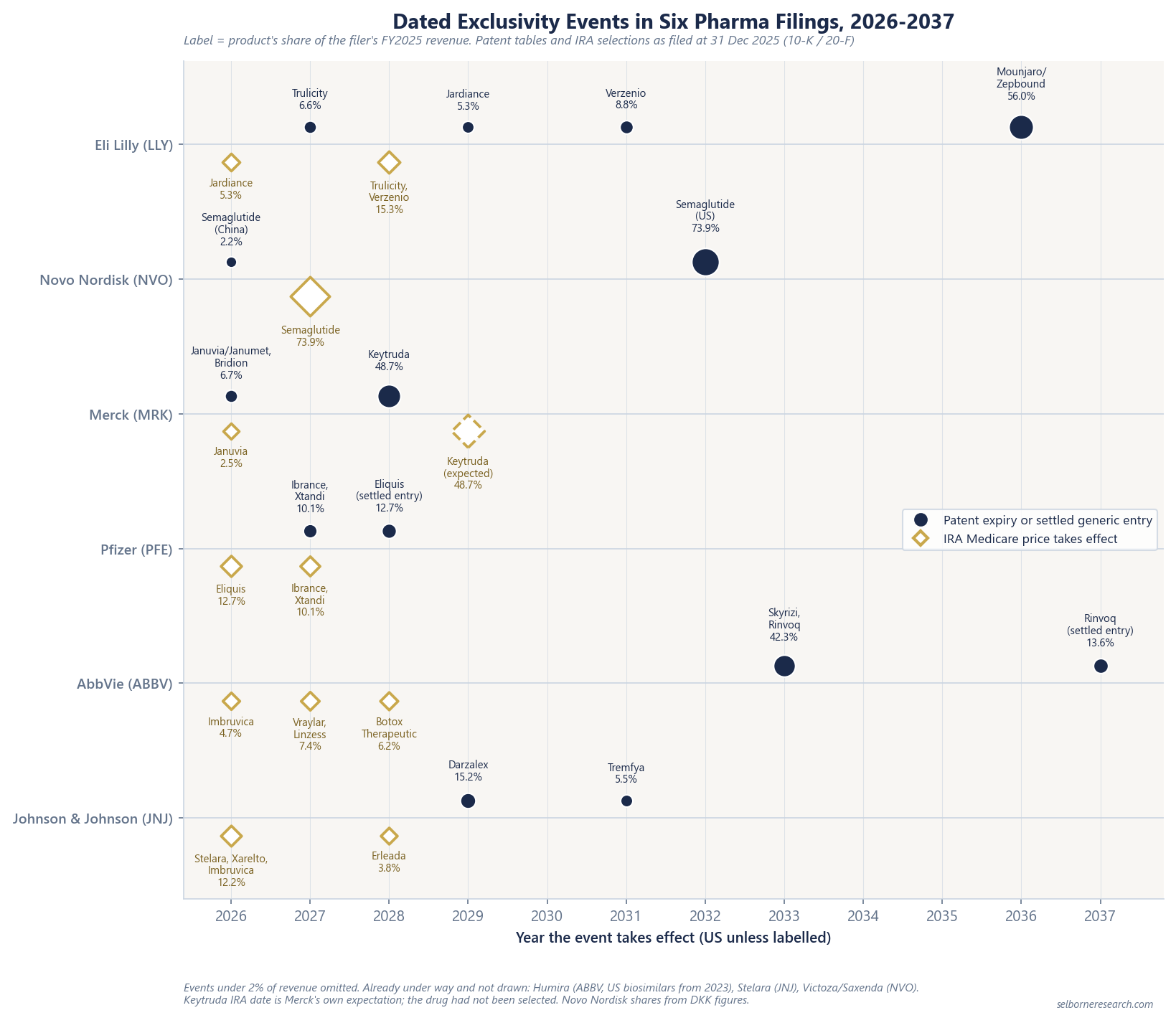
Three things in the table change how a row should be read.
The compound patent is the first date, not always the last. Later patents on a formulation, a manufacturing process or a use can run past it. Pfizer’s Eliquis shows all three layers: a composition patent ending November 2026, a formulation patent to 2031, and settled generic entry on 1 April 2028 between them. Merck’s Keytruda has a primary patent ending December 2028 and two related patents running into 2029, which Merck says it expects to be litigated. Where a filer states which date it plans around, use that one.
Settlements set many real dates. Januvia’s US exclusivity runs to May 2026 because of settlements on a salt-form patent. Rinvoq’s settlements with every generic filer rule out US generic entry before April 2037, four years after its composition patent. Agreed dates can still carry acceleration clauses; AbbVie’s filing says its Rinvoq settlements do.
Dates differ by country. Novo Nordisk’s semaglutide patent ends in China in 2026, in Japan and Europe in 2031 and in the US in 2032. The 2026 event touches the 2.2% of group sales that semaglutide made in China, out of the 73.9% it earns worldwide. Match each date to the sales in that market.
Medicare Price Dates Are a Separate Calendar
An IRA price cuts what Medicare pays for a drug that remains under patent. It does not let a copy in, and it sets no price for commercial insurers or outside the US, so the revenue it reaches directly is the Medicare part of US sales. Lilly’s filing notes possible knock-on effects on Medicaid and on 340B, a discount scheme for hospitals serving low-income patients. No filer here discloses its Medicare share, so the shares below are the whole product’s revenue, a ceiling on the exposure.
| Medicare price from | Company | Product | Share of FY2025 revenue |
|---|---|---|---|
| 2026 | Eli Lilly | Jardiance | 5.3% |
| 2026 | Merck | Januvia | 2.5% |
| 2026 | Pfizer | Eliquis | 12.7% |
| 2026 | AbbVie | Imbruvica (blood cancer) | 4.7% |
| 2026 | Johnson & Johnson | Stelara, Xarelto (blood clots), Imbruvica | 12.2% |
| 2027 | Novo Nordisk | Ozempic, Rybelsus, Wegovy | 73.9% (US sales 48.0%) |
| 2027 | Merck | Janumet, Janumet XR | 1.4% |
| 2027 | Pfizer | Ibrance, Xtandi | 10.1% |
| 2027 | AbbVie | Vraylar (schizophrenia, bipolar), Linzess (chronic constipation) | 7.4% |
| 2028 | Eli Lilly | Trulicity, Verzenio | 15.3% |
| 2028 | Merck | Lenvima (cancer) | 1.6% |
| 2028 | Pfizer | Xeljanz | 1.7% |
| 2028 | AbbVie | Botox | 6.2% (Botox Therapeutic) |
| 2028 | Johnson & Johnson | Erleada (prostate cancer) | 3.8% |
| 2029, expected | Merck | Keytruda | 48.7% |
IRA selections as disclosed in each FY2025 filing. Imbruvica is shared: AbbVie and Johnson & Johnson each book part of it. For Botox the share is the Botox Therapeutic line; Botox Cosmetic is reported separately. Merck’s 2029 row is its own expectation; Keytruda had not been selected when the 10-K was filed.
Two rows show how the two calendars interact. Lilly’s Jardiance takes a Medicare price 66% below its 2023 list price from 2026, three years before its compound patent ends in 2029. And Johnson & Johnson’s filing says the Centers for Medicare & Medicaid Services (CMS), which runs the programme, will drop Stelara and Xarelto from it from 2027. The statute (42 U.S.C. 1320f-1(c)) removes a drug from the first year that begins at least nine months after CMS finds a generic or biosimilar approved and on sale. So a price date matters only until exclusivity ends.
Why One Revenue-at-Risk Figure Misleads
Summing a company’s near-term products into one percentage is the quick screen. For these six the results rest on different bases, and several add a patent event to a price event.
| Company | Single figure | What it adds together |
|---|---|---|
| Eli Lilly | 20.6%, three products summed | Trulicity (patent 2027), Jardiance (IRA 2026, patent 2029) and Verzenio (IRA 2028, patent 2031) |
| AbbVie | About 12%, two products summed | Humira, already facing biosimilars, and Imbruvica, facing an IRA price from 2026 |
| Merck | 48.7% | One product, with a patent date in December 2028 and an expected IRA date a month later |
| Pfizer | About $1.5bn in 2026 | Pfizer’s guided year-on-year revenue decline from recent and expected exclusivity losses, 2.4% of FY2025 revenue |
| Novo Nordisk | No total filed | A table of sales for products with recent or upcoming patent expiry, split by region |
| Johnson & Johnson | No total filed | Product-by-product disclosure only |
Lilly’s 20.6% is the clearest case. Only Trulicity, 6.6% of revenue, loses patent protection before 2029. The other 14 points come from Jardiance and Verzenio, which face an IRA price on Medicare sales first and keep their patents until 2029 and 2031. Modelled as one cliff, the 20.6% would overstate the near-term volume loss and put the patent erosion years too early.
Pfizer’s figure is a different kind of number: a dollar estimate of how much revenue falls in one year, not the revenue of the products exposed. A product that loses exclusivity in April contributes only part of its decline in that year, and the rest lands in the next.
What Expiry Dates Mean for a Valuation
In a valuation, each exclusivity date belongs on one product’s revenue line. The line holds until the date, then drops. Small molecules usually fall faster than biologics, as the erosion benchmarks show. An IRA date is a second input on the same line. It lowers the price on the Medicare share of US sales from its year onward and falls away once copies arrive.
Small errors in the date move value. Shifting a large product’s exclusivity end by one year moves a full year of near-peak cash flow, and settlements, later patents and litigation can push it either way. Start from the company’s own date in the filing, and run the alternatives as sensitivities.
Last, weight each event by the product’s share of revenue, read alongside how concentrated the company is. In a patent table, a product earning 2% of sales and one earning half of them sit side by side. Only the share tells them apart.
Each date becomes a fade. The primer turns every drug's loss-of-exclusivity year into a falling revenue line, then sums the drugs to value per share.
- 15 sections, the patent ladder to a year-by-year sum-of-parts valuation and concentration screens
- 39 pages
- a small molecule at its cliff, a biologic growth driver and a pipeline asset weighted by its phase, plus a base business
- 3 drug schedules
- large-cap innovators on filed product concentration and loss-of-exclusivity dates
- 6-company screen
The Excel model is the primer's sum-of-parts valuation live across 13 sheets: a base-business DCF at an 8.5% WACC; three drug schedules, each set to marketed or pipeline and to a clinical phase that sets its odds; loss-of-exclusivity cliffs that settle on a generic floor; a calendar-year input that turns a filed patent date into a schedule year; the consolidated bridge to value per share; and patent-cliff, concentration and sensitivity views. Change a drug's LOE year, phase or peak sales, or the WACC, and the value moves.
See what's in the Pharmaceuticals Sector Primer →£25 PDF · £59 with the Excel model · £159 for all three Healthcare industries
Frequently Asked Questions
- When does the Keytruda patent expire?
- Merck's FY2025 Form 10-K puts the primary US compound patent on Keytruda at December 2028. Two further patents in the same family run to May and November 2029, and Merck says it expects both to be litigated, so it plans for biosimilar competition from December 2028. The European compound patent runs to 2031. Separately, Merck expects Keytruda to be selected for IRA Medicare price-setting in 2027, with the price taking effect on 1 January 2029. Keytruda was 48.7% of Merck's FY2025 sales.
- Which big pharma drugs lose exclusivity in 2028?
- Across the six filings in this guide, two exclusivity events fall in 2028: Keytruda's primary US compound patent in December, and settled generic entry for Eliquis on 1 April. IRA Medicare prices also take effect in 2028 for Lilly's Trulicity and Verzenio, Pfizer's Xeljanz, AbbVie's Botox, Merck's Lenvima and Johnson & Johnson's Erleada. Those are price events on drugs that remain under patent.
- Is an IRA Medicare price the same as a patent expiry?
- No. A patent expiry lets generic or biosimilar copies onto the market, and the brand typically loses most of its volume and price. An IRA price applies to Medicare only, on a drug that is still under patent, with no copy entering. Government prices generally apply from nine years after approval for a small molecule and thirteen for a biologic, so the IRA date can land years before the patent date.
- What does settled generic entry mean?
- When generic makers challenge a patent, the brand owner often settles, licensing them to launch on a fixed date. Pfizer and Bristol Myers Squibb settled with several generic companies on Eliquis, allowing US launch on 1 April 2028, between the composition patent (November 2026) and a formulation patent (2031). The settlement date, not either patent date, is usually the one to model.
Read next
Patent Cliffs and LOE Erosion
How loss-of-exclusivity erodes branded drug revenue: generic unit-share curves, net-price erosion by competitor count, biosimilar contrast via Humira, and a worked fade on a $3,000M brand.
Pharma Revenue Concentration Risk
Largest-product revenue share as a risk screen: FY2025 ladder from Pfizer Eliquis 12.7% to Lilly tirzepatide 56.0%, with 25–30% and 40% concentration screens.
See it applied
These company profiles apply the concepts from this guide to real public companies.